Top stories

Journalists Cover Microsoft, Using Macs

It’s not an easy time for Microsoft — with Steve Ballmer having to field questions about being “buffoons” and an “evil empire”  at the shareholder’s meeting (.doc) — so when they get together “the world’s most influential technology pundits and online writers” (nb: we weren’t invited) for Mobius to discuss super-secret mobile tech you’d think [...]

Guide To Black Friday Apple Bargains: Cheap MacBooks, iPods and Accessories Galore

Here’s a guide for finding the best bargains on Apple-related gear during the infamous Black Friday sales on November 27. We’ve compiled a comprehensive list of gear from leaked photos of sales flyers and descriptions of sales.
The bargains include a 2.26 GHz MacBook + $150 gift card at Best Buy for $999.99 ; a 32GB [...]

Review: Voices Is Today’s Best Thing Ever, Grab It Now While It’s Cheap

New on the App Store is Voices from the clever folk at Tap Tap Tap. You can guess what it does.

Open it up, pick a silly voice. Helium is pretty silly. A microphone appears and the app even clears your throat for you (try it, you’ll see what I mean). Now speak your brains, and [...]

Review: Sony Walkman S540 Series Video MP3 Player

Press releases, you will hardly be surprised to hear, are rarely very interesting. But one arrived in my inbox a couple of weeks ago that made me double-take.
“Sony’s S Series Walkman,” it chattered, “is a serious challenger to the iPod Nano.” Gosh, really? Perhaps the Cult had better have a look at one, then, despite [...]

Update x3: Apple Working On Fix For iPhone Email Bug

iphone_bug

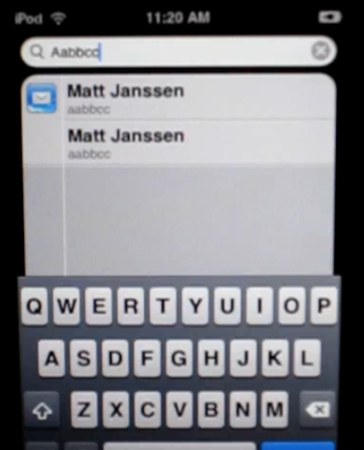
UPDATE 3: The iPhone email issue looks like a real bug and not a settings issue after all. CoM reader Paul Taylor ran through the procedure described below, and all the email he ever deleted on his iPhone is still there going all the way back to the iPhone’s purchase in 2007. Says Paul:

I read your post ” Update x2…..” with interest because I was appalled to discover this problem in mid June and reported it to Apple after having no success correcting it (nor did three Apple ‘Geniuses’ one of whom was characterized by his peers as “The iPhone Genius — if he can’t fix it no one can.” He couldn’t).  I sent it off to Walt Mossberg on August 3rd to see what his efforts might produce but have seen nothing to date.

I had performed all the exercises described in your post (after doing thorough searches of all mailboxes on my Mac Pro and my ISP server to be sure the particular emails were NOT there.

BTW – with regard to the ‘Remove’ settings, ALL deleted emails back to the purchase of my original iPhone in 2007 were still there, so the day / week / month settings are immaterial, at least in my case. The problem apparently has always been present, the new search feature merely exposed it.

The only relief (not fix) I have found so far, has been to first make sure unwanted emails have been stripped from all mailboxes, then do a “Restore” on iTunes.  The relief is short lived — the ‘emails that wouldn’t die’ are gone, but all email deleted following the restore begins to collect anew.

UPDATE: The iPhone email bug that caused such a fuss yesterday is not a bug but a configuration issue, says knowledgeable CoM reader Dr. Harry K. Zink.

If you properly delete your emails, this does not happen – i.e. remove the email from both SENT and INBOX, after which you need to go into the TRASH folder, and manually select the messages, and select DELETE again. This applies to IMAP, ActiveSync and MobileMe accounts. POP accounts are affected by this, but only because they are configured to retain deleted mail for a period set in ’settings’ for that account — if you set it to one day, and wait 36 hours, the messages are also gone.

This is a function of the way IMAP and especially POP mail leave mail in the Deleted Items folder, or Trash folder, for the duration specified in the settings — it seems most users never bothered looking in their settings (the default is to keep deleted messages for a month before they auto-delete – you can also set it to a day, or manually delete instantly).

Furthermore, this does *not* apply to ActiveSync accounts, where a deletion is instant and complete (thus corporate kids can stop the sweating and heavy breathing – Apple’s got your back), and neither on MobileMe accounts (you know, Exchange for the Rest of Us). On IMAP accounts, if you manually delete it from the trash, the messages are gone as well. It’s POP accounts which have this issue.

So for the most part this is being blown terribly out of proportion – not by the original guy who discovered this, but by all ruminants and regurgitators, particularly those who are too lazy to properly investigate something like this.

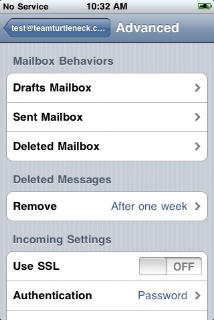
To change the “Remove” settings for POP accounts:
1. Go to Settings>Mail, Contacts, Calendars
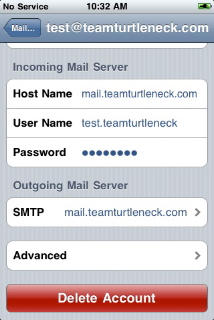
2. Select the account you want to modify
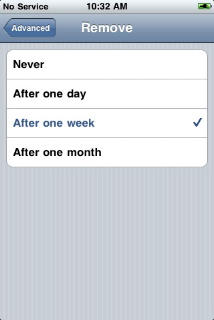
3. Go to >Advanced. Under the “Deleted Messages” heading, you’ll see the “Remove” setting. Choices are: after a day, a week, one month or never.
Screenshots after the jump.

Apple is aware of the iPhone email bug CoM first reported yesterday and will likely issue a fix in iPhone 3.1, the next major update of the iPhone/iPod OS.

“An internal tipster has provided us with proof that Apple is fully aware of this issue and will probably be including a fix in iPhone OS 3.1,” says Gizmodo.

Meanwhile, it appears the bug is limited to POP email accounts, not IMAP accounts. It is probably a Spotlight caching issue. Spotlight on the iPhone/iPod creates local copies of emails, which aren’t deleted when the originals are.

There seems to be several ways to fix the bug. Sometimes, simply waiting works; the message cache is eventually cleared. It’s also possible to erase the cached messages by loading and reloading them several times, according to Richard from 148Apps.

“From my messing around with email, the message actually disappears after viewing it a few times. At first I thought the email disappeared after deleting it a few times but I simply viewed the messages about 3 or 4 times and it disappeared.”

Instructions for configuring your iPhone POP accounts to delete email after jump:
To change the “Remove” settings for POP accounts:
1. Go to Settings>Mail, Contacts, Calendars
2. Select the account you want to modify
3. Go to >Advanced. Under the “Deleted Messages” heading, you’ll see the “Remove” setting. Choices are: after a day, a week, one month or never.

IMG_0001

IMG_0003

IMG_0002

About the author

Leander Kahney

Leander Kahney is senior editor of Cult of Mac, editor of two books about technology culture, Cult of Mac and Cult of iPod, and has written for Wired, MacWeek, Scientific American, and The Observer in London. Follow Leander on Twitter @lkahney and Facebook.

Email the author | Read more posts by Leander Kahney.

20 comments

    [...] Cult of Mac.] Tweet This!Share this on FacebookShare this on del.icio.usAdd this to Google BookmarksDigg [...]

    Um…

    Leander today:

    “So for the most part this is being blown terribly out of proportion – not by the original guy who discovered this, but by all ruminants and regurgitators, particularly those who are too lazy to properly investigate something like this.”

    Leander’s lede to the post yesterday:

    “Never use your iPhone for incriminating or embarrassing emails you might not want others to see.”

    So, who exactly is making mountains out of molehills again? And who is “too lazy to properly investigate” the issue? Or, conversely, who is choosing to scare iPhone users about their mail security without having a solid idea of what exactly the problem is?

    Tsk.

    [...] Apple could improve the experience on? Let us know in the comments! Update: Leander Kahney has posted an update to the original Cult of Mac post that clarifies this issue a bit more. It seems that accounts using [...]

    [...] that this did not work for you, and that you were still seeing cached messages. Then Cult of Mac posted an update to their original piece, suggesting that the problem was more specific to POP accounts. Although I [...]

    [...] that this did not work for you, and that you were still seeing cached messages. Then Cult of Mac posted an update to their original piece, suggesting that the problem was more specific to POP accounts. Although I [...]

    [...] that this did not work for you, and that you were still seeing cached messages. Then Cult of Mac posted an update to their original piece, suggesting that the problem was more specific to POP accounts. Although I [...]

    [...] that this did not work for you, and that you were still seeing cached messages. Then Cult of Mac posted an update to their original piece, suggesting that the problem was more specific to POP accounts. Although I [...]

    [...] that this did not work for you, and that you were still seeing cached messages. Then Cult of Mac posted an update to their original piece, suggesting that the problem was more specific to POP accounts. Although I [...]

    [...] that this did not work for you, and that you were still seeing cached messages. Then Cult of Mac posted an update to their original piece, suggesting that the problem was more specific to POP accounts. Although I [...]

    [...] that this did not work for you, and that you were still seeing cached messages. Then Cult of Mac posted an update to their original piece, suggesting that the problem was more specific to POP accounts. Although I [...]

    [...] that this did not work for you, and that you were still seeing cached messages. Then Cult of Mac posted an update to their original piece, suggesting that the problem was more specific to POP accounts. Although I [...]

    [...] that this did not work for you, and that you were still seeing cached messages. Then Cult of Mac posted an update to their original piece, suggesting that the problem was more specific to POP accounts. Although I [...]

    [...] that this did not work for you, and that you were still seeing cached messages. Then Cult of Mac posted an update to their original piece, suggesting that the problem was more specific to POP accounts. Although I [...]

    [...] that this did not work for you, and that you were still seeing cached messages. Then Cult of Mac posted an update to their original piece, suggesting that the problem was more specific to POP accounts. Although I [...]

    [...] that this did not work for you, and that you were still seeing cached messages. Then Cult of Mac posted an update to their original piece, suggesting that the problem was more specific to POP accounts. Although I [...]

    [...] that this did not work for you, and that you were still seeing cached messages. Then Cult of Mac posted an update to their original piece, suggesting that the problem was more specific to POP accounts. Although I [...]

    [...] Leander Kahney has posted an update to the original Cult of Mac post that clarifies this issue a bit more. It seems that accounts using [...]

    [...] that this did not work for you, and that you were still seeing cached messages. Then Cult of Mac posted an update to their original piece, suggesting that the problem was more specific to POP accounts. Although I [...]

    [...] Leander Kahney has posted an update to the original Cult of Mac post that clarifies this issue a bit more. It seems that accounts using [...]

    [...] that this did not work for you, and that you were still seeing cached messages. Then Cult of Mac posted an update to their original piece, suggesting that the problem was more specific to POP accounts. Although I [...]

Add your comment

Name(Required)

Mail (required, but not published)

Website

Comment

Buy Inside Steve's Brain Buy from Amazon.com Buy from Barnes & Noble