Top stories

Apple Now Accepting iPad Apps, Planning “Grand Opening” of iPad App Store

Apple is now accepting iPad apps for a “grand opening” of the iPad App Store, according to an email just sent to registered developers.
“iPad will begin shipping soon and your opportunity to be part of the grand opening of the iPad App Store starts today,” the email says.
There’s no details about when the store’s grand [...]

Security Expert: “Mac OS X Is Safer, But Less Secure”

20100319-ipwned.jpg

Tech site H-Online has an interesting story today, quoting security expert Charlie Miller about his forthcoming talk at the CanSecWest conference next week.
He says OS X is full of security holes. There are lots more than in Windows, he claims.
And yet: OS X is a safer system to use. Why? Because, in the words [...]

Apple Devotes Entire Home Page To Jerome York Obituary

20100318-york.jpg

If ever you needed a sign that Apple was a different kind of technology company, this is it.
What other computer manufacturer would remove its top-selling, hype-inducing, industry-altering new product from the prime spot on its website home page, and replace it with an obituary to an investor?
This is one of those “Here’s to the [...]

Coming Soon: Steve Jobs, the Sitcom

Fake Steve creator Dan Lyons just signed a deal to bring Steve Jobs to another small screen near you.
The half-hour series called “iCon” is billed by the presser as “a savage satire centering on a fictional Silicon Valley CEO whose ego is a study in power and greed.”
Making sure the barbs prick will be the [...]

Tales from Development Hell – Why iPhone Developers Have It Good

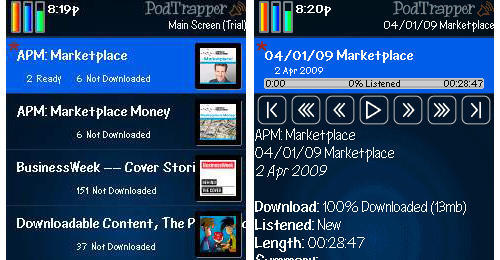
podtrapper.jpg

Screenshots from PodTrapper

An intrepid software developer has published a thorough memoir that details many reasons why Apple is so far ahead of the field in the mobile applications game, and why Blackberry, Palm and Android will have a hard time catching up any time soon.

Marcus Watkins found himself developing an application for his mobile phone in much the same way that countless other developers undoubtedly realized their inspirations: he was minding his own business when he realized one day his life would improve if his phone could do something that, at the point of his epiphany, it couldn’t.

He did his research, found out there wasn’t an application to meet his needs, realized the size of the potential market for his app in the many millions of people with his phone – a good percentage of whom might find his application useful – and he went to work.

Unfortunately (perhaps) for Watkins, his phone is a Blackberry, but fortunately (for Blackberry users) he persevered, and his story shows just how far behind Apple the other smartphone makers are as the device category enters its third year in existence.

Right off the bat, the application Watkins found he needed to develop – PodTrapper, a simple podcast player – was included as part of the basic functionality of the iPhone from the very beginning.

True, there has been controversy over third-party podcast players on Apple’s App Store, but the sheer popularity of podcasts today and the fact that there was no way to play them on a Blackberry until Watkins launched his app this past spring speaks to a certain failure of imagination among the executives and engineers at Research in Motion (RIM), makers of the Blackberry.

In planning how to develop his application, Watkins found he had to choose among 5 versions of RIM’s SDK, which was daunting enough, but he also found that “the more features you get the fewer devices you can support … and unfortunately not all operating system revisions are available for all devices.”

After going through a complex algorithm (illustrated with colorful bar charts) to arrive at which SDK might bring him the best chances for success, Watkins looked at the Blackberry mobile UI and said, “I envy the iPhone developers out there.”

To put a Blackberry app “in the same league” as an iPhone app, he said, “a significant portion of the code [must be] dedicated to drawing lines, bezier curves, bitmaps and shading rectangles in just the right way,” whereas “the iPhone SDK provides all sorts of pretty widgets that come pre-made to fit in with the platform. Right out of the box you get a clean UI that looks ‘modern’.”

Adding insult to injury, from the developer’s perspective, “RIM has all sorts of UI widgets they use in their first party applications — rounded corners, sliding screen transitions, gradient list fields, etc. — but they don’t release any of that for use by third party developers. The results are apps with wildly inconsistent UIs, created by developers who had to spend considerable effort making them inconsistent.”

Watkin’s piece is a long one, but he details a dozen different ways in which it becomes clear – for all the bitching and moaning about Apple’s obsessive secrecy and desire for control, about the inconsistency of the App Store approval process and the ‘Big Brother’ nature of Apple’s gatekeeping function – many of the decisions and choices Apple has taken out of 3rd party developers’ hands have meant more success for the iPhone, more success for Apple, and more importantly, more success for at least some developers.

Hate that iPhone is only on one network? Try developing an app for use across carriers with network communications “implemented as a bunch of totally isolated transports that vary by data plan instead of carrier.”

Hate Apple for not allowing apps to run in the background? Watkins relates a tale in High Geek involving a “100K RSS feed that could never be freed” and concluded in the end, “I can definitely see why Apple has been hesitant to open up background processing on the iPhone. It’s really easy for bad developers to make the whole platform look bad.”

His story about selling his app and choosing among distribution channels and trying to get paid and having to combat random discount “promotions” that always seemed to leave him with the short straw makes Apple’s one-stop shop and across-the-board 70/30 split look beautiful in its simplicity.

It also goes a long way toward explaining why there are over 50,000 iPhone applications in the App Store while the stores of competing mobile platforms have bare shelving in comparison.

The sales and marketing data Watkins presents for PodTraper look much like the sales and marketing data we’ve seen for iPhone apps, and the interactions with his customer base sound like the interactions anyone would have in a similar situation. The bottom lines: promotion is good; publicity is good; customer service (listening to your customers) is good.

Time is an avenger and Apple’s competitors may get it together, in time, to support a development ecosystem that will inspire a 3rd party gold rush similar to the one that has helped the iPhone become a smash hit. As Watkin’s well-written, impeccably documented memoir capably shows, that time is not at hand.

It’s no accident that people say, “there’s an app for that!” when they talk about the iPhone. When they talk about other smartphones, it’s more likely to be, “I wish there was an app for that.”

If you enjoyed this article:
Subscribe via RSS or email, or follow us on Facebook and Twitter

About the author

Lonnie Lazar

Lonnie Lazar is a writer, musician, web designer attorney. He writes about Apple for Cult of Mac and Mac|Life, and about VoIP and telecommunications for Voxilla. Follow Lonnie on Twitter @LonnieLazar, join the Cult of Mac on Facebook, and find Lonnie's photos on Flickr.

Email the author | Read more posts by Lonnie Lazar.

9 comments

    This is a great read Lonnie and something I have been saying to myself and collegues for a year now – that Apple is so far ahead in every way over RIM (and yes dare i say Google/Android) and Pre – that it will be hard to catch up. The 3G s addresses much of the complaints that BB users have (mainly the keyboard) and I think that this will be the year that even more BB enterprise users and businesses ditch their “crack” and grab an iphone.

    Thanks for a great article. Now, I can certainly start working on iPhone App development

    Brilliant article, and the numbers do speak for themselves, I was just reading a pre review on Ars that said for the old PalmOS there were 50,000 apps, and PalmOS is over twelve years old, the App Store is only twelve months!

    Also, it is wondefully ironic how the Google ad at the bottom of this page (for me at least) is for the Crackberry App World…

    Hi, I understand this article’s perspective based on the site, but I feel the need to point out that my experience was much less one sided than this article would suggest. While I do envy the iPhone for the graphical stuff, that’s really it. There are many things possible on the BlackBerry platform that simply aren’t on the iPhone, and much less the other way around (the graphical stuff being the one thing I can think of).

    I don’t think one platform is better than the other, there are definite perks to either. For example, the equivalent to my application on iPhone took 4 months to make it into the App Store and with a severely reduced feature set to boot.

    Anyway, just my two cents.

    -Marcus Watkins
    VersatileMonkey.com

    “There are many things possible on the BlackBerry platform that simply aren’t on the iPhone” says Marcus Watkins. Marcus, like what?

    ” the equivalent to my application on iPhone took 4 months to make it into the App Store and with a severely reduced feature set to boot.” says Marcus Watkins. Marcus, for comparison, how long did your BB app take to develop and what was missing from the iPhone verson?

    Years ago when Windows was at its peak, one of the big arguments about its superiority was the number of applications available, both through commercial developers and shareware/independent developers. But many, many, many of those apps were utter garbage, not to mention the tremendous number of apps doing exactly the same thing with a single variation from the competitors.

    Number of apps is hardly an indicator of quality, much less superiority.

    What kept me with the Mac through the darkest days was the fact the developers during those periods had to really work hard to develop great apps for the Mac. The Mac up until Mac OS X 10.3 really was a tough platform to develop for. Apple was NOT a cooperative partner, and development software like Code Warrior bridged a gap that Apple seemed to be intentionally leaving as wide as they possibly could. Bungie is one of the great success stories of that era. Those guys loved the Mac and brought the most thoughtful and fully plotted firs person shoot to date to the platform with the smallest user base and an even smaller number of gamers.

    Mac developers had to truly give a damn about what they were doing and really understand what the intrinsic differences were between Windows and the Mac to see “Wow, the Mac really does this better, and I can make it EVEN BETTER.” I am not saying that “Making it difficult makes better software.” despite how it looks. I am simply saying that the reason there are 70,000 plus apps is the simple answer: money. Many, many people are trying to make a quick buck by thrown craptacular apps to the App store and Apple will approve anything that doesn’t overload AT&T’s network or challenge Apple’s own position in the market or an interest of one of Apple’s “partners” (i.e. record labels, Disney, movie studios, etc.), but as soon as you release anything that seems remotely dubious to them they immediately put the nix on it.

    As much as I like my iPod Touch, Apple’s insistence on remaining partnered with AT&T and on killing creative but certainly edgy apps in the App Store is keeping me from in any way considering an iPhone as an option.

    Going on 19 years as a Mac user, I still use the Mac as my primary OS, but Apple and the App Store has yet to shown me anything so compelling that it would sway me to pay AT&T $70+ dollars a month for two years or see an interesting and compelling app for my iPhone be denied by Apple because it competes with Apple or causes Apple’s relationship with old school media labels to cry foul.

    @Marcus Watkins: thanks for commenting on the article. I hope those who read comments will appreciate your two cents and I’m grateful you added them here. I intended no denigration of your experience in developing for the Blackberry and hoped that my commendation of your perseverance showed at least some admiration for your achievement. I’m sure as a developer, the rewards come in doing the work, which is something beyond the environment its required to be done in and there is no question that each mobile device platform has its pros and cons. From all indications you serve the aspirations of the Blackberry community quite well. Kudos to you.

    @csbmonkney: I don’t know anyone who pays less than $70 a month for voice and data services on a US cellular network and I know people in various parts of the country who complain about them all. The fact of the matter is that iPhone provides a UI that is far more intuitive, elegant and feature rich than any other smartphone platform today – which may change tomorrow, admittedly – and that mojo currently sits on Apple’s sideline. That’s all I was trying to say.

    “The fact of the matter is that iPhone provides a UI that is far more intuitive, elegant and feature rich than any other smartphone platform today…”

    Good to see it being used to provide such quality and useful apps as a dozen fart machines and ten different kinds of “Lets make the iPhone look like a glass of beer!” apps.

    Innocuous and harmless apps, even lewd and tasteless apps, make it past if they don’t threaten Apple’s own position with a service they offer or offend record labels or movie studios.

    Props to Apple for providing a consistent and intuitive interface for user and developers. They always have provided that for the user, though, and it is one of the many things that keeps me a Mac user. But the current state of things is the result of many, many years of it NOT being easy for developers. Basically, Apple makes it easy for the iPhone because they learned from the mistakes of their past and from the direction of the rest of the world. They still are making mistakes, no doubt, but certainly fewer than ever before.

    I am always amused that Apple was largely a company saved by it’s own lack market share. The small market provided Apple with an astonishingly good test market for the iPod and the iTunes Music Store. Their success gave us iTunes for Windows and iPods for everyone. But the funnier part of that is how Apple used that small window of opportunity and small market share to make the iPod not only the most intuitive and well designed music player, but the make it an MP3 player. A format largely associated with illegal music distribution, Apple knew exactly what it was doing. Napster had given people a brief but incredibly opportunity to gather up tremendous libraries of music. Even though Napster was gone, people still had those libraries, and most of them were in MP3 format. Apple exploited that tremendously. Sony lagged in providing MP3 support for years, even after the explosive success of the iPod, and we see exactly how many Sony MP3 players people are using on the train and bus now.

    Basically, MP3s saved Apple and allowed them to broaden their market share, but given the opportunity to do the same thing for movies and allow the iPod Touch and iPhone to play .avi files, well, no. Success killed the opportunity for us, the iPod Touch and iPhone owners, to have access to the video format equivalent of MP3s, and Apple really didn’t have any choice in the matter if they wanted to stay in the good graces of the studio and television industry for the iTunes Music Store.

    I’ve used my iPod Touch for a year without Jailbreaking it, but frankly, I can’t say I’m that thrilled with it to the point that it makes me want an iPhone at all. I’m leaning toward just jailbreaking it once the year is up (not that I can talk to a human being on the phone for iPod support after 30 days anyway) so I can finally watch whatever I want on it without spending time transcoding everything.

    Got to give my 2c worth here.

    There’s no denying that iPhone is the platform of choice for developers at the moment, however the challenge being posed by android (when phone manufacturers release some decent handsets) is something not to be taken lightly. Here’s a few reasons why android has the power to sway a lot of developers in their direction

    1) Apps are written in Java. There are waaay more developers who are familiar with Java as compared to those who are even touched objective C.

    2) It costs virtually nothing to get started. To get started with Android development, You need an intel based computer (ok this isn’t free but android will run on non mac computers which are arguably much cheaper than mac counterparts), either Mac Os, Windows or Linux (last one is free), the Eclipse IDE with ADT plugin (Both Free), the android SDK (free), Java 5 JDK or higher (free) and developer registration on the Android market ($25, however this is not necessary until you want to upload your apps to the market). Compare this with iPhone development where you need: A Mac of some sort (won’t consider hackintoshes here so big $$$ spend for PC owners), and an iPhone developer license (min $99 + waiting time).

    3) Very little red tape in getting applications on app store. Lots of people including some die hard iPhone developers are often disgruntled by what is sometimes perceived as heavy-handedness by the App store approval process. Getting apps onto android market is a breeze in comparison.

    4) A lot of backing from the open source community. iPhone development can definitely be a goldmine – and it has attracted a vast number of developers because of this (also because it’s a great product to program for). However a lot of developers, particularly those in the open source community are not commercially motivated (e.g. those who develop linux apps). Android is a platform which is very open source friendly and would without a doubt get the majority developers from the open source community who want to develop for smartphones (for the reasons outlined in first 3 points).

    5) Army of numbers as opposed to strength. There hasn’t been an iPhone killer produced yet, but there doesn’t necessarily need to be. Android is designed to run on multiple handsets from different manufacturers. So whilst any one particular handset sales will probably never rival the iPhone sales by itself, the cumulative total across all handsets running android may give it enough market share to be a genuine alternative for developers.

    6) Many of the developers for iPhone apps are writing versions for android. Not all developers are religious about what platform they develop for. Many developers are quite happy to develop on both platforms (me included). A lot of apps which were originally on the iPhone are now on android (e.g. shazam)

    7) Android was a platform built with the developer in mind. – Ok so is the iPhone, but rather this is a point to distinguish android from other older platforms e.g. symbian and RIM. These platforms are crap to develop on, because the ease of development wasn’t really considered. Developing on android however is a breeze.

    Now this is not meant to be a response to get into an iPhone vs android debate/flame war. I appreciate both platforms and see the good points (and flaws) in both. My only point is that android really does have many attributes for attracting the developer base which doesn’t require the “3rd party goldrush” as mentioned in the article.

Add your comment

Name(Required)

Mail (required, but not published)

Website

Comment

Buy Inside Steve's Brain Buy from Amazon.com Buy from Barnes & Noble