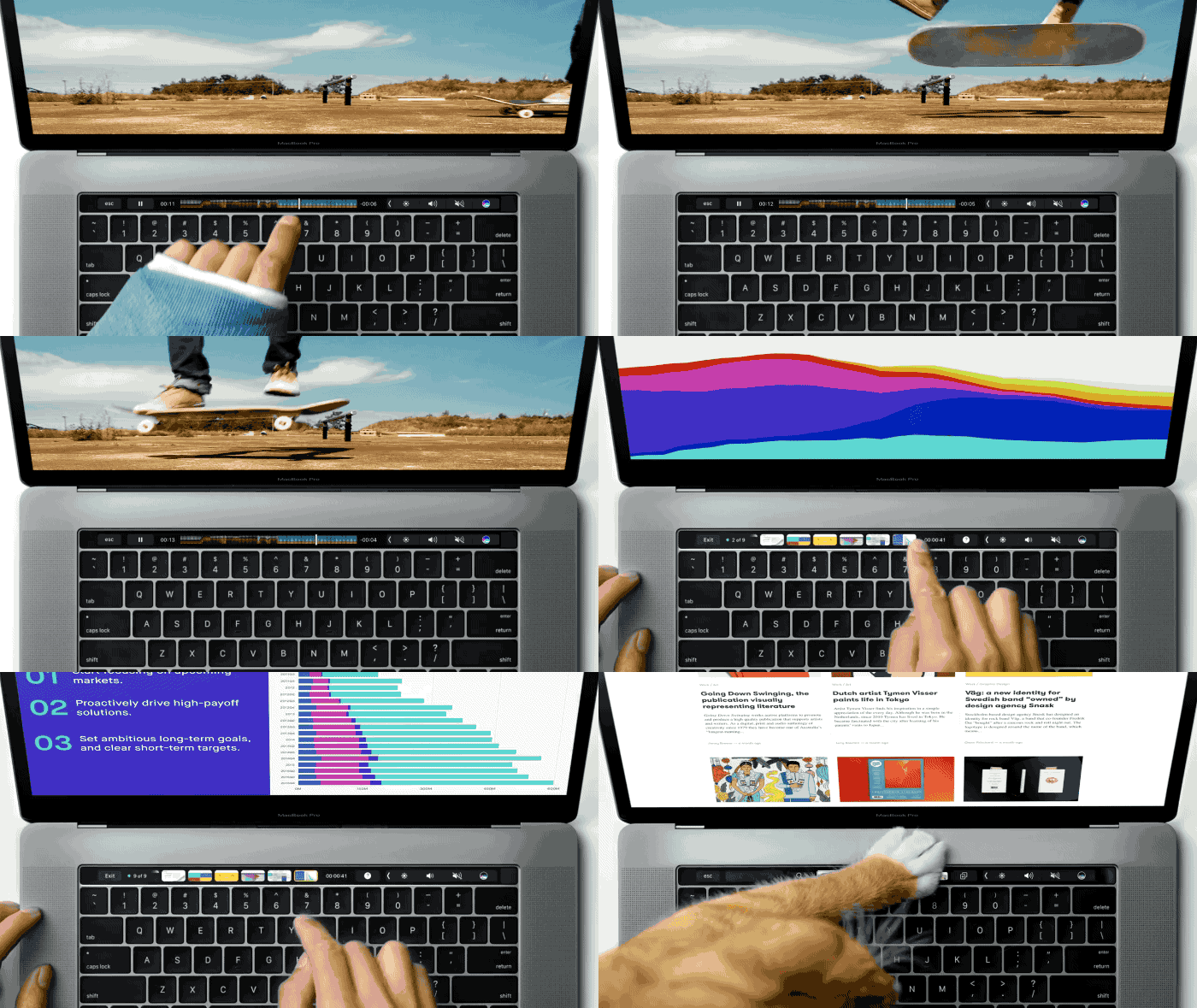
Apple might have just gotten to the Touch Bar with its new MacBook Pro, but according to a new report, Microsoft was working on similar adaptive keyboard technology as early as 1999.
To put that into context, that would be around the time that Apple first shipped its iMac G3 and way before the company started to embrace multitouch technology with the iPhone.
According to The Verge, Steven Bathiche, director of research in Microsoft’s applied sciences group, spent a long time investigating keyboards capable of changing their function keys based on whatever was happening on screen.
“While most of the work was primitive compared to today’s touchscreen interfaces, a lot of the concepts behind Apple’s MacBook Touch Bar were investigated by Microsoft’s research teams,” the publication notes.
[contextly_auto_sidebar]
Microsoft finalized its research in this area in 2009, and ultimately didn’t take the research any further. The reason? Because Microsoft wasn’t in the hardware business at the time: something which Steve Ballmer claims was responsible for his falling out with Bill Gates.
It’s definitely interesting to hear, although — as plenty of other companies have found to their detriment — just beating Apple to market with a product isn’t enough. Another company which beat Apple to the adaptive keyboard was the Lenovo ThinkPad X1 Carbon Ultrabook laptop, which debuted in 2014.
Unfortunately, as a Lenovo spokesperson told Cult of Mac: “The integration of the adaptive user experience was a generation ahead of its time,” and blamed the technology’s lack of adoption on not being compatible with business customers.
“Sometimes the ThinkPad can be too far ahead of the curve, which can create challenges when translating to a consumer base with certain expectations of the technology,” they continued. “ThinkPad has long been associated with industry leading keyboards with a real engineered feel and the X1 Carbon was no different.”
“The integration of the adaptive keyboard was a further step in the continued quest for innovation. Despite the positive user feedback, the adaptive keyboard in reality proved maybe a step too far for our business customers. Many run custom or legacy applications that require physical function keys, or simply have that expectation of the tried and tested ThinkPad classic keyboard which continues to deliver meaningful user value.”
Ultimately, the job of the successful tech company is not just to be first with a particular idea, but to implement it in a way that makes sense at a time that fits with user requirements.
That’s not to put down either Microsoft or Lenovo’s efforts, but beating Apple to the Touch Bar isn’t entirely unlike bragging that you made MP3 players before the iPod.

Luke Dormehl is a U.K.-based journalist and author, with a background working in documentary film for Channel 4 and the BBC. He is the author of The Apple Revolution and The Formula: How Algorithms Solve All Our Problems … and Create More, both published by Penguin/Random House. His tech writing has also appeared in Wired, Fast Company, Techmeme and other publications.

8 responses to “MacBook Pro’s Touch Bar tech was a Microsoft idea first”
I’m not sure why people in tech care who did it first. My car has ABS. Do we really care which manufacturer had them first… NO
It’s been 1 year since I decided to quit my old job and I am so happy now… I started freelancing on-line, for a company I stumbled upon over internet, few hours every day, and I profit now much more than i did on my last work… Check i got for last month was for 9k… The best thing about this gig is that i have more time with my family… KORTA.NU/MDe
You know, I came up with the idea of drones before anyone else. I deserve all the credit.
MS did not come up with the idea first. Students in a contest did. Did MS implement it? No.
Apple has always adapted what it can, for want of a better term, ‘steal’ – but the thing is why Luke outing this and not Ive or Schiller.
“Good artists copy, great artists steal” :)
Chalk up another win for producing both software and hardware. Shame it’s so expensive to join the party. Will we see a desktop keyboard with a touch bar? Hope so.
Your story (and many commentors) seem to be missing a key point…. In 2014, Thinkpad Carbon X1 users — a group of very smart, tech-savvy customers — tried out this “break through” and the majority decided in the end that they preferred real function keys with a tactile response. Apple saying it’s a “great innovation” doesn’t make it so. What remains to be seen is whether the actual base of users who buy and use the new MacBook Pro will actually agree.