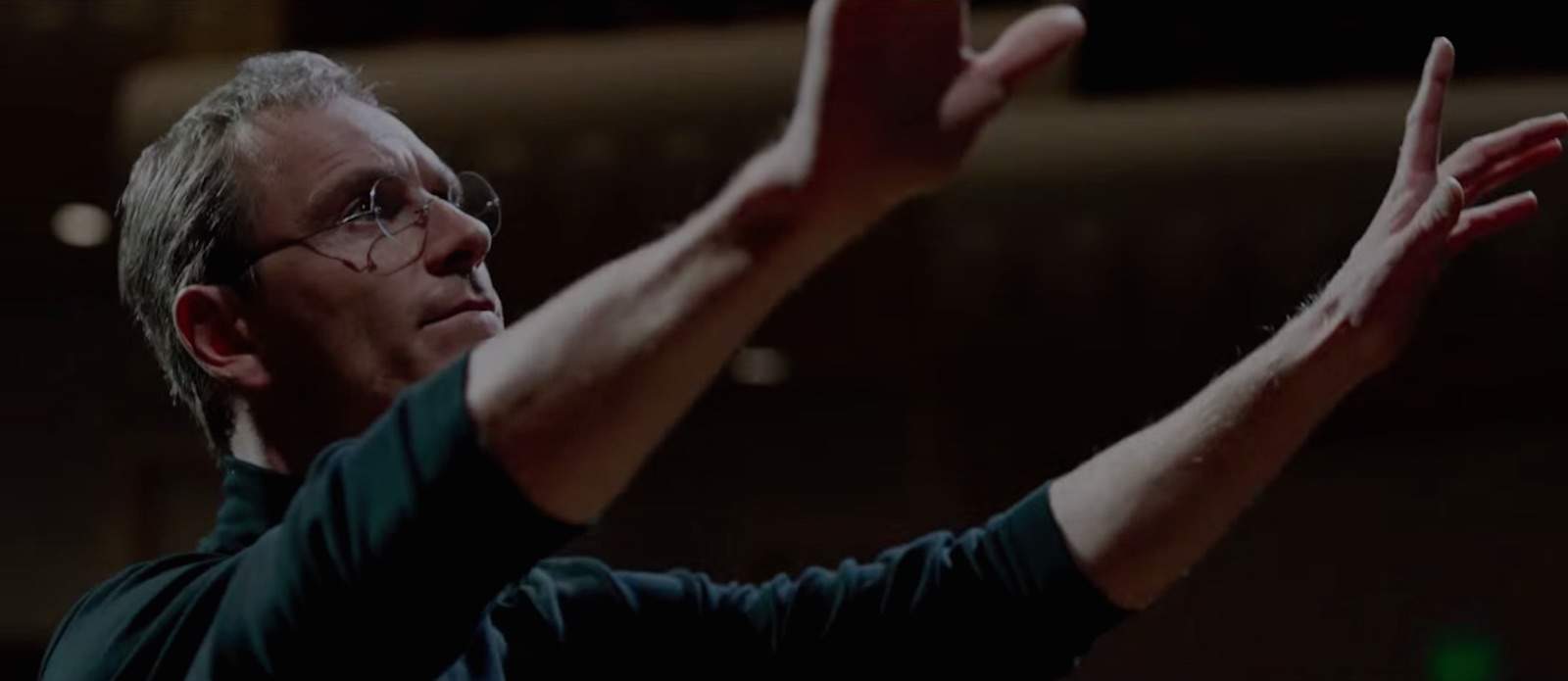
It’s not exactly a shock to hear that Aaron Sorkin’s notorious box office flop Steve Jobs had another disastrous weekend at the box office. But exactly how poor a weekend it had may be something of a surprise.
Now playing on just 326 screens (after being dumped from thousands due to poor earnings), the semi-biopic earned only $394,000 this past weekend.
To put that in perspective, it’s only a little over 1/100 of what Spectre made during the same period, less than Steve Jobs earned when it was playing on just four screens in Los Angeles and New York earlier this year, and slightly less than Apple brings in in revenue in one-and-half minutes. Yikes!
According to this handy infographic, Apple rakes in $4,540 per second. Yes, I know that we’re comparing Apples to oranges here (Apple’s international earnings versus U.S. box office), but it’s still a reminder of how crazily successful Apple is… and how underwhelming this movie has proven as a financial investment.
I’ve written at length about the reasons Steve Jobs has failed as badly as it has — despite its early glowing reviews. Personally I enjoyed it a lot more than Spectre, despite noting the multiple inaccuracies in it (as well as the macro inaccuracy that young Steve Jobs = the same guy who turned Apple around from 1997 onwards).
With that said, I think it’s fair to say by now that it’s going to be a long, long time before its investors ever get their money back — particularly when you consider the total earnings don’t take into account marketing costs (probably another $30 million on top of the budget) and exhibitor costs.
Source: Box Office Mojo

Luke Dormehl is a U.K.-based journalist and author, with a background working in documentary film for Channel 4 and the BBC. He is the author of The Apple Revolution and The Formula: How Algorithms Solve All Our Problems … and Create More, both published by Penguin/Random House. His tech writing has also appeared in Wired, Fast Company, Techmeme and other publications.


6 responses to “Apple makes more in 1.5 minutes than Steve Jobs did this weekend”
Tim Cook was spot on with the “opportunistic” jibe at Sorkin. Biopics, as Daring Fireball’s Jon Gruber remarked, don’t have to hang on to the subject/protagonist’s real name to be successful or award-winning (he cited Citizen Kane, regarded as one of the best of all time, which was about newspaper magnate William Randolph Hearst, and multi-Oscar winners Casino [Sam Rothstein] and Goodfellas [several famous real-life mobsters]), even if they play fast and loose with the facts in order to paint a compelling picture story.
And the sheer malice of stopping the narrative “before the good guy shows up” proves that Sorkin was actually playing to the “Apple-haters” demographic.
What he forgot (or didn’t know) about that subset of human detritus is their notorious penchant for freeloading, of paying as little or nothing for anything of value, which easily explains the virtually non-existent profit share of Apple’s competitors whether it be in PC, smartphones or even the curiously-sagging tablet markets. And also explains why his apology for a biopic is “sinking like a lead Zeppelin” (google that last quote for some interesting pop trivia!).
/Rant off
Did you see the film? Seems like more of a rental than a go-to-theater flick.
Did not see the film because Mr. Fassbender looks absolutely nothing like SJ. We and a bunch of friends from our design team went to see the Ashton Kutcher flick and while the movie was a bit quirky the young Mr. Kutcher was goose-bumpingly accurate with his portrayal.
The media has to accept a great deal of responsibility for Steve Jobs’ larger than life/cult leader persons. No CEO was rerouted on so aggressively, or glowingly, before him. Apple’s meteoric rise from near death was attributed exclusively to him, with no consideration given to the quality of the team he assembled.
Jobs did not walk on water, nor was he the devil incarnate. What set Jobs apart from the ordinary was his fanatical focus on the consumer experience and the products that focus created.
As the media does with all things, in their hands the truth is shaped to benefit them (at the box office) and not the consumer. Maybe now, with the utter failure of “Steve Jobs” the movie, the media will will stop exploiting the image they created.
By Sorkin’s own admission, his “Steve Jobs” movie is fiction (or as he called it “art”). It is not historically accurate, or a true representation of the real Steve Jobs.
It may have been a well produced movie, but people do not want to see fictional representations of real people in movies… unless it is satire. Other than that, people want to see serious movies that are factually correct about real people. Otherwise, it is pointless to see fiction presented as fact.
This is the main reason why the movie has flopped so badly.
Throw the movie up onto PPV just like they did with The Interview, who knows, it may gain traction from the crowd of watch it at home folks.