
It’s been over two and a half years since Apple TV was updated, and while Apple’s been happy resting on its laurels, its biggest competitors are passing it by.
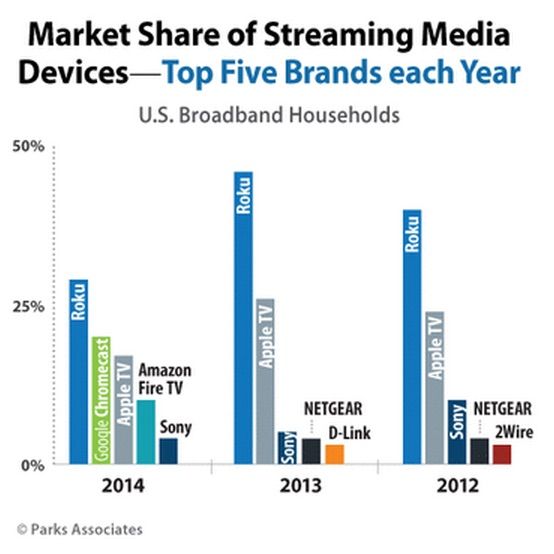
Google’s Chromecast is now more popular than Apple TV, reports Parks Associates, which says streaming media players become more popular than ever in the first three quarters of 2014, as 10 percent of U.S. households bought at least one new streaming device.
The news of Apple TV’s slumping appeal comes amid years of rumors that a big update is in the works, but Apple hasn’t been able to launch it yet because of negotiation problems with content providers. As Apple’s been satisfied with releasing small software updates to its little TV box, Google and Amazon have launched competitors that offer different content and cheaper prices.
The biggest benefactor in the upswing of set-top box purchases has been Google. Chromecast managed to go from minor player in 2013, to the second most popular device among households with a broadband connection. Roku still sits at the top, but its marketshare shrank significantly over the last 12 months, dropping from 46% last year, to 29% in 2014.
Amazon’s new Fire TV has been quickly gobbling up marketshare too. Fire TV was only announced in April 2014, but Jeff Bezo’s Apple TV replacement has already captured 10% of the market.
Source: CNET

Buster Hein is a freelance writer who lives in Phoenix, Arizona. Twitter: @bst3r.

18 responses to “Chromecast and Roku are crushing Apple TV”
Do we know for sure that Apple even still wants in on this business? Why do we all assume that they’re going to make a sequel to Apple TV?
Ever bit of verbiage they’ve let loose regarding the Apple TV over the past few years has pointed to the idea that it’s an area that they’re heavily invested in.
Apple on a loss this week. lol.
First they lose their top education spot to Chromebooks and now they lose their 2nd position to Chromecast and Roku. Time to update Apple TV, hasn’t been an update on mine for 2 years now. The streaming market is only getting more competive Apple, don’t be lazy.
What’s the big deal? Is Apple in desperation mode to beat out little Roku, for crissakes? I doubt that. Before Comcast took over Time-Warner, Apple was set to release some fancy box but maybe those plans fell through. Apple needs to control the content, not just hardware. Only idiots don’t realize that Apple’s own A-series ARM processors could make mincemeat out of FireTV and Roku’s offerings if Apple decided to use them in AppleTV.
People need to stop concerning themselves about what Apple is missing out on or falling behind in. Apple has the cash to do whatever it needs to do, if necessary. I’m sure AppleTV is still profitable for Apple but I’d hardly think it is an Apple priority at the moment. I use a Roku 3 and it’s a terrific little box. I like the Roku because it can run PLEX. AppleTV doesn’t. All I’m getting at is Roku has a box streamer and stick streamer and that’s all it needs to focus on. That’s it’s revenue makers. Apple has far more than that to concern itself with.
I don’t see why Apple should need to crush Roku or Google’s Chromecast. If AppleTV sales are weak, it’s hardly going to affect Apple at all. Personally, I don’t think it’s good business for Apple to try to put smaller companies out of business just for the sake of market share. The cable companies control most of the content and they’re not giving it up. Apple isn’t Samsung trying to steal everyone’s market share for peanuts. AppleTV is a cheap $99 box. How’s that going to be a major revenue maker for Apple? Apple needs to put major effort into AppleWatch because that’s where the money will be.
That’s just it though, at 2 or 3 times more in cost to buy than competitors (Chromecast @45.00 unless on sale and Roku at 50.00 all the time on sale) it’s NOT a cheap box (in comparison) so why on earth one would buy it over the others is silly. And it doesn’t support plex etc. so there’s really no home theatr value by owning one. The only reason I kept mine is simply for Airplay and nothing more. I don’t use it for anything else because my Chromecast does more and supports Plex.
Plex? HBO GO and Showtime Anytime have infinitely more options than Plex…Hell, even Netflix has more stuff to watch.
? PLEX is NOT a content subscription service, such as Netflix or HBO.
PLEX is a derivative of XBMC – a service that organizes and distributes your HOME VIDEO video library (such as ripped DVDs, Blurays but also home videos and pictures), such as you may have saved (as backup) onto a home networked hard drive.
XBMC was originally created as a service to let your organize and watch your home videos on your XBOX, but it went into the open source world and has been adapted to many other devices, such as PCs, streaming devices, etc.
XBMC runs very well on the old Apple TV 2 as a hack, but not as an official app. Then Apple made future Apple TVs harder to hack, and so you can’t run XBMC on newer AppleTVs. Consequently hackable old Apple TV 2s fetch more in the aftermarket than new AppleTVs – because you can turn them into XBMC servers (similar to PLEX).
PLEX is a commercial version of XBMC that requires no hacking, while XBMC mainly appeals to hobbyists who like working with their PCs and hacking stuff.
PLEX lets you build “your own Netflix” out of the content you have saved on your own drives at home. Say, you have a 4TB hard drive with videos saved on a computer or dedicated network storage device in your basement, but you want to watch those videos on your living room TV or your TV in your bedroom in a fully-featured interface without special wiring or hauling your PC into your living room.
PLEX organizes your content so that it looks as good as HBO or Netflix – it automatically applies the correct naming, poster art and content info to your home files, so you have similar descriptive data as on Netflix.
Then it distributes your personal video library via your home network to your TVs, tablets or other PCs.
It even lets you selectively share that content with people off of your network. Say you want to let a friend watch on their own PC or TV a DVD that you ripped to your hard drive – or maybe you just want to share your home videos, but don’t want to upload such private files to a service like Youtube.
If the friend or relative has PLEX (PLEX is free to download and use) and you have PLEX, you can do that.
PLEX is kind of like setting up your own Netflix from your personal video library.
You can share with any devices that can support PLEX – Android and Windows tablets, or with OSX, Windows or Linux computers, and with devices like Roku, Chromecast or FireTV.
It is strange that every set-top box supports PLEX but AppleTV.
Who stores their own content anymore. That is seriously old school. ;-)
Not sure if you’re just being facetious?
Of course anyone with their own content might be interested. People do have libraries Blurays, DVDs and video files they’ve downloaded from various sources.
Recently we saw that Apple blithely eliminated their customer’s content from their services.
While Apple is the only firm I’ve hear of that has been caught at this, it is clear that we as customers should not trust the content “ecosystem” providers – i.e. Apple, Amazon, Microsoft and Google – to be the primary storage systems of the content we own.
All of these companies have incentives to push strategies to lock us into their software and hardware ecosystems, and those incentives work against our interests as users.
Plex is for streaming, not a media app per se, it doesn’t contain movies. it hosts them
The original Google TV box such as the one made by Sony or Vizo supports Apple AirPlay playback with a ViMu app or a AirTight App download.It also can do DLNA and a bunch of other things. Yes the user experience overall is a little rough, but not that bad for a 60 percent discount versus apple. It supports Plex and everything else and can be had for 40 bucks on ebay. That’s what’s cool about the Android ecosystem. Now if only someone made a truly polished Android TV device it could give others a run for the money. For now Roku offers the best developer ecosystem and great performance at a reasonable price. More content, faster response, and reasonably priced. It’s no wonder they own the biggest market share. Kudos to Roku for execution.
I have four Rokus, including two Roku 3s, one of which is on our primary TV in the living room. I also have an Apple TV 3 on my living room TV. In my view, each box has its strengths and weaknesses and I use both. Given all the money I’m saving since cutting cable, I see no reason not to have both. If Apple had, say, the top 200 channels on Roku, the Apple would probably be my preferred box. Roku’s strength over Apple TV is primarily because of content which I can’t get on the Apple TV. Apple TV’s strength over Roku is primarily because of AirPlay.
“The cable companies control most of the content and they’re not giving it up.”
Hardly. 94 of the top 100 shows last year were on the six biggest broadcast networks (ABC, CBS, FOX, NBC, PBS, and the CW), which more than 90% of all American households can receive for free with an antenna. 80% of all TV viewing is done on networks which broadcast for free over-the-air (though many people pay to receive them as part of their cable/satellite package). Almost all cable-only TV shows can be purchased for current season passes through streaming services such as Vudu (Wal-Mart), Amazon Instant Video, and iTunes. Since you can purchases only the shows (or even just the episodes) you want, this, combined with OTA, gives the vast majority of Americans a much cheaper way to watch TV shows than cable.
ABCNews (available on Apple TV) and CBSN (available on most streaming boxes) offer 24/7 news coverage.
A ton of sports is still available OTA. ESPN3 is available for free through WatchESPN. MLB streams a free game of the day all season long. MLB, NBA, NHL, and MLS all offer streaming subscriptions, which can be subscribed to for a full season or a partial season at a discount. Only local professional sports has most of its local games still limited to cable/satellite. As the audience moves elsewhere, they’ll follow their audience.
I have both a Roku 3 and an Apple TV and I find that I use the Roku much more these days, mostly because of Plex support.
Switched from Apple TV to Roku so I could get Amazon videos. Found Roku soooooo much easier and better to use too.
I am also using my iPad less because so many websites are using Flash including eBay. The Acer Chromebook is starting to look really good.
That’s hardly “crushing.” Apple TV has been updating apps and channels consistently lately. They just added FX Now a couple of weeks ago so I can watch the Simpsons back-to-back all day. So it’s not like they’re getting out of the business anytime soon. But if you don’t have a Mac or an iPhone, it makes no sense to get an Apple TV. Conversely, those of us who do have iOS stuff can use it with Apple TV but not Roku or Chromecast.
I don’t understand all the Apple or Droid or Google (or whatever) bashing. I use an iPhone but I don’t harbor bad feelings towards those that don’t. Just like driving my VW doesn’t make me automatically a Ford or Chevy hater.
Apple TV is great, but at this point, why don’t they come out with a stick/dongle (or stem?) that competes at the $35-$50 level. It would do so well. It is still the best TV product when you are in Apple’s ecosystem. Once you go AirPlay, it’s hard to not have it. Or why don’t they make ROKU an offer it can’t refuse? For more on the streaming TV showdown, check out this podcast I did: http://www.matthewmcqueeny.com/2014/11/91-how-about-apple-tv-stick-or-stem.html
Our first streamer was an AppleTV2 (only 720P), and we recently moved to Roku and FireTV to get 1080p but there is a very important thing that the old APPLE TV2 STILL did better than these others (though it might have changed in a recent Netflix update).
On the old AppleTV, your starting point was a simple list of categories, like Comedies, Action, Drama, Documentaries, Family, etc. There was a “Recommended for you” category as well. Perfect.
On Roku and FireTV, they seem to think the special sauce is recommendations. It’s kind of like if someone thought the best part of a Big Mac was the Special Sauce, and so now they decided to quadruple the Special Sauce, and remove one of the burgers and the onions. And now what used to be a pretty tasty sandwich is pretty awful, because it’s 80% special sauce.
Putting priority on pushing Netflix recommendations has made it very hard to find the CATEGORY of show I am interested in, which makes it very hard to find what I actually want to see. Netflix on Roku and Fire TV is like a restaurant advisor who is trying to make his customer go to another Italian restaurant today because he ate Italian for lunch yesterday.
Yeah, my grandfather used to like to eat pretty much the same thing every day, but I don’t think most people do.
On the old AppleTV, it was more logical and much more pleasurable experience. You first selected from a list of broad categories (including a separate category specifically, “suggestions for you.”) And what was cool, was if you selected a movie or TV show that you liked, on the show’s main page it recommended similar shows. This was cool because it was looking at what you DECIDED you want to watch NOW, NOT WHAT you happened to have watched YESTERDAY, which is what Netflix on Roku and FireTV are pushing.
But on both Roku and FireTV (and maybe it’s now universal), Netflix doesn’t have a simple category page, but rather rows of movies – most of which are “Because you watched Biker Babes from Beyond, you may like . . . ”
This is a royal PI the B. They kind of sprinkle the category rows throughout lots and lots of rows of “Because you watched “Sailor Moon, Cute Pink Dreamie Eyes!”, you may like . . .” Yeah, maybe my kid watched Sailor Moon on my account.
Why do I have to wade past recommendations based on what I or any other member of my family watched yesterday to find Documentaries randomly placed amongst 20 rows of other recommendations based on TV shows I or someone else watched.
Why did they eliminate a simple movie & TV category page for Netflix, like existed on the old AppleTV2? The absence of a fast, easy Netflix category menu – something so easy to do – makes for a really lousy, frustrating user experience.