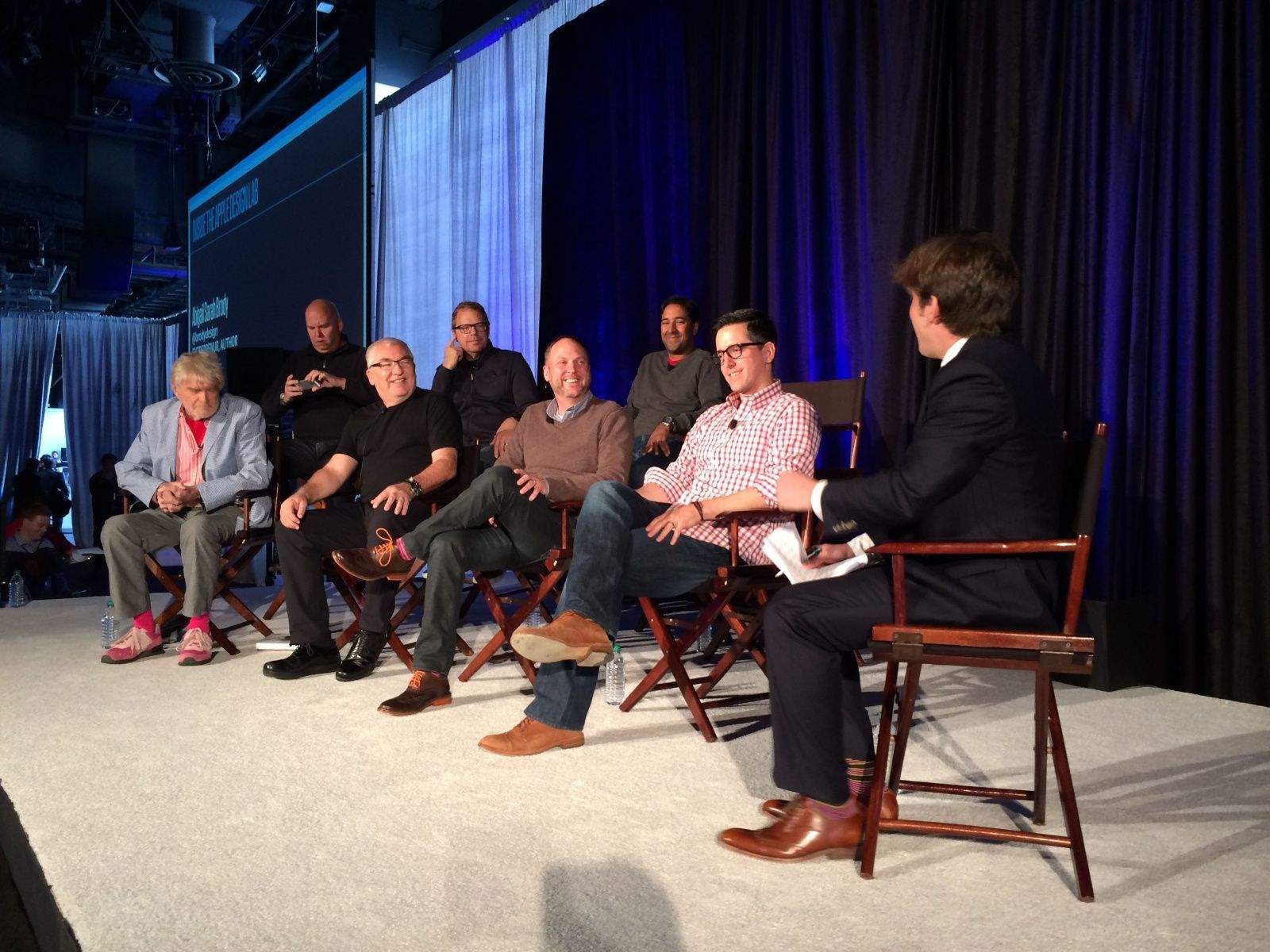
Fast Company's panel of ex-Apple designers. Photo: Leander Kahney.
SAN FRANCISCO — Apple went from being chump of the tech world to champ, and what was the product that turned it all around?
That was the question posed to a panel of ex-Apple designers at a special event here in the city.
The answers might surprise you.
The question was posed at Inside Apple’s Design Lab, a panel discussion at Fast Company’s Innovation Uncensored, a cleverly-named one-day conference about design and innovation (clever, because it promised to lift the cloak on Apple’s infamous secrecy).
Before a full house at the Metreon Center, the panel consisted of Robert Brunner, designer of Beats headphones and former head of Apple’s Industrial Design studio and now at Ammunition Group, and Hartmut Esslinger, founder of Frog Design and Apple’s first world-class designer.
So which single product put Apple back on the path to success?
Final Cut Pro: Because it was a playground for a lot of UI experimentation that became important later. (Brody)
OS X: The operating system that’s the foundation of all the hit products, from the iMac to the iPad. (Morin)
PowerBook 100: The first great design of Apple’s new era. (Ganatra)
iPod: The product that changed everything. (Brunner)
iPhone: A huge revolution in computing. (Grignon and Esslinger)
iTunes on Windows: Because that blew the doors open.
The Apple Stores: They made Apple accessible to the great public. (Max Chafkin, the moderator)
It’s a great list, and very debatable. iTunes and the stores are not something most people would suggest, but they are great candidates. What do you think? What was Apple’s most important innovation of that era?
Leander’s new book about Jony Ive and the Apple design studio is out in November. ‘Jony Ive: The Genius Behind Apple’s Greatest Products’ is available for pre-order on Amazon.
Leander has been reporting about Apple and technology for nearly 30 years.
Before founding Cult of Mac as an independent publication, Leander was news editor at Wired.com, where he was responsible for the day-to-day running of the Wired.com website. He headed up a team of six section editors, a dozen reporters and a large pool of freelancers. Together the team produced a daily digest of stories about the impact of science and technology, and won several awards, including several Webby Awards, 2X Knight-Batten Awards for Innovation in Journalism and the 2010 MIN (Magazine Industry Newsletter) award for best blog, among others.
Before being promoted to news editor, Leander was Wired.com’s senior reporter, primarily covering Apple. During that time, Leander published a ton of scoops, including the first in-depth report about the development of the iPod. Leander attended almost every keynote speech and special product launch presented by Steve Jobs, including the historic launches of the iPhone and iPad. He also reported from almost every Macworld Expo in the late ’90s and early ‘2000s, including, sadly, the last shows in Boston, San Francisco and Tokyo. His reporting for Wired.com formed the basis of the first Cult of Mac book, and subsequently this website.
Before joining Wired, Leander was a senior reporter at the legendary MacWeek, the storied and long-running weekly that documented Apple and its community in the 1980s and ’90s.
Leander has written for Wired magazine (including the Issue 16.04 cover story about Steve Jobs’ leadership at Apple, entitled Evil/Genius), Scientific American, The Guardian, The Observer, The San Francisco Chronicle and many other publications.
He has a diploma in journalism from the UK’s National Council for the Training of Journalists.
Leander lives in San Francisco, California, and is married with four children. He’s an avid biker and has ridden in many long-distance bike events, including California’s legendary Death Ride.
Our daily roundup of Apple news, reviews and how-tos. Plus the best Apple tweets, fun polls and inspiring Steve Jobs bons mots. Our readers say: "Love what you do" -- Christi Cardenas. "Absolutely love the content!" -- Harshita Arora. "Genuinely one of the highlights of my inbox" -- Lee Barnett.
Nitin Ganatra’s choice of the PowerBook 100 seems pretty ridiculous. Maybe everyone felt compelled to give a different answer, but the PowerBook 100 came out in 1991 right as Apple was about to slide into its worst performance period ever. No way you consider that the product that turned them around.
Surprised that no one mentioned the original bondi blue iMac that turned heads shortly after Steve came back, but I think iTunes on Windows was the one that really turned the tide for Apple.
The question wasn’t fair because it was these things and more. It was the perfect storm of iMac (saved Apple), iPod (transformed it), iTunes (opened it up), stores (opened it more); and iPhone/iPad (next phase of personal computing). but it’s fun to debate!
Even Final Cut Pro is an interesting choice, because she’s kinda right — there was a lot of unconventional software tweaking in that era. I remember a huge debate about how the QuickTime player violated Apple’s own human interface guidelines and was an abomination. But it lead — eventually — to stuff like iOS.
My knee-jerk answer would have been the iPod. I was in high school when MP3 players first came out, and the iPod+iTunes really did change the music landscape. But all those other responses are also great answers to an interesting question.
The iMac debuted in 1998 and it was the first Jony Ive product that changed Apple’s direction and companies started copying it. It gave them the cash flow to SAVE the company. How anyone can think otherwise is beyond me.
Someone might want to tell Morin that the iPad doesn’t run OSX (it runs iOS). And the iMac hasn’t been a runaway success (a hit product). Don’t get me wrong, I’m typing on a 27″ iMac right now and I love it, but people get gun shy about dropping $2,700 on a desktop computer.
The question was, “What product SAVED Apple?”
The iMac debuted in 1998 and it was the first Jony Ive product that changed Apple’s direction and companies started copying it. It gave them the cash flow to SAVE the company. How anyone can think otherwise is beyond me.
Microsoft gave Apple funds in the form of an investment to help save the company. I’m sure the iMac sales also helped out, but it wasn’t the only thing Apple relied on to stay afloat.
That iMac didn’t set the world on fire and there may have been a few copy cats around but I look around today and I don’t see too many blueberry or cherry colored monitors around.
Someone might want to tell Morin that the iPad doesn’t run OSX (it runs iOS). And the iMac hasn’t been a runaway success (a hit product). Don’t get me wrong, I’m typing on a 27″ iMac right now and I love it, but people get gun shy about dropping $2,700 on a desktop computer.
The iMac has been the best selling desktop computer for years.
Someone might want to tell Morin that the iPad doesn’t run OSX (it runs iOS). And the iMac hasn’t been a runaway success (a hit product). Don’t get me wrong, I’m typing on a 27″ iMac right now and I love it, but people get gun shy about dropping $2,700 on a desktop computer.
The iMac has been the best selling desktop computer for years.
I am going to go way out on a limb here and nominate a product Apple owned, but never sold: NeXTstep. By purchasing that product and the company that went with it, NeXT, Apple brought back Steve Jobs and the rest is history. NeXTstep saved Apple.
11 responses to “Ex-Apple Designers Ask: What Product Saved Apple?”
Nitin Ganatra’s choice of the PowerBook 100 seems pretty ridiculous. Maybe everyone felt compelled to give a different answer, but the PowerBook 100 came out in 1991 right as Apple was about to slide into its worst performance period ever. No way you consider that the product that turned them around.
Surprised that no one mentioned the original bondi blue iMac that turned heads shortly after Steve came back, but I think iTunes on Windows was the one that really turned the tide for Apple.
The question wasn’t fair because it was these things and more. It was the perfect storm of iMac (saved Apple), iPod (transformed it), iTunes (opened it up), stores (opened it more); and iPhone/iPad (next phase of personal computing). but it’s fun to debate!
Even Final Cut Pro is an interesting choice, because she’s kinda right — there was a lot of unconventional software tweaking in that era. I remember a huge debate about how the QuickTime player violated Apple’s own human interface guidelines and was an abomination. But it lead — eventually — to stuff like iOS.
My knee-jerk answer would have been the iPod. I was in high school when MP3 players first came out, and the iPod+iTunes really did change the music landscape. But all those other responses are also great answers to an interesting question.
The question was, “What product SAVED Apple?”
The iMac debuted in 1998 and it was the first Jony Ive product that changed Apple’s direction and companies started copying it. It gave them the cash flow to SAVE the company. How anyone can think otherwise is beyond me.
Someone might want to tell Morin that the iPad doesn’t run OSX (it runs iOS). And the iMac hasn’t been a runaway success (a hit product). Don’t get me wrong, I’m typing on a 27″ iMac right now and I love it, but people get gun shy about dropping $2,700 on a desktop computer.
Microsoft gave Apple funds in the form of an investment to help save the company. I’m sure the iMac sales also helped out, but it wasn’t the only thing Apple relied on to stay afloat.
That iMac didn’t set the world on fire and there may have been a few copy cats around but I look around today and I don’t see too many blueberry or cherry colored monitors around.
The iMac has been the best selling desktop computer for years.
I’ve gotta go with the iMac. It was the linchpin to the whole turnaround. Without it, there is no iPod, OSX, Stores, etc.
iMac was the hail-mary touchdown to make the playoffs. The iPod was the game winner in the Super Bowl.
I am going to go way out on a limb here and nominate a product Apple owned, but never sold: NeXTstep. By purchasing that product and the company that went with it, NeXT, Apple brought back Steve Jobs and the rest is history. NeXTstep saved Apple.
Not letting the sale people be in charge.