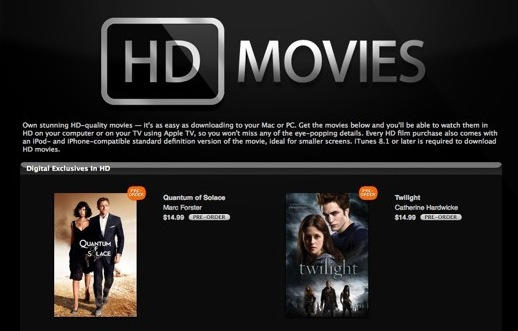
New rumors this weekend suggest that Blu-Ray may finally be coming to the Mac. But while Blu-Ray is high on many people’s wish list, the rumors just don’t make sense.
Citing a “pretty reliable source,” Boy Genius Report says Blu-Ray is coming to iTunes 9, maybe as soon as September. The rumor jibes with a particularly vague story on AppleInsider suggesting that new iMacs will get new features (yeah, it’s almost sounds like self-parody), possibly Blu-Ray.
But although Blu-Ray format is gaining popularity, it’s unlikely to come to the Mac, ever. Here’s why:
It’s a Bag of Hurt: Even though Apple is a long-standing member of the Blu-Ray association, Blu-Ray licensing is still expensive. Last year Steve Jobs called Blu-Ray licensing a “bag of hurt” and explained: “The licensing is so complex. We’re waiting until things settle down, and waiting until Blu-ray takes off in the marketplace before we burden our customers with the cost of the licensing and the cost of the drives.”
Blu-Ray Still Pricey: Blu-Ray hardware is still expensive. Despite falling prices, Blu-Ray players still cost about $200. Many analysts think Blu-Ray won’t really take off until players are $100 or less.
Solid State Is The Future: Optical media is dying. Apple’s already dropped CD/DVD from the MacBook Air, just like it dropped the floppy drive from the iMac in 1998. It’s a sign of things to come. Witness the addition of an SD Card slot to the new MacBook Pro 13-inch. Solid state media like SD Cards will replace spinning optical disks; and probably quicker than we expect, given the fast-falling prices of flash memory chips.
Some movie studios are already starting to ship movies on solid state memory cards. In Japan, Walt Disney is offering National Treasure and Pirates of the Caribbean on microSD drives (It’s probably unrelated, but Jobs sits on Disney’s board). In the U.S., a pair of companies is preparing to release movies on USB memory sticks.
The H.264 codec developed by Apple that underlies MPEG-4 is becoming standard for compressing online video. It’s also a good format for compressing HD movies for SD cards. If Apple is going to support physical media, it’s more likely to be memory cards than spinning disks.
UPDATE: Toshiba said on Monday it will be making Blu-Ray players and adding Blu-Ray drives to its PCs. Toshiba’s HD-DVD, of course, lost the HD format battle against Sony’s and Panasonic’s Blu-Ray. The Blu-Ray market is too lucrative to pass up and PC makers are steadily replacing standard DVD drives with Blu-Ray drives, according to the New York Times. Whatever, I still don’t think Apple will add Blu-Ray.

Leander Kahney is the editor and publisher of Cult of Mac.
Leander is a longtime technology reporter and the author of six acclaimed books about Apple, including two New York Times bestsellers: Jony Ive: The Genius Behind Apple’s Greatest Products and Inside Steve’s Brain, a biography of Steve Jobs.
He’s also written a top-selling biography of Apple CEO Tim Cook and authored Cult of Mac and Cult of iPod, which both won prestigious design awards. Most recently, he was co-author of Cult of Mac, 2nd Edition.
Leander has been reporting about Apple and technology for nearly 30 years.
Before founding Cult of Mac as an independent publication, Leander was news editor at Wired.com, where he was responsible for the day-to-day running of the Wired.com website. He headed up a team of six section editors, a dozen reporters and a large pool of freelancers. Together the team produced a daily digest of stories about the impact of science and technology, and won several awards, including several Webby Awards, 2X Knight-Batten Awards for Innovation in Journalism and the 2010 MIN (Magazine Industry Newsletter) award for best blog, among others.
Before being promoted to news editor, Leander was Wired.com’s senior reporter, primarily covering Apple. During that time, Leander published a ton of scoops, including the first in-depth report about the development of the iPod. Leander attended almost every keynote speech and special product launch presented by Steve Jobs, including the historic launches of the iPhone and iPad. He also reported from almost every Macworld Expo in the late ’90s and early ‘2000s, including, sadly, the last shows in Boston, San Francisco and Tokyo. His reporting for Wired.com formed the basis of the first Cult of Mac book, and subsequently this website.
Before joining Wired, Leander was a senior reporter at the legendary MacWeek, the storied and long-running weekly that documented Apple and its community in the 1980s and ’90s.
Leander has written for Wired magazine (including the Issue 16.04 cover story about Steve Jobs’ leadership at Apple, entitled Evil/Genius), Scientific American, The Guardian, The Observer, The San Francisco Chronicle and many other publications.
Leander has a postgrad diploma in artificial intelligence from the University of Aberdeen, and a BSc (Hons) in experimental psychology from the University of Sussex.
He has a diploma in journalism from the UK’s National Council for the Training of Journalists.
Leander lives in San Francisco, California, and is married with four children. He’s an avid biker and has ridden in many long-distance bike events, including California’s legendary Death Ride.
You can find out more about Leander on LinkedIn and Facebook. You can follow him on X at @lkahney or Instagram.

