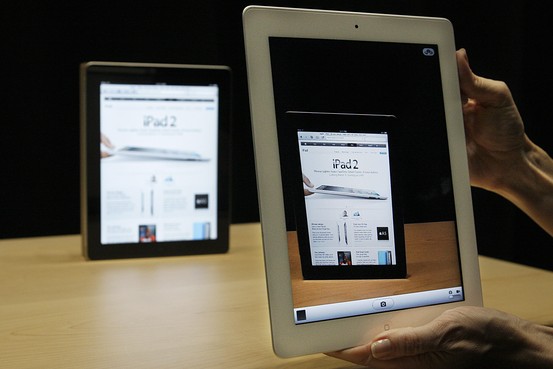
Just kidding. Of course it doesn’t suck. Just the opposite.
The first reviews are in, and they range from enthusiastic to downright giddy. Everyone raves how light and thin it is, and what a big difference that makes in a tablet. Across the board, the reviewers say Apple has made a great device greater, and it’ll be difficult to beat: on design, performance, experience and price.
The only knocks are the screen (last year’s spec) and the cameras, which are functional but not great.
Here are some highlights of the early reviews:
Killer price
David Pogue in the New York Times gives it a pretty rave review, commenting on the thinness, lightness and great battery life. He notes that the camera is fun with such a large screen, and the built-in gyroscope allows you to walk around objects in a game or look behind you by swinging round.
One of the biggest benefits, though, is the price:
“But the shocker here, though, is that the iPad 2 actually costs less than its comparably equipped Android rivals, like the Xoom and the Samsung Galaxy Tab… It means that for the first time, your heart can succumb to the iPad mystique — without having to ignore the more practical input from your brain.”
Garageband is groundbreaking
Joshua Topolsky in Engadget was impressed with Garageband:
“We were immediately impressed with the layout and thoughtfulness that’s obviously gone into this app; it doesn’t feel like a watered down version of the desktop application — it feels like a whole new game.”
However, the iPad 2 cameras “are really pretty bad.”
Looooong battery life
Jason Snell in Macworld was impressed the faster CPU and graphics didn’t kill the battery:
“The iPad’s all-day battery life, perhaps its killer feature, remains intact.”
Crashproof
Walt Mossberg in the Wall Street Journal compared stability to Android tabs:
“It never crashed in my tests, unlike every Android tablet I’ve tested.”
Mossberg concluded the iPad 2 isn’t perfect, but it’s still the best:
“But the iPad 2 moves the goal posts, by being slimmer and lighter, boosting speed and power, and holding its price advantages, available apps and battery life. As of now, I can comfortably recommend it as the best tablet for average consumers.”
Smooth graphics
Ed Baig in USA Today noted the graphics preformance:
“Apple claims the graphics in the new machine have nine times the horsepower of the original. That’s difficult to measure, but Epic Citadel, a stunning, graphics-rich game, played smoothly in my tests.”

Leander Kahney is the editor and publisher of Cult of Mac.
Leander is a longtime technology reporter and the author of six acclaimed books about Apple, including two New York Times bestsellers: Jony Ive: The Genius Behind Apple’s Greatest Products and Inside Steve’s Brain, a biography of Steve Jobs.
He’s also written a top-selling biography of Apple CEO Tim Cook and authored Cult of Mac and Cult of iPod, which both won prestigious design awards. Most recently, he was co-author of Cult of Mac, 2nd Edition.
Leander has been reporting about Apple and technology for nearly 30 years.
Before founding Cult of Mac as an independent publication, Leander was news editor at Wired.com, where he was responsible for the day-to-day running of the Wired.com website. He headed up a team of six section editors, a dozen reporters and a large pool of freelancers. Together the team produced a daily digest of stories about the impact of science and technology, and won several awards, including several Webby Awards, 2X Knight-Batten Awards for Innovation in Journalism and the 2010 MIN (Magazine Industry Newsletter) award for best blog, among others.
Before being promoted to news editor, Leander was Wired.com’s senior reporter, primarily covering Apple. During that time, Leander published a ton of scoops, including the first in-depth report about the development of the iPod. Leander attended almost every keynote speech and special product launch presented by Steve Jobs, including the historic launches of the iPhone and iPad. He also reported from almost every Macworld Expo in the late ’90s and early ‘2000s, including, sadly, the last shows in Boston, San Francisco and Tokyo. His reporting for Wired.com formed the basis of the first Cult of Mac book, and subsequently this website.
Before joining Wired, Leander was a senior reporter at the legendary MacWeek, the storied and long-running weekly that documented Apple and its community in the 1980s and ’90s.
Leander has written for Wired magazine (including the Issue 16.04 cover story about Steve Jobs’ leadership at Apple, entitled Evil/Genius), Scientific American, The Guardian, The Observer, The San Francisco Chronicle and many other publications.
Leander has a postgrad diploma in artificial intelligence from the University of Aberdeen, and a BSc (Hons) in experimental psychology from the University of Sussex.
He has a diploma in journalism from the UK’s National Council for the Training of Journalists.
Leander lives in San Francisco, California, and is married with four children. He’s an avid biker and has ridden in many long-distance bike events, including California’s legendary Death Ride.
You can find out more about Leander on LinkedIn and Facebook. You can follow him on X at @lkahney or Instagram.

