Mobile menu toggle

Search results for: apple tv

Check-in Wars Gain a New Combatant in Rally Up

By

post-36024-image-568a231b7cc812f54585a2ce24fcd47f-jpg
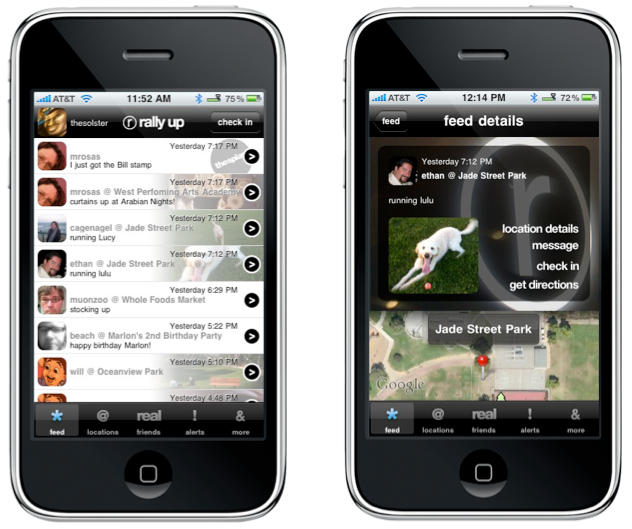
Rally Up promises to cut social network noise, emphasize privacy.

Rally Up, a new location-based iPhone and iPad app from the innovative Santa Cruz, CA team behind 12seconds apps, made its debut in the iTunes App Store Wednesday, hoping to capture the attention of a growing fanbase for apps that leverage mobile communication technology to let people connect with one another.

For the past year the social networking game has been dominated by two players: New York-based Foursquare and Gowalla, out of Austin, TX. With loyal adherents numbering in the hundreds of thousands each, both companies have raised millions in investment funding and explored media partnerships with the likes of Bravo TV, Zagat and the Travel Channel to position themselves for a future in which everyone owns a smartphone and GPS technology allows their location to be pinpointed on a mythical matrix of Coolness.

Enter now Rally Up, which looks to capitalize on privacy concerns that have led many to remain skeptics of social networking apps. Rally Up touts itself as a unique vehicle for letting “real” friends share their wisdom and discoveries about the places they live and visit. “Foursquare and Gowalla are mainly broadcast apps,” said Rally Up founder Sol Lipman. “You check in somewhere and tell the Facebook and Twitter universes about it and there’s very little interactivity or real communication about the experience.”

Rally Up’s focus is more on combining microblogging with location, providing its users a platform for sharing text, videos and direct messages with one another. With an emphasis on the quality of a user’s friends in the Rally Up network, the app doesn’t support mass ‘Friend’ imports from Twitter or Facebook, rather it draws from the phone’s contact list or address book to populate the app with people a user is more likely to be interested in sharing with.

Within the app, any Rally Up contact can be set with a profile providing that contact with more or less access to a user’s comings and goings with Rally Up. The app also allows a user to choose between broadcasting his or her current location or letting contacts know where they are headed next to facilitate greater interactivity and social planning than other social networking apps allow. With 1.7 million points of interest at launch through integration with Open Street Map, Rally Up also has a look and feel distinctly different from the stylized GUIs of Gowalla and Foursquare, while also supporting many of the features that have made those apps so popular, including push notification, leaderboards and stamp/badge collecting.

With an iPad optimized version of the app also ready to go when the highly anticipated Apple tablet device launches April 3rd, Rally Up may be poised to turn the Check-in Wars into a three-front battle.

Rally Up went live as a free download on the iTunes App Store Wednesday.

Daily Deals: $1,449 Unibody MacBook Pro, App Store Freebies, Sony iPod Media Port

By

cult_logo_featured_image_missing_default1920x1080

712095-large712095-large712095-large

We start off a new week with a deal on unibody MacBook Pro laptops. The refurbished units start at $1,499 for a 2.53GHz model. Next up is a round of always popular App Store Freebies, including “Dungeon Run,” a game for your iPhone and iPod touch. We also check out Sony’s Digital Media Port for the iPod, allowing you to listen to tunes stored on your pod on your Sony stereo.

We also check out some storage options and other accessories. As always, details on these and many other items are available at CoM’s “Daily Deals” page right after the jump.

Trapster iPhone Speeding App Attracts the Most Unlikely Users

By

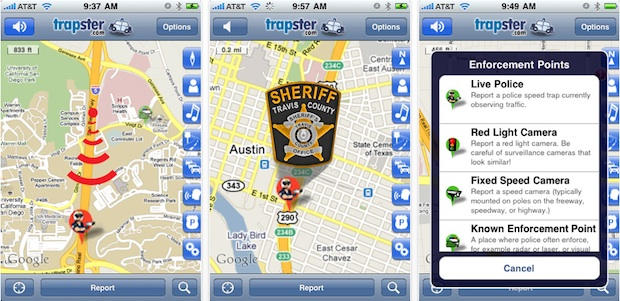
Trapster is a popular iPhone app that alerts drivers to police speed traps, red light cameras and DUI checkpoints. The company has tried to remove DUI checkpoints, but users kept putting them back in.

Trapster is a popular iPhone app that alerts drivers to police speed traps, red light cameras and DUI checkpoints. It’s attracting between 15,000 and 50,000 new users a day. Among those new users are are some of the most unlikely – the police themselves.

Trapster is partnering with several police departments to get cops to add their own traps to the database. The company is training cops how to use the software. The Travis County Sheriff’s Department in Austin, Texas, is already publicizing its use of the app, and the company expects to announce more partnerships soon.

“It’s more effective at slowing people down than issuing citations,” says Trapster founder and CEO Pete Tenereillo. “It’s not about revenue; it’s about enforcement.”

Travis County Deputy Tom Carpenter told a local TV news crew the same thing: “Our job is compliance, so if I can slow traffic down by just being there, that works too,” he says.

Tenereillo disclosed  more interesting facts: Trapster’s biggest competition is not nav apps, but Pandora. And even though navigation apps are popular, people hardly use them.

Police Offer DNA Kits to Curb iCrimes

By

post-34767-image-a4780a812aad3f72e336509450786895-jpg
Selecta's home DNA kit.

Police in rural England are offering kits that capture DNA traces so locals can mark high-tech valuables such as iPods in the hopes of preventing thefts.

The CSI-worthy plan comes from cops in Fleggburg, an idyllic-looking village of 909 people in Norfolk, England.

Similar to the home kit pictured above, the product made by Selecta consists of a water-based adhesive containing a locked-in DNA code, a UV tracer and a series of microdots which can be easily applied to property “such as a TV or an iPod,” police said.

The fluid marks the property with a unique code which is revealed when scanned with a UV light. The DNA marking allows police to place the burglar at the crime scene, which could increase chances of a conviction.

Daily Deals: $849 20″ iMac, App Store Freebies, MagSafe Adapters

By

cult_logo_featured_image_missing_default1920x1080

773166-large773166-large773166-large

We’ve reached mid-week with a number of Mac-related deals. First up is about nine iMacs from the Apple Store, including a $849 model with 20-inch screen and a 2.66GHz processor. Next we have a new batch of App Store freebies, including “Squism,” a puzzle game. We round out our top trio of deals with a bargain on Apple’s MagSafe power adapters for MacBook and MacBook Pro laptops. The 60-watt power adapters are priced at $35.95.

Along the way, we also take a look at MacUpdate’s Spring Bundle of Mac applications for $49.99.

As always, details on these and many other items are available at CoM’s “Daily Deals” page right after the jump.

Report: ‘Hundreds of Thousands’ of iPads Already Sold

By

CC-licensed. Thanks to Rego on Flickr.

Despite last-minute hang-ups on getting content onto the iPad, Apple has sold “hundreds of thousands” of the tablet devices since the Cupertino, Calif. company began taking pre-orders a week ago. The report seems to mirror a Venezualan blogger and analyst who predicted Thursday Apple will reach the 200,000 mark sometime today.

Apple could sell more iPads than it did iPhones during the same first three months, “people familiar with the matter” told the Wall Street Journal. Blogger Daniel Tello has said Apple could reach the 200,000 mark for online pre-orders of the iPad by mid-Friday. Tello, also known as Deagol, bases his estimates on order numbers buyers submitted since Apple unleashed pre-orders March 12. An equal amount of in-person pickups at Apple retail locations are also expected, according to Fortune.

The iPad is Coming, But Where’s The Content?

By

CC-licensed, thanks Richard-G on Flickr.

You may have beat the crowd to pre-order an iPad, but when you pick it up April 3, Apple still doesn’t know content will be available for it.

According to a Wall Street Journal report, Apple is “scrambling” to firm up content deals just weeks before the device ships.

All of the usual unnamed insiders say that Apple has had a hard time lining up TV programs, digital newspapers and other content before the launch as media titans weigh the advantages of jumping on the iPad bandwagon against the potential threat to current revenue streams.

Talks are still on, according to these Cupertino deep throats, to secure discounted TV shows.  iPad users would get $0.99 downloads instead of the $1.99 and $2.99 they pay now at the iTunes store. Deals with newspapers, magazines and book publishers have all been put on the back burner for now.

If the numbers insiders cited in the story are correct — hundreds of thousands of iPads have been pre-ordered and Apple could sell more iPads in the first three months than iPhones in the first trimester after debut– the content owners could soon be the ones scrambling.

What, if any, content do you consider essential for the iPad?

Via WSJ

Daily Deals: iMacs, iMacs, and iPhones – Oh, My

By

cult_logo_featured_image_missing_default1920x1080

770202-large770202-large770202-large

We start the day with two – count ’em, two – 27-inch iMacs. First up is an iMac Core i5 Quad running at 2.66GHz for $1,699. Next is a Core 2 iMac running at 3.06GHz, outfitted with 8GB of RAM for $1,899. If you haven’t found an iPhone 3G yet, AT&T is back with a $49 deal on an 8GB handset.

Details on all these and plenty other bargains are available at CoM’s “Daily Deals” page coming up right after the jump.

WSJ, NPR to Create iPad Web Sites with Limited Flash

By

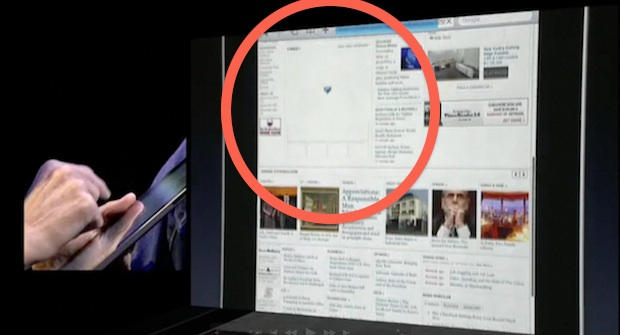
The iPad will notr support Adobe's Flash, which is widely used across the web for rich media. During Steve Jobs' introduction of the device, he loaded the New York Times homepage, which had a big blank spot where it's Flash movies are located.

At least two media sites are following Apple’s no-Flash policy when it comes to the iPad. The Wall Street Journal and National Public Radio have produced versions of their Web sites with front pages that do not require Adobe’s Flash, reports say. However, possibly more interesting is how publishers view the iPad experience differently than the iPhone. The iPad, it seems, has jumped that evolutionary hurdle from strictly a computing device to more akin TV.

Kinsey Wilson, NPR’s head of digital operations, told MediaMemo‘s Peter Kafka iPhone apps are a ‘very intentional experience’ where people actively search for information. That possibly is why pages on the NPR Web site deeper than the front page are customized for the iPhone.

What’s Next For the iPad? A Tabletop iPad, According to Xerox PARC Circa 1991

By

samsung_multitouch_board
A 50-inch multitouch screen from Samsung shown off at CES in 2009. These devices will soon be common, according to a visionary, 20-year-old report from Xerox PARC. Image: Engadget.

Way back in 1991, just as Apple was transitioning from 68k to PowerPC chips, the braniacs at Xerox PARC were predicting it’s entire iPod, iPhone and iPad strategy. And next up for the iPad is a blackboard-sized device.

Nearly 20 years ago, just as personal desktop computers were taking off, researchers at Xerox started thinking about the next stage: ubiquitous computers and the cloud.

They envisioned a range of always-connected devices that came in three basic form-factors: Tabs, Pads, and Boards. They are described thus in a Scientific American article:

“Ubiquitous computers will also come in different sizes, each suited to a particular task. My colleagues and I have built what we call tabs, pads and boards: inch-scale machines that approximate active Post-It notes, foot-scale ones that behave something like a sheet of paper (or a book or a magazine), and yard-scale displays that are the equivalent of a blackboard or bulletin board.”

The inch-scale “tabs” are Apple’s iPhone and iPod touch, plus smartphones from Google and Palm. The foot-scale “pads” are the iPad and the 50-odd tablets coming out this year. And next up are yard-scale “boards,” which will act a big-screen hubs in the home and interactive workspaces in the office. Microsoft’s Surface table is the best current example, but more big-screen devices are inevitable as component prices come down thanks to the flat-screen TV industry.

What’s amazing is how twenty years later PARC’s vision describes Apple’s transition into a “mobile” company with a range of devices accessing the cloud. It’s fitting that the vision that should come for the same lab that invented more-or-less personal desktop computing.

Via Adam Rosen: Ubiquitous Computing 2010 – Tabs, Pads, Books and Clouds.