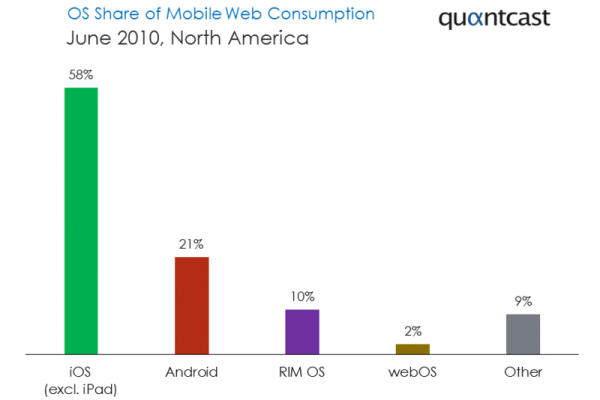
Although Apple devices, such as the iPhone and iPad are still more than half the web traffic, Google’s Android is coming on strong. According to Internet measurement firm Quantcast, Android devices comprise 21 percent of the web hits it detected. What could be even more troubling for the Cupertino, Calif. handset maker is that Android’s gains are now coming at the expense of the iPhone.
The flurry of iPhone 4 purchases in late June didn’t translate into greater Apple handsets online, Quantcast noted. Akin to a person trading in a car not signalling more autos on the road, “most new iPhones sold were simply replacing earlier models,” the measurement firm announced.
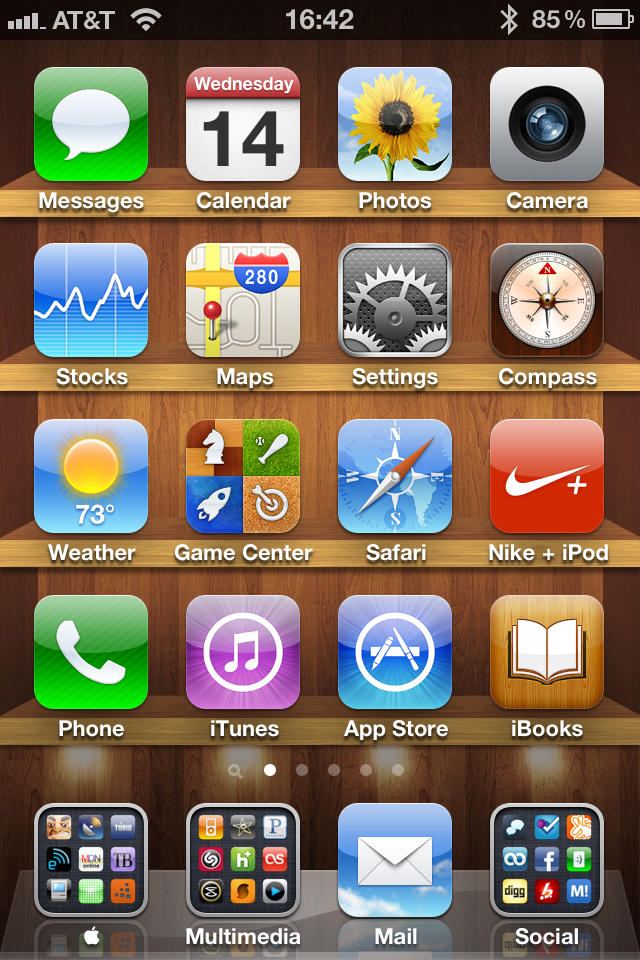
As you can see in the above screenshot, Apple has delivered on their improved signal bar graphics. Only time will tell if this is an actual indication of signal strength. Other noticeable changes include a revamp of the Game Center app, the ability to add FaceTime favorites and the Camera app (incl. camera roll) auto-rotating in landscape. More screenshots after the break.
This is the app every iPhone sold int he U.S. should come pre-installed with. There are probably good reasons — or maybe bad ones — why it isn’t; but it’s easily available, it’s free and it might just save you some money.
TeamViewer released their free app that lets a user remotely control any computer over the Internet (with permission) back in March for the iPhone. Yesterday, they brought out an iPad version.
While it’s a pretty cool app to have sitting around on an iPhone, it practically gains Essential Status on the iPad because of the latter’s much bigger screen, making remote-access sessions much easier than on the iPhone’s tiny screen — not to mention the fact that the iPad is the kind of tool that lends itself to functioning as a remote client.
As with the iPhone version, if you’re using the app in any sort of professional circumstance, TeamViewer ask that you purchase a $100 license.
We’ve heard for some time the iPad could eat into the Netbook market. Now comes Goldman Sachs with the 5 Cs of why the Apple tablet device will crush the inexpensive PCs.
First up is Consumption. It wasn’t by mistake Apple gave the iPad a big screen and no keyboard. Unlike the Netbook, the iPad is meant to mimic your TV, not the PC. You sit in front of your TV to watch, not create. That brings us to Goldman Sach’s second point: content.
The iPad is also all about Content. With a direct connection to iTunes, iPad owners can easily slurp up content from the App Store. “Apple has created an easy-to-use, direct conduit between users and a vast library of content that is custom-tailored for the iPad,” writes financial blogger Henry Blodget.
Unlike netbooks, which rely on spotty 3G or Wi-Fi connections, the iPad offers both to ensure the consumer is constantly connected. This only reinforces Goldman’s previous point of the iPad being all about content.
Again, differing from netbooks, the iPad is instantly available. Just image you have the urge to play a game or check out the news. You go to your netbook and wait up to a minute for it to boot-up. The iPad is instantly on, keeping that urge to buy or consume alive. What’s more, according to the analysts, the iPad’s battery lasts between twice or five-times that of a netbook’s.
Similar to instant-on, Apple has reduced the steps needed to purchase an item via the iPad to just one click. Because Apple stores all the credit card information at iTunes, you don’t need to enter that data and go through other steps which present opportunities to change your mind or back out of a purchase.
The 5 Cs of iPad domination: Consumption, Content, Connected, Constant-On and Commerce.
Ever since Apple purchased Lala late last year, iTunes users have been expecting to see their music collections make a jump to the cloud (often referred to as iTunes Live).
More surprising, though, is how many users are actively looking forward to a new, streaming iTunes: according to NPD’s polling of 3,862 iTunes users, about 25% are interested in a new streaming library function. Extrapolated upon iTunes’ population as a whole, that’s about 13 million users in the United States alone.
Even more interesting, according to NPD, is that roughly half of those users would be willing to pay up to $10 a month for the service, providing it supported multiple devices. That’s about 7 to 8 million iTunes users, adding up to a billion dollar market in the first year.
I was hoping that whatever form a streaming iTunes took, it would be free, but obviously that’s wishful thinking: Apple’s already got a huge number of users chomping at the bit to stream their entire libraries wirelessly to all of their computers and iOS devices. Of course they’ll end up charging.
My big question is what this means for Apple’s iPod-line. If iTunes goes into the cloud this year, does this mean we can expect a 3G-capable iPod Touch at this year’s September iPod event? In the context of a streaming iTunes, the lack of an always-connected iPod in Apple’s device line-up seems like a hole that would need to be filled.
The iPhone 4’s reception issues may get all the press, but there may be another big issue when it comes to iOS 4: a growing number of users are reporting that upon upgrading any iPhone to iOS 4, the performance and audio quality of Bluetooth headsets is vastly degraded.
The symptoms vary, but are usually reported as sounding “muffled,” “like you’re in a tunnel” or “far away” when using a Bluetooth headset with any iOS 4 device.
We are aware of and concerned with the user frustration surrounding the issues affecting all Bluetooth devices (headsets, car kits, and speakers) connecting to the iPhone 4 and iOS4 updated phones. We know users have come to expect the freedom of hands-free and we are working night and day with our partners, Apple and AT&T, to resolve the issues as quickly as possible.”
It’s now been three weeks since iOS 4 went public, and I honestly can’t imagine going back to my past iPhone existence. Folders alone have simplified my life so much that I can’t remember how I ever dealt with seven screens of apps instead of two. Without a doubt, it provides a dramatically superior user experience to iPhone OS 3.1.2 on the 3GS (your mileage may vary on the 3G), as I noted in a review last month.
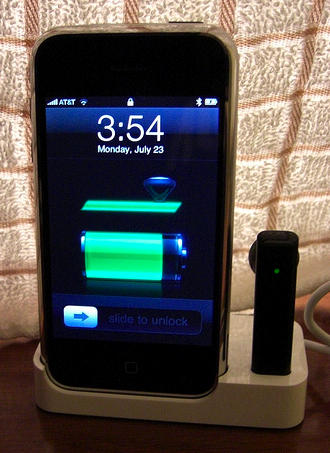
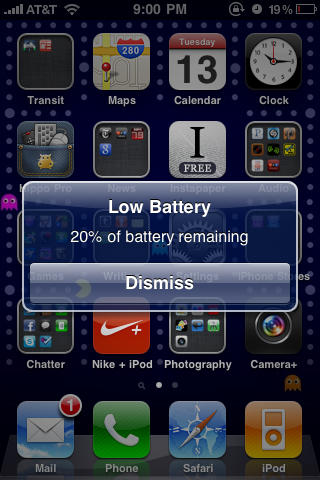
But that doesn’t mean that everything is perfect. You see, a flaw that wasn’t evident during the beta phase of iOS 4 has become abundantly clear as the majority of my apps have been upgraded for multitasking: keeping background apps in memory for fast app demolishes iPhone 3GS battery life. For all of Steve’s promises to deliver multitasking without battery problems, I now have to charge my iPhone by 8 p.m. to keep it functional through the evening, which I never did before. Without changing my behavior in the slightest — nor even using more advanced multitasking like background third-party audio and VoIP, my phone now needs its charger around at all times.
And, unfortunately, it’s just the tip of the iceberg for the issues found on any 3GS running iOS 4 as it’s meant to be.
This is a guest commentary by Bryan J. Ball, a stand up comedian and long-time Apple fanboy.
My relationship with Steve used to be such a happy one. He would create beautiful bits of electronic amazement and I would buy them, show them off and feel generally superior to my non-Apple friends and family. That’s still mostly true but I’m starting to have my doubts.
My life is pretty Apple-centric. I have an iMac, an iPad, all manner of iPods and I was literally first in line to get an iPhone 4. I’ve been pretty happy with everything I’ve had so far. My area has excellent AT&T coverage so I’m not even plagued by the death grip reception issue on my iPhone.
Yes… I’ve been called a fanboy on more than one occasion. I used to categorically deny this but after watching Steve Jobs’ behavior and listening to myself defend it over the last couple of weeks, I’m starting to wonder.
Way too little, way too late: speaking at the opening keynote at the Worldwide Partner Conference, Microsoft CEO Steve Ballmer told his audience that we should expect Windows 7 tablet computers “sometime before the end of this year.”
“We know you really want to know what’s coming,” said Ballmer. “[Tablets] will come from the people you would expect. From Asus, from Dell, from Samsung, from Toshiba, from Sony.”
Microsoft just doesn’t get it. Their business is software, so it’s understandable they are focusing on selling a tablet operating system instead of a single iPad-challenging tablet themselves (even if that business model is so stagnant that it has directly contributed to the death of possibly revolutionary products).
The problem is: Windows 7, as an operating system, isn’t capable of taking on iOS. One was built from the ground-up to support multitouch; the other is a bad hackjob rlaid on top of a desktop operating system.
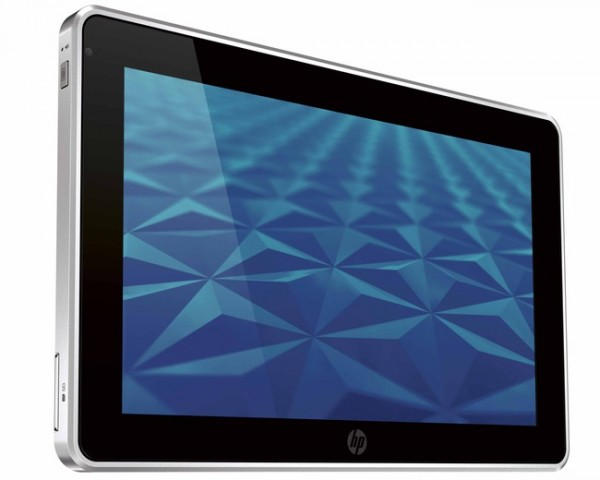
HP knows full well that Windows 7 isn’t up to the job of taking on iOS: that’s why they killed the Windows 7 Slate and purchased Palm’s mobile, multitouch operating system, webOS. It’s only a matter of time before Microsoft’s other hardware partners get the same memo.
At the end of the day, Microsoft is going to enter the slate arena several years late, just like they did with Windows Phone 7. How can a company this hopelessly entrenched in the business models of the past hope to survive when the likes of Google and Apple are swimming in the same waters, faster, stronger and smarter?