As the week winds down, we offer three deals for Mac fans on the go. First up is Apple’s Nike+ armband for the iPod nano. For iPhone owners, we have Morphie’s JuicePack charging case battery pack for your handset. The unit provides 270 hours of standby or 4.5 hours of talk. Finally, if you are heading out but not certain how to get there, there is NAVIGON’s MobileNavigator app for the iPhone.
Like always, details on these and many other bargains (such as Gameloft’s iPhone apps, including “Earthworm Jimmy”) are available on CoM’s “Daily Deals” page right after the jump.
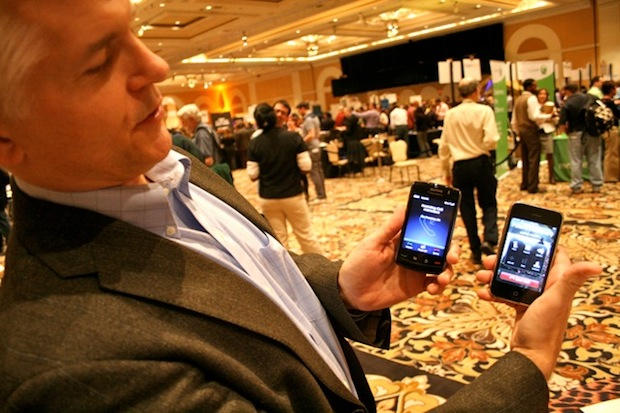
Toktumi CEO Peter Sisson demonstrates his Line2 app, which adds a second phone number to the iPhone. The app is now available for the iPod touch, turning the device into a sophisticated softphone.
Apple seems to be changing its tune on VoIP apps for the iPod touch. Less than a week after it was submitted, Toktumi’s Line2 VoIP app has been approved by Apple. The $14.95 a month app turns the iPod touch into a fully-featured telephone.
“Interesting was how quickly it was approved – less than a week from submission!” says Toktumi’s founder and CEO, Peter Sisson. “I think its an important development.”
Already available for the iPhone, Toktumi‘s Line2 app joins Skype and Truphone For iPod on the touch, but boasts more features, Sisson says. As well as unlimited U.S. and Canada calling and low international rates, the app has a host of “professional-grade” features, such as call waiting, conferencing, call transfer and visual voicemail.
“It turns the iPod touch into a serious telephone,”Sisson says. “It’s a real telephone. You use it over Wi-Fi and you’re spending $15 a month and that’s it.”
In January, Apple approved an update of the Line2 app on the iPhone to make and receive phone calls over a 3G or WiFi. The approval was in stark contrast to Apple’s earlier stance on VoIP apps, which seemed hostile. Apple’s position was highlighted by the spat over Google Voice, which Apple still hasn’t approved for the App Store.
On the iPhone, the Line2 iPhone app provides with an additional number. It’s pitched at business users as a way of separating business and personal calls.
It also provides a host of advanced, business-oriented call control features like caller-specific call forwarding, after-hours settings, voicemail by email and an auto-attendant (“Press 1 for…”). And it can be used to avoid roaming charges when travelling overseas.
Avaliable as a free 30-day trial, Line2 is $14.95 a month, pay-as-you-go. Here’s the iTunes Link.
Hit the jump for a couple of videos showing how it works.
There’s been a tremendous amount of peek-a-boo over racy apps in the iTunes store lately. Following a purge of apps with names like Epic Boobs — which once squeezed their way past censors — some of them were re-instated.
Most of the offending apps, however, were produced by small shops. The hotties available on the iTunes store from big franchises — like Playboy and Sports Illustrated — were left untouched.
In this now-you-see-it-now-you-don’t fest, Apple, however, seems to have ignored an implicit gentleman’s agreement with German publisher Springer.
Springer owns tabloid Bild whose “Shake the Bild Girl” app undresses women with a shake of the device, leaving them naked, like the babes featured in the print edition.
Apple now wants them to remove the Teutonic ta-tas from the app — leaving the women in bikinis — raising the ire of the publisher. Springer reportedly sold 100,000 downloads of the app which costs €1.59 a month ($2.15, circa), also available with a PDF edition of the print tab for €3.99 ($5,40) a month.
“Today they censor nipples, tomorrow editorial content,” Bild Digital CEO Donata Hopfen told local media.
Speculation over whether or not Verizon will get a contract to sell the iPhone is pointless. But no matter the outcome, Apple is on track to sell at least 35 million of the iconic handsets in 2011, an analyst told investors Friday.
Merrill Lynch analyst Scott Craig said selling 33 million iPhones this year is “basically achievable” this year, no matter if Verizon becomes the second handset carrier this year or AT&T remains Apple’s exclusive carrier throughout the remainder of 2010.
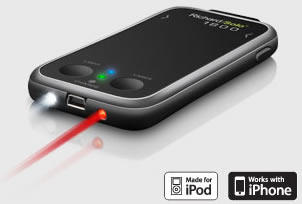
iPhone Battery charger with flashlight & LED from RichardSolo
Back in the mists of time at the dawn of the Gadget Age, Richard Thalheimer’s Sharper Image was one of the more highly regarded purveyors of well-made, interesting and sometimes even useful products for the discerning gadgeteer. Starting out as a catalog selling jogging watches in 1977, The Sharper Image eventually grew into a heavy hitting company selling high-end consumer gadgetry through dozens of retail stores throughout the US as well as its monthly catalog and website, before imploding in bankruptcy in 2008.
The end for The Sharper Image was drawn out over a couple of years and after being forced from his position as CEO in 2006, Thalheimer founded RichardSolo, an online venture completely unrelated to The Sharper Image, in 2007. Recently RichardSolo debuted its own line of portable charging solutions for iPhone, iPod and other smartphones, proving sometimes it’s smart to dance with the date that brung ya.
The RichardSolo lineup is eerily reminiscent of items that might have been found at The Sharper Image back in the day, updated of course to reflect technology’s advances: in addition to chargers, there are cases, speakers, docks headsets and personal stereo devices, all in the $29 to $199 range and all featuring a design aesthetic positioned to lend the buyer a claim to a certain degree of coolness. Beyond the realm of personal gadgetry the company offers everything from massage chairs to body monitors to travel and Earth Friendly items. And yes, even jogging watches.
Yesterday, Cupertino surprised everyone by throwing a bonafide legal temper tantrum about rival handset maker HTC’s alleged infringement on up to 20 Apple patents.
Although Apple is targeting HTC, the takeaway here is clear: Apple’s going after Android, HTC’s bread-and-butter. Google recognizes this, and is standing in solidarity with HTC.
As Apple fans, it’s easy to lose sight of the big picture here. Competition is good for the consumer, and Android becoming a credible threat to the iPhone’s dominance will only make the iPhone cheaper and better for consumers in the long run.
There’s other aspects that make this sort of patent battle bad news for consumers though. The New York Times Bits blog asked some IP experts on the possible ramifications of the Apple-HTC patent dispute, and according to Harvard Law School professor Jonathan Zittrain, if Apple wins, we could see the courts order HTC to hit the kill switch on their Android phones, just like what happened in the TiVo/EchoStar lawsuit of 2004.
Apple’s App Store Approval Process is often too arbitrary or subjective by half, but no matter how you feel about the latest app rejection to storm the newsfeeds, at least their rationale makes sense: QuackPhone, an app developed by Nick Bonatsakis of Atlantia Software, was rejected for “containing minimal user functionality.” In other words, the app — which made your iPhone quack like a duck — just didn’t do enough for Apple’s tastes.
From a critical perspective, it’s hard to argue with that logic: the App Store is already distressingly filled with lazily programmed and tasteless sound board apps that will allow your iPhone to simulate everything from the sound of a braying jackass to the flatulation of a loose rectum. A higher signal to noise ratio on the App Store is in everyone’s best interests.
But while most people can probably do without these kind of apps, the real issue with Apple rejecting them outright is the old slippery slope argument: exactly how much “functionality” does an app need to have to be approved on the App Store, and isn’t this sort of rejection just really a veiled editorial move on Apple’s part? If an app is open and honest about what it does, who is Apple to say that its users aren’t allowed to use it? If iPhone owners want their handsets to quack like a duck, just what’s the big deal, outside of Apple’s own arbitrary distaste at the concept?
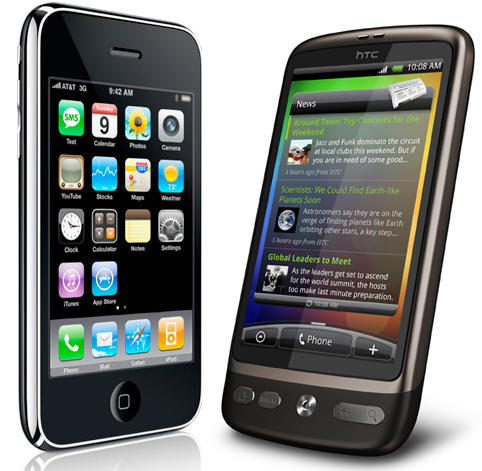
Apple is again back in legal headlines, Tuesday suing handset maker HTC for allegedly infringing 20 unspecified iPhone patents. HTC has designed a number of smartphones powered by Google’s Android mobile operating system.
The lawsuit, filed with the U.S. International Trade Commission and in the U.S. District Court of Delaware, points to the iPhone patents covering user interface and associated architecture and hardware, reports said.
Apple’s latest iPhone ad “Family Travel” follows the app-heavy formula of the most recent iteration of the campaign but adds a Mom’s gushing narration mix to make its point: the App Store is pretty neat.
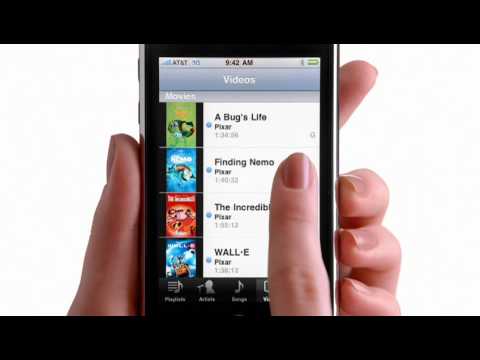
The premise of the app is that the iPhone works as a veritable Swiss Army Knife for traveling Moms. “It’s unbelievable how much better family trips have gotten!” Narrator Mom enthuses, as she demonstrates using the SouthWest Airlines app to check on her reservations, find a place to eat at the airport with Gate Guru, checks if she turned the lights off with the Schlage Link app and then finally hands her iPhone off to the kids so they can watch Pixar’s FInding Nemo to the flight.
It’s a pretty standard iPhone ad, interesting mostly because of how synonymous the iPhone is with the App Store at this point. Most of the iPhone “features” that Apple advertises these days are third-party software: the iPhone, as far as its advertising campaign is concerned, is pretty much defined as a product by the App Store. Apple is essentially advertising a platform instead of a product, and it’s simply amazing to me that two years ago that platform just didn’t exist.
After January 27th’s unveiling of the iPad, it became abundantly clear that Apple has meaningful plans for iPhone OS outside of the smartphone arena. In fact, given the App Store’s runaway success, it’s just good business sense for Apple to try to get iPhone apps on as many devices as possible: not just phones, portable media players and tablets, but more traditional laptop and desktop machines as well.
The question is, then, when will OS X and iPhone OS begin to converge? When will OS X become compatible with iPhone OS?
In a recent New York Times blog post, Nick Bilton examines this very question, and talks to a former senior Apple Engineer to get to the bottom of whether or not iPhone apps could run natively on OS X one day.