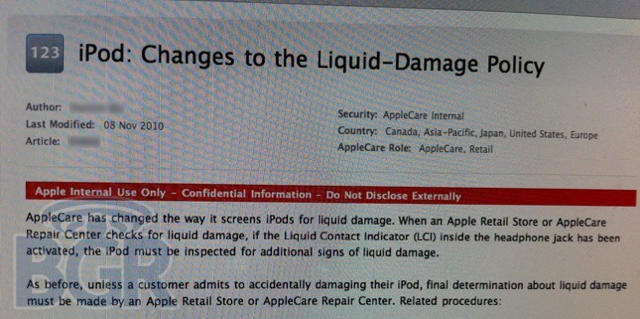
The new MacBook Air has the highest number of liquid contact indicators, or LCIs, of any Apple product yet… little stickers that tell a Genius if it’s okay to deny you service on your broken gadget because you dropped it in the drink.
LCIs have always been troubling, since they tend to trigger by humidity alone, making Apple gadgets a risky investment for those who live in the tropics. Apple’s actually been sued about false LCI reports, so the fact that the new Air had so many of them was particularly worrisome: it seemed like Apple was just chomping at the bit to deny you service on the notoriously hard-to-service Air.
However, things may not be as clearly conspiratorial as that.
The Businessman works hard, and he relies on his stuff to get him through the day. Make life easier both at home and on the road for the Businessman with these Wall Street-worthy gifts.
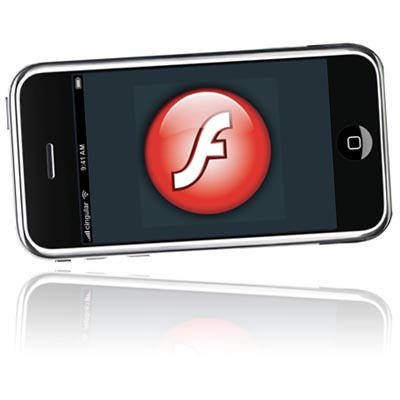
I don’t many people who have disputed Adobe Flash Player’s impact on battery life — especially since Ars Technica discovered that merely having Flash installed on the new MacBook Air took two hours off the battery life — but nonetheless, Adobe CTO Kevin Lynch thinks it’s somehow indicative of a coordinated Apple plot to put them out of the business of interactive web content.
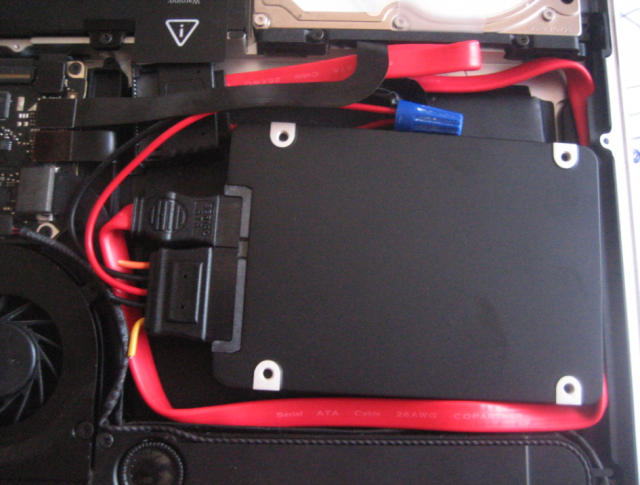
The Solid State Drive, or SSD, appears to be the future of Apple devices, including the recently updated MacBook Air. Toshiba, the maker of the SSD in the razor-thin MBA is making the Blade X-gale series more widely available. The drives – just around 2.2mm thick – are available in 64GB, 128GB and 256GB configurations to resellers and bulk purchasers.
“Delivering a product that enables superior user experience in a smaller footprint is the ultimate goal,” said Scott Nelson, vice president, Memory Business Unit, Toshiba America Electronic Components, Inc. A denser memory module permits the smaller size, Nelson explained.
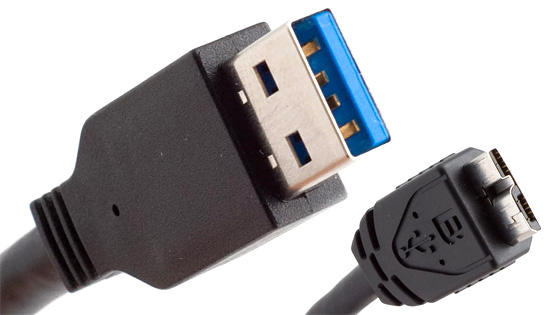
Apple’s not ready to throw their hat into the USB 3.0 ring just yet. As Steve Jobs made abundantly clear in an email last week, Cupertino’s doesn’t see USB 3.0 taking off, at least until Intel starts officially supporting it… and evidence suggests that Apple might avoid USB 3.0 entirely in favor of Light Peak.
But what if you want USB 3.0 on your Mac now? Well, Apple’s not serving up official drivers yet, but LaCie’s stepping up to fill the void: they’ve just announced USB 3.0 drivers for their line of solutions.
To get USB 3.0 on your Mac, first you’ll need to buy one of LaCie’s cards: either a $49.99 USB 3.0 PCI Express Card or the $59.99 USB 3.0 ExpressCard/34, both of which will bring a couple of USB 3.0 (and backwards compatible USB 2.0) ports to your Mac Pro or MacBook. Then install the free driver and you’re ready to pick yourself up one of those blindingly flash USB 3.0 external drives that are all the rage right now.
Not a bad solution for Mac Pros, but ExpressCards can be fairly irritating to have hanging out of a MacBook, and obviously this won’t help you if you’ve got a MacBook Air, Mac mini or iMac. Still, if you’re committed to being on the cutting edge, LaCie’s happy to take your cash and make it happen.
Here’s a simple how to that will lead you and your computer to an internet without Flash just like on your iPhone, iPad, or iPod touch. I think most of you won’t miss it, but if you do you can reinstall it.
I’ll have to say that when I went cold turkey and kicked the Flash habit, that I’ve had for years, I didn’t suffer from withdrawals. In fact, I found my browsing experience with Safari to be a whole lot better and definitely more stable than before. I don’t have any regrets about it so far.
Some people might recommend, ClickToFlash, which is a Safari plug-in that blocks flash content and doesn’t allow it to run unless you allow it or you add specific sites to a “white list. ” It’s a great plug-in, but I prefer to use fewer plug-ins and no Flash. You on the other hand might think otherwise so ClickToFlash might worth a look for you.
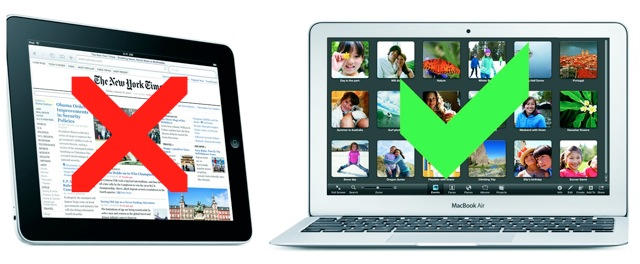
In short: the iPad was a nice portable computer, but the Air is better. It offers more flexibility and freedom. The iPad was a good solution but bulky (because Riegler was toting a keyboard for it too), and sometimes – not often – he found himself wishing for a plain old USB port, or the chance to see something in Flash.
An analyst Tuesday issued a very bullish prediction for iPhone and iPad sales next year, double that of other onlookers and following lower-than-expected fourth-quarter sales. Wedge Partners analyst Brian Blair believes the Cupertino, Calif. company will sell 100 million iPhones and up to 48 million iPads in 2011.
While Blair admits the sales estimate is a “staggering number any way you look at it,” he insists Apple is prepping for a “nearly 100 percent year-over-year growth for iPhone” next year. By comparison, Oppenheimer analyst Yair Reiner believes Apple will sell 52 million iPhones and 23 million iPads during 2011. On the low end, following lower than expected fourth-quarter numbers, Needham & Company analyst Charlie Wolf predicts Apple will sell only 18 million iPads, but cautioned even that figure may be too high if tablet distribution doesn’t increase.
Unkrich during production of "Toy Story 3" in November 2009 (Photo by Deborah Coleman / Pixar)
This is a guest interview by Mike Bastoli of The Pixar Blog, a popular news blog about the studio.
Lee Unkrich is the director of Disney-Pixar’s Toy Story 3, the highest-grossing animated film of all time, which was released on DVD, Blu-ray and iTunes today. He also served as co-director of Toy Story 2 and editor of Toy Story, and is a member of Pixar’s Senior Creative Team.
Unkrich is an avid Mac user and Apple ‘addict’ who can be spotted at Apple’s events from time to time. “Whenever I’m invited, it’s something awwwwwwesome,” he tweeted to his 80,000 plus followers on Twitter ahead of the launch of the iPad in January.
Here’s an exclusive interview with Unkrich, who talks about his first Mac, Apple cameos in Pixar’s movies and Steve Jobs feeding his Apple addiction.
Apple’s massive new data center is a 21st-century broadcasting system to rival the TV networks of old, says a leading expert in cloud computing.
Nick Carr, author of the “The Big Switch” a bestseller about the cloud, says Apple’s North Carolina facility is a “broadcasting system” not unlike NBC or CBS, but one that distributes software as well as media.
“Apple increasingly views its mainstream computers, from iPod Touch to iPhone to iPad to MacBook Air, as media players, with “media” spanning not just audio and video but also apps,” Carr wrote in an email. “From that perspective, the North Carolina data center can be seen as essentially a broadcasting system that will enable Apple to make the shift from a downloading model of media distribution to a streaming model. It’s a proprietary broadcasting system (not altogether unlike traditional broadcasting systems), which means it’s a very different model of the cloud from the open model promoted by Google.”
At 500,000 square feet, Apple’s $1 billion data center will be among the largest in the world. The unusual size of the data center suggests that Apple has ambitious plans for cloud computing.
It’s assumed it will be used to stream music and movies from iTunes. Reports suggest the company is going to build a big office complex next door and is “going after the cable market.”
But it goes deeper than that, says Carr. The facility will help transition Apple from a download model of computing to a streaming model of computing.
Here’s what else he had to say about Apple’s unique take on the cloud: