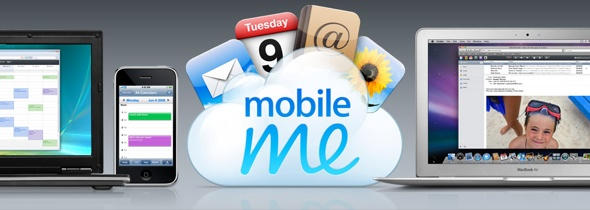
For a Steve Jobs Keynote, the kick-off to last week’s Worldwide Developer Conference was surprisingly, well, surprise-free. Apple rumor-mongers nailed the specs on the iPhone 3G, the pricing, the slipping ship date, and even the launch of Mobile Me, a major redesign of Apple’s .Mac service that focuses on Push technology for the rest of us. For subscribers of Mobile Me, all you have to do is make a change to your calendar on one platform, whether Mac, PC or iPhone, and the change instantly occurs on your other machines. Apple was going to become the Push company.
Phil Schiller demoed the applications involved, from photos to e-mail to address book for almost a half-hour, repeating the phrase “desktop-quality applications” roughly 900 times. As promised, the apps instantly updated across platforms. The Push technology really works, as well as, or, Apple hopes, even better than Microsoft Exchange for corporations. In every respect, it looked like a winning platform. For $99, anyone can have world-leading syncing of their entire digital lives. There’s just one problem: you have to use Apple’s Web applications to do that. No GMail, no Flickr, no GCal, no Facebook. Rather than delivering on the promise of automating the process of keeping every aspect of your life up to date, Apple requires you to leave behind your existing digital life to build a new one. Unless you’re an existing .Mac user, you need a new e-mail address, a new online photo gallery, a new calendar, a new form of online storage. And I, like a lot of people, am not going to make that change. I love Google Apps, Flickr, and Facebook. They’re where I keep my stuff. And that isn’t going to change any time soon. Rather than Mobile Me, Apple seems to have created Mobile Steve. To see the implications of this decision, click through.
Take calendaring. GCal has done everything that Phil Schiller demonstrated, minus the Push syncing, practically since the day it was introduced. And because it has a relatively open API, it has hooks to sync it with all kinds of different stuff – including Exchange. Google even makes a little tool for cell phones called Google Sync that brings push syncing between a Google calendar and my BlackBerry’s calendar (which push-syncs to my work’s Outlook calendar). The same works for GMail for mobile. And it’s all free.
Apple’s insistence on foisting its adequate but far from market-leading web applications on Mobile Me users is tremendously disappointing. The company is just not poised to create, maintain and dramatically update its own compelling web services. It does not have the tools to compete with Google and Yahoo on their turf. Instead, Apple should focus on its strength — putting a friendly, intuitive face on ugly technology. Take Mobile Me and use it to help people hook all of their myriad web services together into a lean, mean fighting machine. Help Flickr talk to iPhoto talk to GMail talk to Facebook talk to GCal talk to iCal talk to Jaiku talk to WordPress. Make the cloud accessible, but acknowledge that people enjoy choosing their preferred tool for a particular task instead of building all of them.
What Apple doesn’t grasp is that the real opportunity for the company isn’t in becoming a web services also-ran. In today’s Internet, we have no shortage of good web services. What we lack is an intelligent unifying technology to make them play nicely today If Mobile Me made sense of the twenty-odd Web 2.0 accounts that I had, I would subscribe in a second. Instead of focusing on expensive to develop Apple-only web services, just link together the fragments we leave online, and charge $50 for it. That would be compelling. I would sign up immediately, even before I finally pick up an iPhone.
But that’s just not the Apple way. In spite of a few signals of increased openness, Apple’s default approach is to build a mostly closed shop. The company doesn’t like to compromise on quality or consistency of look and feel. Working well with Google, Yahoo, and Facebook would lose Apple’s vision, which company leaders can’t live with. So they built their own elegant and, I fear, underpopulated playground. Even on the wide-open web, Apple distrusts anything that’s not invented here.

Pete Mortensen is a design strategist for consulting firm Jump Associates and the co-author of Wired to Care: How Companies Prosper When They Create Widespread Empathy, a book and blog that are significantly more interesting than you might initially think. Pete’s particular Apple avocations are both around design–interface and industrial. Follow him on Twitter!