
It’s been Apple against the world for so long that we’re kind’a just used it being that way. However, when we compare Apple against her chief rivals, as well as against some entire industries, a different picture emerges.
Looking at our favorite company in this light maybe helps us understand parts of Apple’s strategy that seem confusing if not just downright bizarre. Follow us after the jump and we’ll discuss why, when we talk about Apple vs Microsoft, Dell or the entertainment industry at large, this ain’t a David versus Goliath matchup anymore.
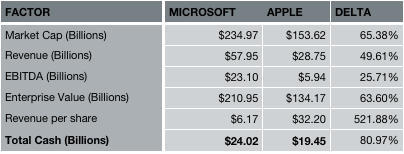
Remember the house joke is that Microsoft is the Borg, they’re ginormous, yet on most KPI’s Apple is a better than half the size of Microsoft. The Borg’s sky-high EBITDA is understandable; they’re a software company, and margins on software are higher than on consumer products. But what is really shocking is looking at cash on hand; Apple and MS are virtually on par with each other here.
Now lets look at former rival, Dell:
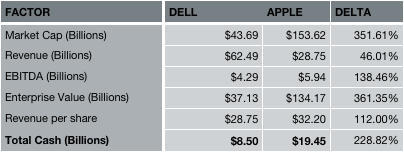
That’s just staggering. Dell’s claim to fame is efficiency, yet while having twice the revenue as Apple, Dell still under performs in every other KPI.
So what does this mean to Apple’s Business Strategy?
The questions we hear all the time: Why doesn’t Apple grow faster, why don’t they focus on the Enterprise, why not buy Adobe, why not open the OS, why don’t they enter into (fill in your favorite here) market?
The answers to these “Whys“ become pretty clear once we see where Apple really is, and how they got there.
Slow and Steady wins the Race.
Apple’s growth since the Return of Steve has not been explosive; it’s been one of steady growth, even when market forces were eroding their competitors. While Dell has been squeezing vendors, their rapid growth in the 90’s caused their internal support staff to balloon into a monolith. Apple’s disciplined slow, steady growth pattern has reduced the growth of internal bureaucracy, while they continue to manage vendors.
Expect more of the same. Despite their cash on hand, no buying Tivo or Circuit City/ Blockbuster, instead focusing on internal R&D and small point acquisitions.
The Anti-Microsoft Approach to the Enterprise
Microsoft’s Developers, Developers, Developers motto is more than just the chorus of the Monkey-Boy Dance. It has been the foundation of their business strategy for 15 years. Visual Basic was the Plymouth Rock of this strategy. It enabled developers to create productive business applications quickly and easily. From this MS has grown into a suite of platforms that makes them appear intractable from the enterprise.
Not so.
Someone in Cupertino has been reading their Sun Tzu: Fight your enemy where they are not. There are two routes into the enterprise: Developers and End Users. Trust me here: End Users are a MUCH more compelling force.
True Story: in my last gig as a CTO of a large bank, I switched the whole of the executive team to Macs because the CEO’s college age daughter had one and he liked it so much he insisted that we switch.
Build, Refine, Dominate, Refine More.
This has been Apple’s strategy from the get-go. They enter a segment, they refine their position in that segment, and then they dominate the segment and then continue to innovate. Examples: iPod, Multimedia, (Final Cut, Logic Pro, etc), personal creativity (iLife).
Expect exciting things in the emerging segments of productivity and mobility. iWork and Filemaker Pro / Bento will continue to evolve, until they are something more akin to Final Cut Studio, rather than iLife. Similarly, iPhone is merely the first hit in the mobility game that will likely culminate in a true cloud computing based mobile platform with a variety of devices.
No opening of the OS.
Opening the OS is a non-starter for Apple. It would be dilutive to their core revenue stream, as well as opening up a Pandora’s box of troubles. One could argue that the new revenue streams might offset the bottom-line ding, but there’s no arguing that supporting the Tower of Babel of PC hardware would be problematic, and the hit to the “goodwill” of the company in the form of customer satisfaction would quickly erode those gains.
That said, 33% is the magic number. After Apple passes one-third market share they’re going to start getting pinged for their “closed-ness” Their total control over the whole platform that makes the Mac awesome today will begin to look anti-competitive in the future (look to iPod / iTunes lawsuits for examples). Their allowing other OS’s to run on Mac hardware provides them some Kevlar on this account but not much. Mark my words: there will be calls to open the OS up to other platforms.
The solution: Look for “Unbreakable OS X“. A version of OS X that runs on native Apple hardware, and / or licensed 3rd party hardware configurations, and an “Open OS X“ variant, without the support, or claims of bulletproof-ness of the current version.
Apple’s Media Strategy
There has been so much hoopla of late regarding iTunes, DRM, music companies moving to Amazon, movie downloads, lawsuits and etc, it’s worth putting a bit of perspective on the topic.
- Total US and Canada Box office revenue for 2007: $9.6 billion.
- Total US Music Industry Revenue for 2007 (inc. digital): $10.4 billion
- Total iPod Sales in 2007: $10.7 billion.
I’m sure Steve is laying awake at night pondering the threat from the recording and movie studios when his company is worth eight times more than their US sales combined, and iPod sales alone are greater than either one individually. I’m sure he’s equally concerned about the lawsuits and EU investigations into the so-called iTunes / iPod monopoly.
The point: Apple could turn the iTunes store into a non-profit and give away at cost music downloads (nothing anti-competitive there is there European Union regulators?) and there’d be no dint in the bottom line. Heck, iPod sales would skyrocket as a result.
What’s this mean for the Cult?
Well as I wrote a while back, we’re on the verge of becoming a mainstream religion and I’m not totally sure if that’s a good thing. Nevertheless, were going to have to give up the underdog mentality because by all evidence it turns out we’re the top dogs after all.

Leigh McMullen leads the Advisory Services & Strategy practices for the professional services arm of one of the Big-Five firms. He has written several books that would cure any insomnia you might have, and is an avid Mac junkie.

