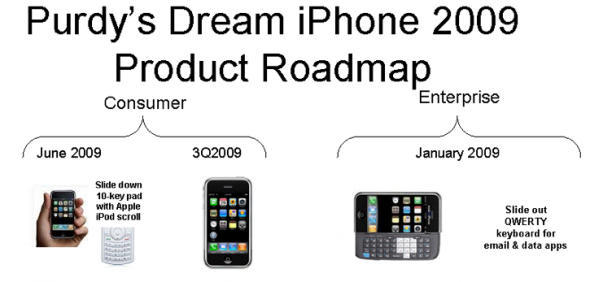
Gerry Purdy, a veteran mobile analyst with Frost & Sullivan says the next generation or two of Apple iPhones will have to adapt to different user requirements as Apple builds the franchise to address its growing audience. In a recent report to clients, he cites the many shifts Apple made in the iPod family to cater to different users, saying we can expect it will do the same with the iPhone.
Specifically, Purdy sees the phone being spun into separate consumer and enterprise models, with the consumer device focused on multimedia and ease-of-use features, while enterprise customers will get a phone that offers more ways to work with data and interact with enterprise services.
In all models, Purdy recommends that Apple add a small infrared (IR) transmitter so that future iPhones can be used as a universal remote in the home, a micro scanner so that all 1-D and 2-D bar codes can be easily read (useful for both consumers and enterprise customers), and a Near Field Communications (NFC) chip so that all iPhones can be used at retail to ‘swipe’ by credit card payment terminals. He agrees software would be necessary to make these three additions work properly, but sees the App Store and Apple’s iPhone development partners provide multiple solutions to those problems.
Another recommendation he has for all models is that Apple ‘open up’ the iPhone by adding a microSD slot that would allow users to add peripherals or more storage.
Purdy would like to see an iPhone “nano” that retails for $99 and an “extreme” version of the phone with an 8 megapixel camera and 32GB of storage for $499.
“What’s fun about doing a product roadmap for another company is being able to pretend that you’re working for them and that you’re in charge of Product Marketing,” Purdy says, adding, “of course, Apple’s Product Marketing team might feel differently about what they believe customers want and what they plan and will offer over the next year or two.”

Lonnie Lazar is a writer-musician-web designer-attorney. He writes about Apple for Cult of Mac and Mac|Life, and about VoIP and telecommunications for Voxilla. Follow Lonnie on Twitter @LonnieLazar, join the Cult of Mac on Facebook, and find Lonnie’s photos on Flickr.