The App Store ecosystem generated more than $1.4 trillion in developer billings and sales during 2025, Apple said Thursday. The figure nearly triples what the platform posted in 2019 and underscores how central the App Store has become to digital earnings. And artificial intelligence-boosted apps played a huge role.
AI apps fuel record App Store developer earnings
The newly released App Store sales and billing numbers come from a new study commissioned by Apple and conducted by economists at Analysis Group. Notably, developers kept the lion’s share of that revenue: more than 90% of billings and sales carried no Apple commission at all, the iPhone giant said. This sounds like good news for all those developers looking forward to next week’s massive developer conference, WWDC26.
AI reshapes the top of the charts
The major finding for Apple users comes in the accelerating role of artificial intelligence. More than 40 of the App Store’s top 100 apps now feature consumer-facing AI capabilities. Think personalized health recommendations, AI-powered photo editing and productivity tools that handle complex tasks automatically. Those AI-forward apps grew their billings four times faster than other top-100 titles in 2025.
Apple’s Foundation Models framework is central to that shift. By tapping the on-device large language model that powers Apple Intelligence, developers can build AI features that work offline, protect user privacy and run without any inference costs. Meanwhile, Xcode 26’s new agentic coding tools let developers move faster than ever, handling more of the repetitive build-and-test work autonomously so creators can focus on the ideas themselves.
Where the money actually flows
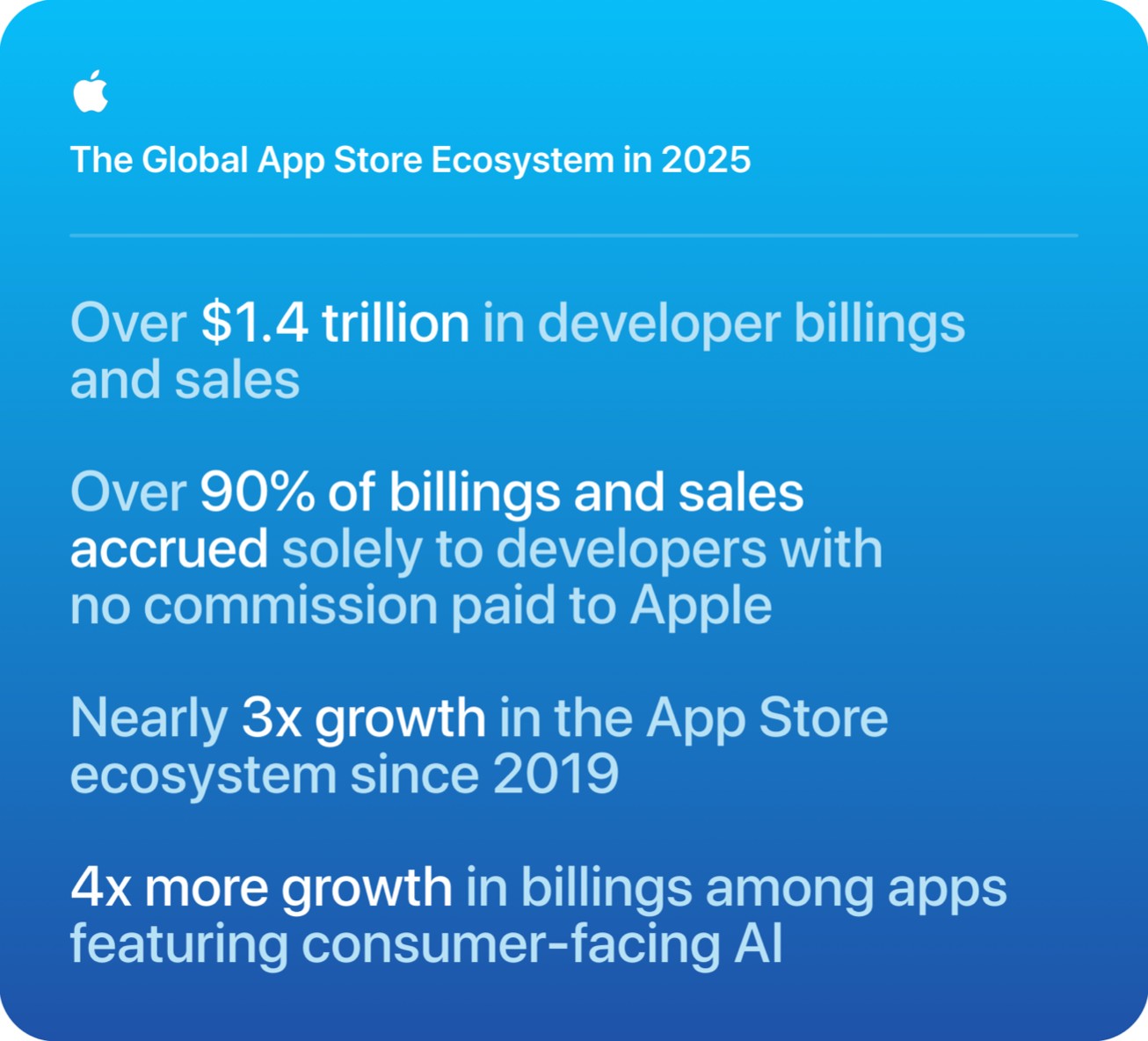
Photo: Apple
Physical goods and services dominated the ecosystem, accounting for $1.1 trillion of the total. Grocery, food delivery, general retail and travel all drove that figure upward. Digital goods and services — games, enterprise apps, and video streaming subscriptions among them — added $149 billion. Meanwhile, in-app advertising contributed another $151 billion.
The App Store served more than 850 million average weekly users across 175 countries and regions, giving even small developers an immediate path to a global audience.
AI apps fuel record App Store developer earnings: Regional trends
The ecosystem’s growth wasn’t uniform. In the U.S. and Europe, billings and sales more than tripled over six years. In China, they more than doubled.
Spending patterns also differed by market. Travel ranked second in physical goods and services spending in the U.S., Europe, Japan, Australia, New Zealand and Brazil. Korean users put food delivery and pickup in that spot. Chinese users pushed grocery and food delivery into the second and third positions, respectively.
More developer support on the way
Apple said it continues to invest in the infrastructure and resources that help developers build and scale apps. Developer Centers currently operate in the U.S., China, India and Singapore, with a new Berlin location set to open in Germany later this year. Nearly 20 Apple Developer Academies operate across Brazil, Indonesia, Italy, Saudi Arabia, South Korea and the U.S.
Next week, WWDC26 will give developers their first look at new APIs, frameworks and platform features. More than 100 video sessions covering tools, design and emerging technologies will be available through the Apple Developer app, website and YouTube channel.

David Snow, an expert on Apple hardware and software, writes on a variety of technological and cultural topics for Cult of Mac. They include Apple news, technology buying guides, and features about computer setups and Apple TV shows and movies.
With 30 years of experience covering technology and other subjects, he has written and edited for numerous print and online publications, including CMP Media, TechTV.com, CNET, Wired News, Red Herring magazine, Law.com, The National Law Journal and Law Technology News magazine. Among other roles, he served as executive editor of the Law.com network of websites and editorial director, technology, for ALM Media.
Snow graduated with a B.A. from Syracuse University with majors in magazine journalism and psychology. While there, he worked as a reporter for The Daily Orange newspaper and associate editor of Equal Time magazine.
Founder of the blog At the Waterline, he can be reached on X (formerly Twitter) via @atthewaterline and on Mastodon via @dsnow.