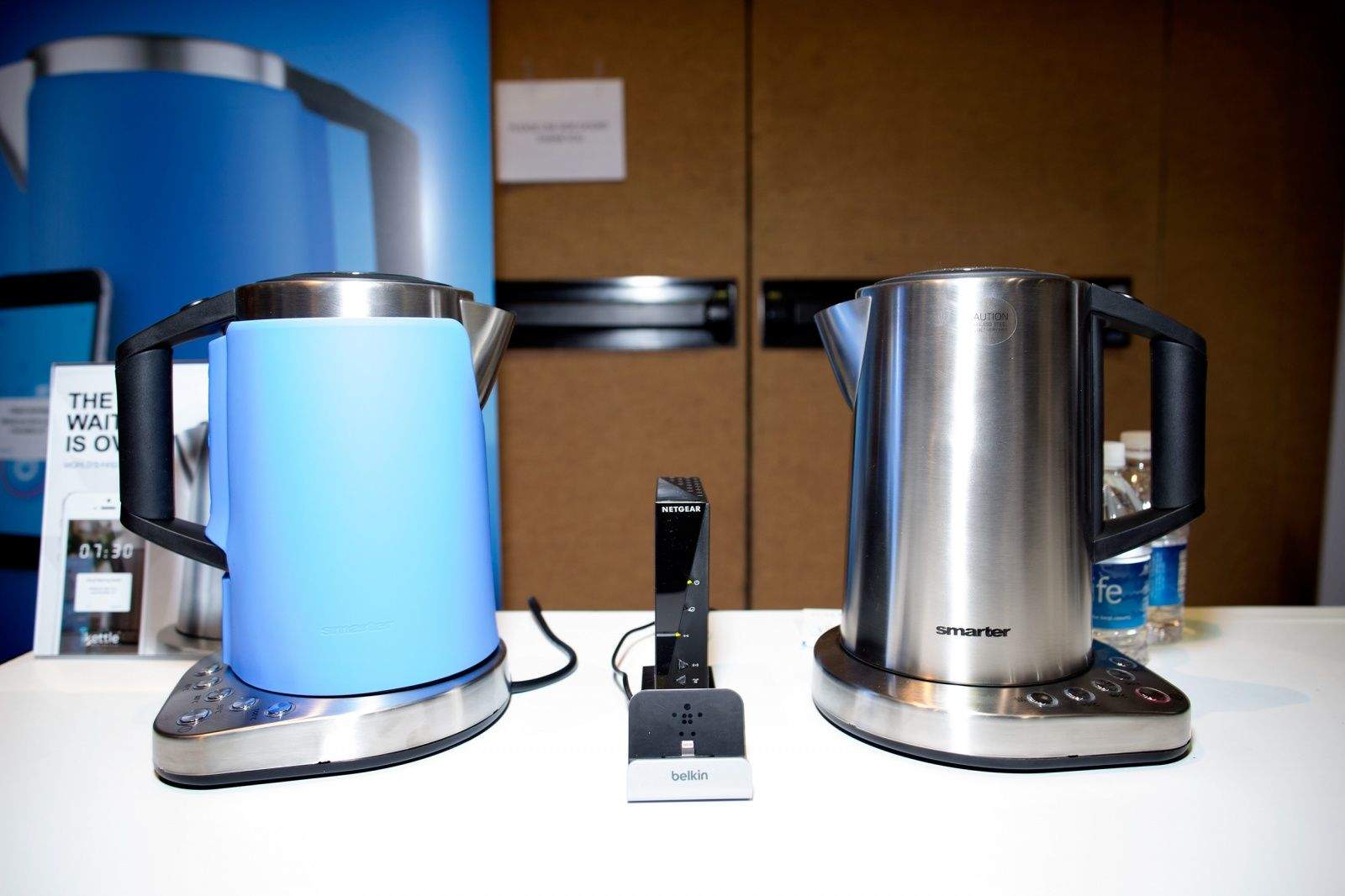
LAS VEGAS — As soon as I saw this Wi-Fi-connected kettle, I wondered to myself: “Why on earth would anyone want a Wi-Fi-connected kettle?”
 This is crazy. Connectivity gone mad. It’s got Wi-Fi for the sake of it. It’s a gimmick. Tech trying to solve a problem that doesn’t exist.
But I talked to the CEO, and his answer surprised me. Now I totally want one.
The Smarter Wi-Fi-connected kettle, called the iKettle in the U.K., is so British it’s not funny. Every household in the U.K. has an electric kettle. It’s on all day, every day, making cuppa after cuppa, all day long.
Thanks to its Wi-Fi connection, the iKettle can be turned on from anywhere. Boiling the kettle from the couch is a no-brainer. But thanks to IFTTT (If This Then That), an internet action service, the iKettle can turn itself on automatically when there’s a commercial break on TV.
The British love to make tea when the ads are on. Commercial breaks aren’t as frequent as they are on U.S. TV, and it’s the perfect time to make a brew.
“When the ads come on, the kettle starts boiling,” said Christian Lane, CEO of Smarter.
Maybe this sounds strange to an American (or anyone else), but as a British expat, this raison d’être totally resonated with me. Now I understood exactly why a kettle should have a Wi-Fi connection.
The company is bringing some of the same smarts to a coffeemaker, which is more American. Launching in March, the $199 WiFi Coffee Maker makes individual cups of coffee from a connected iOS and Android app. There’s scheduling: It can be set up to make coffee before your alarm goes off and when you arrive home. Set up through IFTTT, it can monitor traffic conditions, waking you with fresh coffee 10 minutes early if the commute looks bad.
It has a built-in grinder. The hopper holds enough coffee beans for a week (at two cups a day).

Leander Kahney is the editor and publisher of Cult of Mac. Leander is a longtime technology reporter and the author of six acclaimed books about Apple, including two New York Times bestsellers: Jony Ive: The Genius Behind Apple’s Greatest Products and Inside Steve’s Brain, a biography of Steve Jobs.
Leander has written for Wired magazine, Scientific American, The Guardian, The Observer, The San Francisco Chronicle, MacWeek and many other publications.

8 responses to “Wi-Fi kettle is so British, it’ll make you sound like Madonna”
It might work, but I heard the USA has only 100 volts mains so a kettle would take an eternity to boil.
Our kettles boil just fine thank you very much.
How many kilowatts?
MOST – US appliances are 110-120v. My Braun kettle for instance when full boils in about 60-90 seconds. Its the same kettle my aunt in the UK has. Its all about the heating element. We are AC in the US. Isn’t the UK DC and that is the reason you have those big honkin plugs?
My limited knowledge of DC is that DC is inherently safer than AC, but Hey, whatever boils your kettle.
Thanks, interesting. No-one has DC by the way, Tesla superseded it with AC.
US mains plugs carry about 10 Amps at 110 V, which means that the available power is just over 1KW. UK mains plugs can provide 13 Amps at 230 V AC, which means that about 3KW is available.
Therefore in the UK, devices such as electric kettles and electric toasters are universally used because they can use a lot of power to get the job done rapidly. A kettle will boil quickly and a toaster will properly caramelise bread to make excellent toast.
UK houses don’t need special provision for large domestic appliances such as washing machines because every mains socket is capable of powering them.
The reason why UK plugs are so bulky is that there is a replaceable fuse inside each plug ( anything from 3A to 13A, to suit the appliance ), so if a device blows it’s fuse, the other nearby devices will keep working.
I’m not saying the UK system is better or worse, it’s simply different and offers some advantages together with some drawbacks.
Its so UK that it only works in UK/EU not in US @ 110/120 volts.
Sorry, but who’s problem is that? Folks from across the pond complain when an app or movie isn’t available there at the same time it comes out here. Not everything needs to be everywhere at the same time.