2014 will go down as one of the biggest years in Apple history. The stock hit record highs. The company’s first wearable was revealed. And Apple dropped $3 billion on its biggest acquisition ever. But of all the huge news Apple dropped in the last 12 months, nothing is likely to have as big an impact as the previously unthinkable announcement that Apple and IBM buried the hatchet and partnered up.
The move was significant not only for the historic aspect of the two rival tech titans uniting, but also for how it will impact all of us in the workplace. In his final note of the year, top Apple analyst Horace Dediu dubbed the IBM partnership “the most significant technology news of 2014.”
That may sound ridiculous considering how much hype Apple Watch is getting ahead of its release, but Dediu points to the first wave of apps created by the partnership. These offer an early indication of just how transformative the relationship could be. For the first time, enterprise apps are being designed for their users (the employees) rather than their employers.
Just take a look at the difference between IBM’s new Expert Tech app compared to the closest equivalent from Oracle, and see which one you’d rather work with:
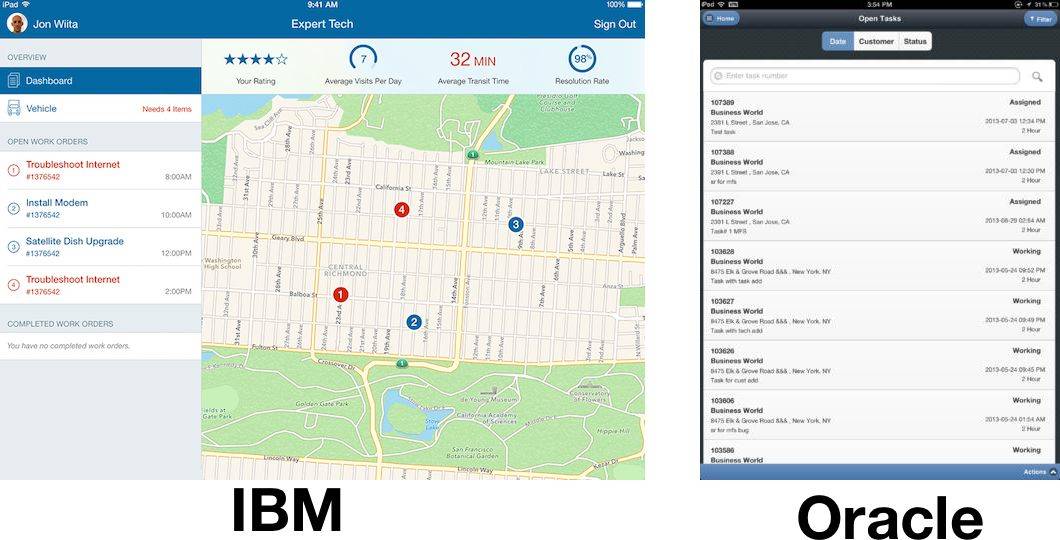
By tapping into Apple’s design skills, IBM apps bring corporate America into a new age of mobile enterprise apps that will completely change the way you work going forward. And the two companies are just getting started.
“IBM has had to essentially say no to those who buy and yes to those who are paid to use,” say Dediu. “The quality of the experience is evident at first sight. The number of user actions, the number of screens to wade through have been ruthlessly culled. These are concepts and ideas which now permeate app design best practices. Yet they are practices which still elude the spec-driven enterprise software wastelands.”
People laboring away in cubicles deserve good apps too. When the first wave of IBM apps landed earlier this month, Leander and I spent hours combing through apps from IBM’s biggest competitor in enterprise, Oracle. The results were so horrific it was hard to believe companies pay thousands of dollars to use them. Every app looks like it was built in 2008. Now there are finally easy-to-use alternatives that can run on the same devices you use everyday in your personal life.
The best thing about the Apple-IBM partnership is that we all win because of it. Apple gets to sell more iPhones and iPads. IBM makes the enterprise world more dependent on its services. Workers get to use software they actually enjoy, and ultimately customers will be happier too.
Via: Asymco

Buster Hein is a freelance writer who lives in Phoenix, Arizona. Twitter: @bst3r.


7 responses to “Why Apple’s IBM partnership was the biggest tech news of 2014”
A bit over dramatic considering Microsoft will be greeting them at the door. Be careful not to trip.
MS? LOL!!!
when you live in the reality distortion field you don’t realize the world is made up of more than just Apples. Microsoft is the business world. Server and development software, SQL, cloud (way bigger than Apple) and a thing called office. Not to mention the Surface is doing quite well.
And exactly what will Microsoft do? Bar these Apple-IBM apps from interfacing with companies’ installed MS infrastructure? Fly down and threaten the CEO of any MS enterprise customer who places a call with IBM?
That is not how Microsoft operates. Apple kicked fitbit out of their store because they would not interface with the watch. Apple has setup very restrictive contracts with companies that want to work with them. This is a desperate move on Apples part because they could not get in Corporate on their own. Microsoft and Apple started their businesses at the same time
. Gates and Jobs were friends and Gates helped Apple survive when Jobs needed Microsoft in their darkest hour.
I believe they have a healthy respect for one another. Competition is good for both companies. I also respect and like Apple. My negative comments come from a place that wants to counter Apple people who believe Apple can do no wrong.
I see this as IBM is backing Apple Devices in corporate (no one ever got fired for buying IBM, so i expect this will be a huge boost for Apple sales in the business world), and IBM is finally learning how to make a UI that’s not from 1997.
While Apple culture has always been huge in the design/creative world, this could be a huge push for it against MS in the financial/statistics/ect markets where Apple has generally been seen as not as good, or well supported Windows. Now that many more business apps will slowly gain OS X support this means that even in the corporate world there will no reason for a person to “need” Mac or PC, it will come down to preference and price.
Imagine speaking to Siri on your iPhone and having IBM Watson search through its global database of medical information to recommend personalized treatment based on medical record information as well as monitored sensor data and genotype & phenotype information. This is a Big Data analytics challenge that the two companies seem ready to accept, and it’s just one of the many healthcare trends described in http://www.mhealthtalk.com/101-minitrends-in-health-care/.