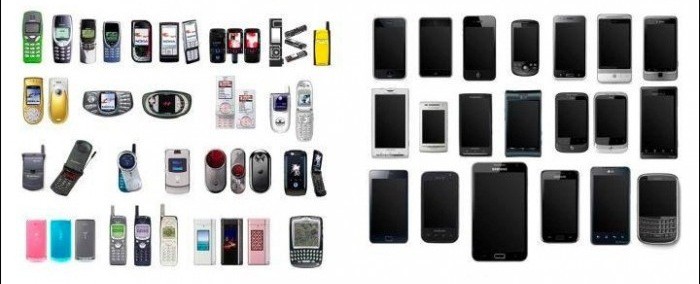
Ask a lot of people who don’t use iPhones like to dismiss Apple’s impact on the smartphone industry. Hey, we had PDA-like smartphones with touchscreens before the iPhone, so what’s the big deal?
Such logic is patently absurd, but as it often does, a picture says a thousand words about how a thousand shitty devices did things before the iPhone came around, and how the makers of these crappy phones do things now that the iPhone is the gold standard of smartphone design.
Think that’s pathetic? Check out how tablets changed after the iPad too. Unreal!
[image by Josh Heifferich, via AppAdvice]
46 responses to “What Phones Looked Like Before And After The iPhone Transformed The Industry [Image]”
the tone of every single brownlee piece is beyond condescending. i’d ditch him to protect what little integrity this site has left.
The old phones may of been poor but at least there was a choice of shape and colour… too many sheep prehaps …
That’s what cases are for. I don’t walk to be tied to one shape and color for 2 years anyway. I think customization is better now than ever.
The same could be said for the posters who post here, too.
I do miss having physical buttons on a phone though, no way to accidentally press something with your ear during a call and accidentally mute the phone. In some ways I think this touchscreen stuff is not the best solution, there should still be REAL buttons, or at least pressure sensitive touch receptors.
There’s a sensor which blacks the screen when you are talking, bro… If that’s not the case, get an iPhone, it has that function…
The same holds true of laptops. It was Apple’s PowerBook 100 that started the trend of shifting keyboards up from the front edge to create palm rests and space for a pointer device.
But, he’s right.
I find this interesting because it also shows how the current obsession with large Android phones is similarly misguided.
Before iPhone, all cellphones were small and over many generations they got smaller and smaller because this is what the public actually wants. Odds are good that the “giant phone” thing that Android has been pushing is going to fade away and the drive in the future will be towards smaller and smaller again.
If you check on sales of individual phones you will find that the best selling phones are always the smaller iPhone sized ones and that the larger ones just don’t have the popularity ne would expect from reading tech blogs.
Thanks John. I get very tired of the lack of acknowledgement that Apple has received from the computer and cell phone industries on how they have revolutionized both. Your photo says it all extremely elegantly. I remember in 2007 so many pundits predicting the quick death of the iPhone because of its lack of physical keyboard. Apple, they said, could never hope to make it in the cell phone industry because they had no experience and couldn’t hope to compete against the likes of Nokia and Motorolla.
What I find depressing is that Apple’s way seems to be the ONLY way things can be done these days. Phones and tablets now look nearly identical, and I’ve frequently seen comments that “it’s obvious that there are only a few ways that a phone or tablet can be designed” and that “Apple didn’t invent these designs because they were so obvious.” Pure horse hockey of course.
Surprisingly, the only bright spot of innovation seems to be coming from — Microsoft, with its Windows 8 mobile OS. It’s the only thing out there that is really different from Apple’s iOS. I applaud Microsoft’s work in this area, and I wish that other companies could “think different” from what Apple is doing. Heck, Apple shouldn’t be the only company that’s doing the innovating.
Apple thought of this! That’s why they have slide to unlock to prevent the device from opening accidentally
And also the screen automatically turns off(but still running) when you put the iPhone near your ear(making a call) because it has sensor. Watch the original iPhone keynote.
Sounds like WardC has never owned an iPhone…
Varieties of shapes and colours on ageing devices are what happens when the manufacturers are unable to innovate on the things that really matter.
Want to see my phone? Look somewhere to the left. #PoorCollegeStudent
How am I not surprised …….
I don’t disagree that Apple has had an immense impact on the mobile industry … but this picture is a little sensationalist. You’re basically showing a bunch of dumb phones (on the left) against a bunch of smart phones (on the right). Smartphone market share has definitely grown a lot, but you’re assuming that smartphones currently dominate the marketplace, which they do not.
Awesome picture!
agreed
agreed
Where the lg touch screen phone before the iphine ? And the large screened Nokia phones?
There is that one phone in the bottom right corner that looks like an old TREO (though it might be a stretch to call it a smart phone lol). it’s pretty well acknowledged that smartphones are the growing sector and will outstrip other “non-smartphones”.
When was the last time you saw a non-smartphone advertised on TV?
Touchscreen phone may get slimmer but there is a limit to home small they can be before it is impractical to operate by touch. Jobs famously made a crack about having to file down your finger tips in order to type on those Blackberry style physical keyboards and the same holds true for the touch-sensitive screens.
I read somewhere that one of the reasons that Android phones are adopting larger screens (apart from the knuckle-dragging belief that bigger is always better) is that the way icons and UI elements are rendered would result in smaller and smaller icons as the screen resolution increased.
Unlike on iOS where there is a resolution independence in the under pinnings of how UI elements are rendered. There is an absolute size that remains the same; as the resolution increases, the icons switch to higher res versions.
As usual, Apple does it right, and does it the smart way with an eye to future improvements in technology while the other companies show little foresight.
Larger touch screens also become less practical for one-handed operations.
“The old phones may of been poor but at least there was a choice of shape and colour”-powermacx
Brilliant. Let’s all use inferior technology so we can have it in a different shape or color. Talk about loosing track of what’s important.
To quote bugs bunny: “What a maroon.”
“The old phones may of been poor but at least there was a choice of shape and colour”-powermacx
Brilliant. Let’s all use inferior technology so we can have it in a different shape or color. Talk about loosing track of what’s important.
To quote bugs bunny: “What a maroon.”
Like I said, I acknowledge that smartphone marketshare is rapidly growing … but if you wanted an accurate representation of what the current mobile market is like … you should take out about 6 of those smartphones and put in a couple of cheap dumb phones.
To your point on advertising, that also isn’t an accurate representation of the market. It makes sense for the carriers to try to sell you a smartphone because they don’t make any money off selling you a dumb phone.
Merely a gimmick by OEM’s to differentiate themselves from competitors. The fact of the matter is, if people wanted phones with huge screens we would have had them years ago. The recent proliferation of these ginormous phones has a lot to do with the current state of “4G” technology; larger chipsets and more power hungry (larger battery). The public isn’t given an option of a small “4G” phone, so the perception is shifted by the OEM’s from a desire for “4G” (a carrier tech) to a desire for large screens. Apple is the only company that isn’t going to bend over backwards for the carriers. They are more than willing to wait to move to new cell technology until something more elegant can be designed – and I’m not talking about the phone, but the silicon. There is supposed to be a shift to 28nm process this year, which will answer both current short-comings. I’d wager, we’ll start seeing these huge phones make the transition back to a more normal size as consumer demand and desire moves as back to more manageable and less invasive devices.
Um, the author might want to re-read the first line of this article and then replace it with something that actually makes sense…
I don’t consider having lots of phones of different design a bad thing. My wife for instance wanted a very small phone, with very basic commmunications capabilities and an actual keyboard. She tried a big smartphone that I had and hated it. She went with a Kin2 – (the second generation kin) and absolutely loves it. Not everyone needs or wants a big old flatscreen device. I also think that the large screen touch screen displays only became reliable and possible after Corning started making gorilla glass – and that had as much to do with the format change as the iphone did.
Androids also shut off the touchscreen if you’re holding the phone in typical “talking on the phone” position.
The first iPhone was launching with a plastic screen (good quality though). A few months before launch, Steve Jobs approached Corning and got them to create a glass screen for them based on a technology they had abandoned. This is how it happened.
Exactly! Before the PowerBooks, the keyboard on all laptops came nearly flush to the front rim of the case, and the back area closest to the screen was used for speakers. Of course nowadays you never see a laptop like that, and every manufacturer uses the “obvious” design that Apple pioneered. I think the Powerbook was the first to have a built-in trackball, and then the trackpad.
There are still plenty of phones around with “real” buttons if you want one. The iPhone and most Android phones have proximity sensors that can tell when you have the phone near your head, and then automatically cancel any input from the screen to prevent accidental input. The problem with “real” buttons is that they 1) take up physical space on the phone which causes the screen area to be smaller, and 2) because they are physical, they are unchangeable. Touchscreen keyboards can be there when necessary and gone when not. They can be changed to suit any program at the whim and decision of the programmer. “Smartphones” are actually tiny, endlessly customizable mobile computers you can carry in your pocket, which can also be an extension of your desktop computer. The large screen makes all this possible. Physical buttons are now an anachronism.
Isn’t this hypocritical? If you don’t have an iPhone I probably don’t want to know you. I hate green message bubbles.
He doesn’t. Proofreading is not in his job description.
What about the PDA phone like this:
http://www.techshout.com/image…
Way before iPhone’s time…bunch of Apple fancrap that’s all…unfortunately Apple died with Steve.
Well the logic is that all you need is a big badass screen, that’s all! All the fancy shit around, is yeah just useless…
Seen a few of my old phones in the “before” image. LOL
What about the Sony Ericsson P800 – touchscreen + keypad, handwriting recognition, “apps”… hell it even had some half decent emulators and SCUMMVM.
http://www.google.co.uk/search…
Doesn’t the LG Prada ever get recognition? While the iphone was a game-changer, the design wasn’t pioneered by them.
“Brilliant. Let’s all use inferior technology so we can have it in a different shape or color. Talk about loosing track of what’s important.”
Spelling aside, this isn’t a mistake I’ve made since claiming that Tandy’s Repeater was superior to “Simon” in 1980. Technological superiority is no substitute for being nice to use. I had a series of Windows CE devices and have been through the pain of carrying something the weight and value of an iPhone (albeit without the enormous TCO) in order to do stuff more “cleverly” (including voice control for reading e-mails) than I could do on a simple phone. Not any more. Apple may be legendary in making improvements in usability but their phones are still twice the size of my 2006 Sony and I like the colour!
except apple didn’t invent that form factor
like old cars, now they look the same :(
see the images in better resolution – http://bit.ly/wY6GMi
really cherry picking those older phones. Should add some of these phones. Palm, Google Sooner,
Symbian phones, Nokia 9210, Windows CE Pocket PC OS phones, BlackBerry , Audiovox PPC4100, Hitachi G1000, HP iPaq Pocket PC h6315 (most coming out 2004 or sooner.) and my favorite Samsung SPH-i700 (2003)
Its funny how LARGE newer phones are, like almost as big as the VERY FIRST cell phones of the 80s, lol. Personally, my strongest phone was an old nokia. That poor thing survived flying off the roof of my car and into traffic/brick walls many times.

