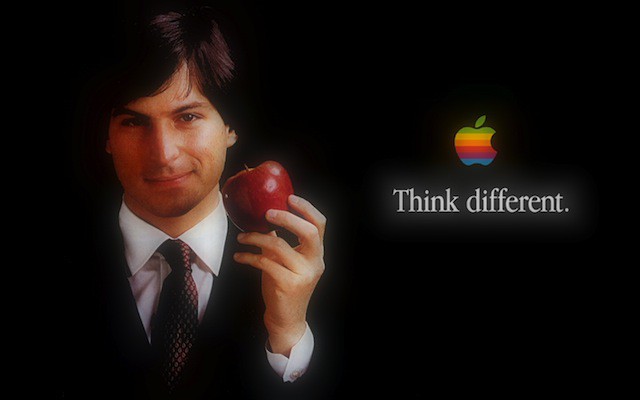
Although everyone knows that Apple Computer was named after the namesake fruit, Steve Jobs has never talked about where the name came from — until now (AFAIK).
It was named during one of his fruitarian diets, Walter Isaacson’s new biography of Jobs reveals.
On the naming of Apple, he said he was “on one of my fruitarian diets.” He said he had just come back from an apple farm, and thought the name sounded “fun, spirited and not intimidating.”
AP: Jobs questioned authority all his life, book says

Leander Kahney is the editor and publisher of Cult of Mac. Leander is a longtime technology reporter and the author of six acclaimed books about Apple, including two New York Times bestsellers: Jony Ive: The Genius Behind Apple’s Greatest Products and Inside Steve’s Brain, a biography of Steve Jobs.
Leander has written for Wired magazine, Scientific American, The Guardian, The Observer, The San Francisco Chronicle, MacWeek and many other publications.

37 responses to “Steve Jobs Finally Reveals Where The Name “Apple” Came From”
So the bitten rainbow apple was not a reference to Alan Turing, genius who created logic engines that were precursors to modern computers and cracked a code during WWII and was later condemned to either imprisonment or forced castration due to his homosexuality so he committed suicide by taking a bite out of an apple laced with cyanide? I am beyond disappointed.
Good god, cult is right. Jobs did all for Jobs; he brought…or in actuality, helped to bring about…a lot of great technology. I will always remember him for his unnatural need to control…that and the huge screen of his image playing in the background of his too-human self talking down to the rest of us. Begin naming what he did for society in the name of others, and I’ll pay attention.
“The Macintosh project was begun in 1979 by Jef Raskin, an Apple employee who envisioned an easy-to-use, low-cost computer for the average consumer. He wanted to name the computer after his favorite type of apple, the McIntosh,[2] but the spelling was changed to “Macintosh” for legal reasons as the original was the same spelling as that used by McIntosh Laboratory, Inc., the audio equipment manufacturer.[3] Steve Jobs requested that McIntosh Laboratory give Apple a release for the name with its changed spelling so that Apple could use it, but the request was denied, forcing Apple to eventually buy the rights to use the name.[4] (A 1984 Byte Magazine article suggested Apple changed the spelling only after “early users” misspelled “McIntosh”.[5] However, Jef Raskin had adopted the Macintosh spelling by 1981,[6] when the Macintosh computer was still a single prototype machine in the lab. This explanation further clashes with the first explanation given above that the change was made for “legal reasons.”)”
Source: http://en.wikipedia.org/wiki/Macintosh