
Ulysses, one of the best writing apps on the Mac and iOS, just switched to subscription pricing. It’ll now cost you $5 per month, or $40 per year. This is fantastic news for Ulysses users. It means the app will generate enough income to support itself. And it minimizes the risk of the developers abandoning the app when the flow of new users dries to a trickle.
Yet despite this good news, the internet lost it mind after yesterday’s announcement of the pricing change. Currently the Ulysses blog is only serving a single post, the one detailing the change, because the traffic has been enough to collapse the servers. What happened?
The App Store is like a pyramid scheme where nobody wins
If you use well-designed, complex software, you will be familiar with the App Store Ghost Ship Problem (a problem I just named myself). An app launches, often to a lot of great publicity, and collects new users for a couple of years. These new buyers keep enough money coming in that the developer can keep working on the app — updating it, adding new features and removing bugs.
After a while, though, these new users dry up. Maintaining the app becomes unsustainable. The devs leave the app to rot, perhaps pushing out an emergency update every once in a while to stop it from becoming incompatible with a new version of iOS. The developer moves on to a new app, because that’s the only way it can stay open for business. Meanwhile, people who use the app every day watch their favorite tool wither and die.
That’s the App Store model right now. It works like a kind of pyramid scheme, with an endless and swift supply of new users required to support existing users.
Subscription pricing fixes this. The heaviest users of an app, the ones most likely to appreciate its continued improvement, can now pay to support it. I’m a happy Ulysses user, on Mac and iOS. I write all my Cult of Mac articles in it, even using it to publish them.
I’m probably as heavy a user of Ulysses as you can get. Yet even I balked at the idea of the app moving to subscription pricing when Max Seelemann, one of the two bosses at Ulysses developer The Soulmen, told me about it a month or so back. (I shared an office with the team for a few months when I first moved to Germany.)
Ulysses subscription prices can be cheaper
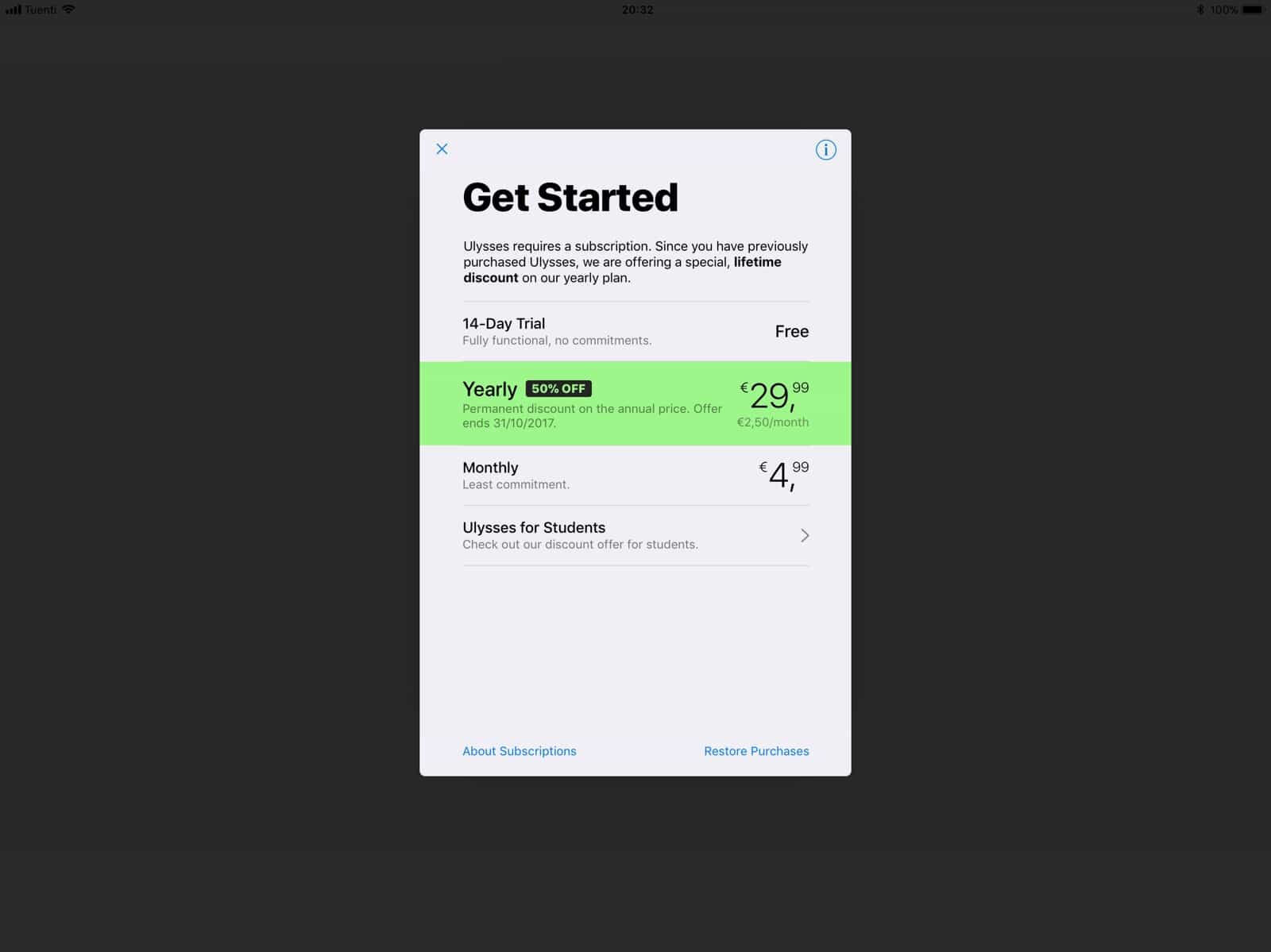
Photo: Cult of Mac
Previously, the Ulysses iOS app cost $25 and the Mac version cost $45. That’s $70, and there was no way to try Ulysses first on your iPad or iPhone to see if you like it, or to see if the sync works (it does, BTW — really well).
Now, you get a free 14-day trial on all platforms. Once the trial ends, you can keep the app in read-only mode. The $40-per-year subscription price ($30 for existing users) covers all versions of the app. If one imagines an App Store where app upgrades could be sold, then $40 every year for a new Mac app and a new iOS app seems reasonable.
Even so, people don’t like subscriptions. With paid upgrades, you can always keep using the old version when a new version launches. You’re not forced to upgrade. With subscriptions, if you stop paying, you lose access to some or all of the app. And subscriptions don’t fit all kinds of apps.
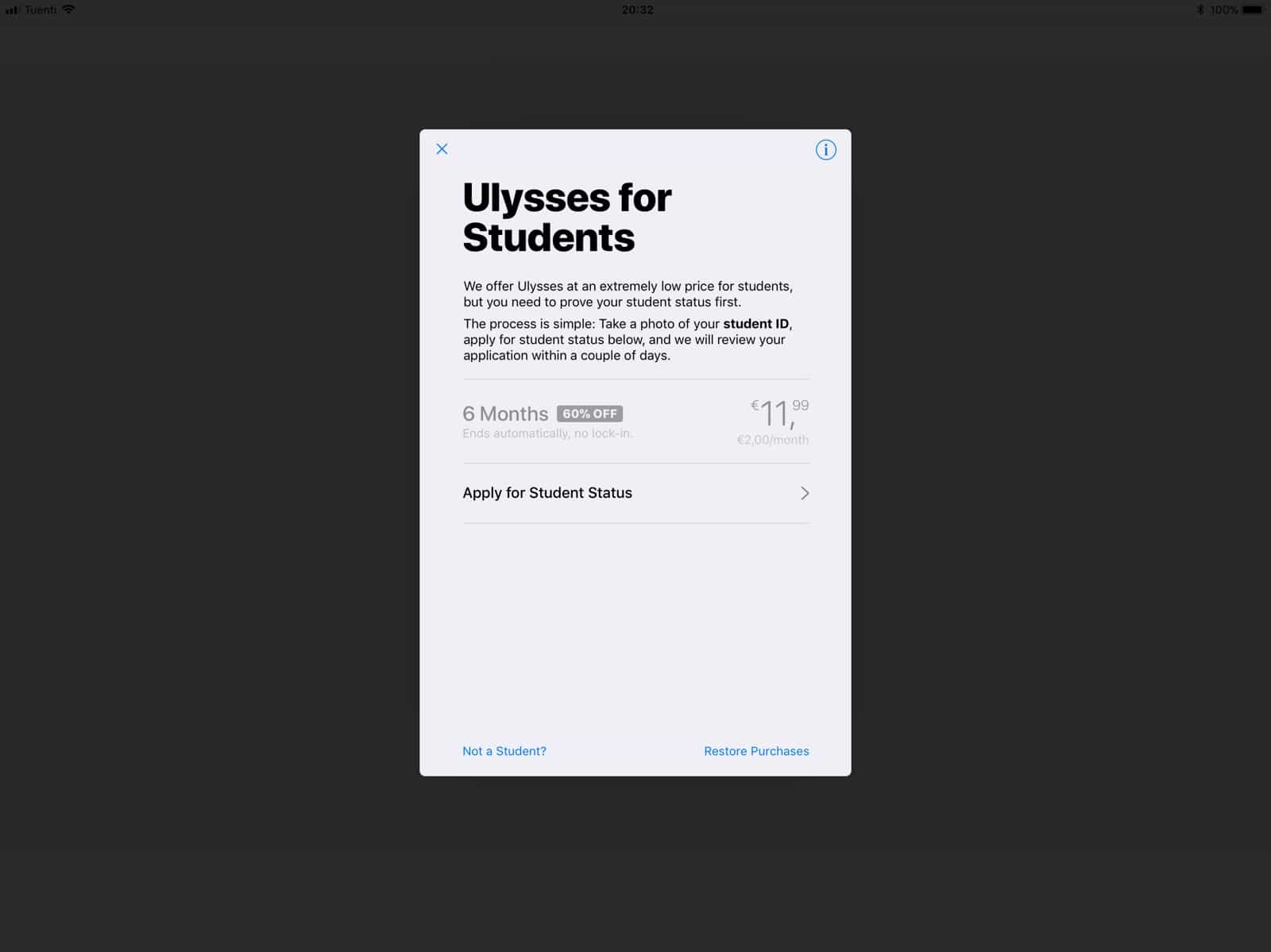
Photo: Cult of Mac
For something like Ulysses — a pro-level tool with a paid support team — the subscription model makes sense. But for a one-shot app with a single purpose — like an app that removes the location metadata from your photos before you share them or a sticker pack for Messages — a subscription is too much.
In between, though, are apps that could go either way. Would you pay to keep your favorite hiking maps app updated? We seem happy to pay subscriptions for apps that have ever-changing content — magazines, Netflix, etc. — but not for apps that require ongoing support, or a big effort to develop.
Haters gotta … wait?
Since the announcement, the @UlyssesApp Twitter has been off the hook. The complainers and the supporters, though, split roughly 50:50, running through the gamut of opinions.
“I’d say it’s around half-and-half, with the full spectrum,” Seelemann told Cult of Mac. “Flaming supporters, people that think it’s OK, people that dislike it but can be convinced, and a number of people that really hate the step.”
We already know that haters are more vocal than supporters, and the numbers for Ulysses’ subscription launch agree. Subscription signups have been “better than we would have expected,” says Seelemann.
A lot of thought seems to have gone into keeping existing users happy. There’s a grace period for people who already purchased Ulysses, along with a lifelong discount on all future subscriptions.
Here’s a relevant entry from the Ulysses FAQ:
I have previously purchased Ulysses (on macOS and/or iOS). Do I get a discount?
Yes, you are eligible for a lifetime discount of 50% on the monthly subscription (limited time offer).
Also, depending on your purchase date, you can use Ulysses completely for free for up to 18 months. Recent purchases of the Mac app will unlock up to 12 months of free use, and purchases of the iOS app will unlock up to 6 months of free use. Your individual free-use duration is calculated from your actual purchase dates, and if you bought Ulysses on both platforms, we will add together both periods.
In practice, it’s not so complicated. You just tap the subscription signup section in either the Mac or the iOS apps. The app will tell you when your grace period runs out, and how much the subscription will cost you after that. Despite the hurricane of whining on Twitter, the majority of existing Ulysses users signed up immediately.
Most Ulysses users signed up already
“70% or so purchased before the grace period ended,” Seelemann told us. “That’s a huge number of potential adopters.” To make that clear, 70 percent of the people who have previously paid for Ulysses have already signed up for a subscription, even if they have months left where they could have used it free. Despite the complainers, it doesn’t sound like the move to subscriptions will put off Ulysses customers. On the contrary, it seems more like they were waiting for an opportunity to support a product they use and love.
And it’s not just old hands that are happy, either. Seelemann didn’t share precise numbers for people who signed up for the free trial. But, he says, “We do have a count for the trial starters, and the number is amazing.”
Part of this relatively benign reception for a controversial change is the company’s communication. In a long piece published on Medium, Seelemann lays out the reasons for the change, the problems with the current App Store model, and the decisions surrounding this new direction. Here’s a snippet.
We want to make sure the app will be around for years and years to come. We want to heavily invest in its development, and this requires the right setting for our team, our families and our users. Writers want to rely on a professional tool that is constantly evolving, and we want to keep delivering just that.
Switching to a Ulysses subscription is easy
If you do switch over to the subscription version (and you don’t have to — you can keep using the app you already purchased), the app will import all your existing documents at launch, in the background. Any custom fonts you added will also show up there. In fact, you won’t notice anything other than the new subscription options.
It’s smooth, and typical of The Soulmen. The company has a knack for taking complex problems and coming up with simple-seeming solutions. If you use Ulysses, you know how much power the devs packed into the simple-looking app, which somehow remains easy to use. Now, it looks like the the Soulmen team did the same for App Store sustainability.

Charlie Sorrel writes reviews and how-tos. Follow Charlie on Twitter at @mistercharlie, and at micro.blog on @mistercharlie

14 responses to “Why Ulysses subscription pricing is good for the App Store [Opinion]”
I have Ulysses, but have not really used it, much or at all. Looks like I lost some money here.
Well, you lost money by buying an app you never used, I guess. It going to subscription didn’t change that loss. From the article: “If you do switch over to the subscription version (and you don’t have to — you can keep using the app you already purchased), the app will import all your existing documents at launch, in the background.” Note the bit in parentheses.
Thanks, I missed that I can still use it. Ulysses is among the myriad of apps I have, many purchased, that I haven’t had the chance to explore yet. My first boot up of it showed me I’d have to spend a good deal of time getting to understand it, so I put it aside until that time presented itself. It is not an intuitive app by any means.
What the bleep is a “writing app”?
You seriously asked that question?
““70% or so purchased before the grace period ended,” Seelemann told us. “That’s a huge number of potential adopters.” To make that clear, 70 percent of the people who have previously paid for Ulysses have already signed up for a subscription, even if they have months left where they could have used it free. ”
No. They were tricked into giving up their free period by the misleading wording on that screen.
As a user, I don’t like subscriptions. But I understand why developers of a certain type of software prefer it. So it’s not the subscription per se.
It’s the price point. Ulysses was never cheap. The fixed prices of $45/$25 (Mac/iOS) was already quite high compared to other, similar software packages – but I paid it, because I liked the software – and it was a one time payment.
The subscription pricing, however, is way too high for what Ulysses offers, compared to competing packages. In fact, I wouldn’t even use a trial as a new user seeing these price points. And Ulysses has done little to justify this high of a price point. There were few updates before, some features (that competing software has) were complained, but never addressed, the subscription version is identical to the current non-subscription version. And new features are, so far, not announced. So, what do I pay the subscription for, exactly, given that the recent updates were mere bug-fixes with no actual feature additions? I might add that the implied expectation – “Users expect constant improvement” – is simply not true. In particular for writing tools like Ulysses, a lot of people only expect to get a set of features, and want just this set of features – unless a killer feature is developed, at which time a paid upgrade that users may or not may do (depending if they like said feature or not) is justified. In the meantime, bug-fixes are enough, and most developers get by for bug fixes just fine with the one-time payment up front for that.
In addition to that, the roll-out of the subscription was, said politely, rather insensitively done. By nag-screens overlays, with no previous announcement, done from one day to the next. There was inexact misleading wording with regards to the actual costs for existing users. The rebates for existing users, and educational discounts, are shockingly low.
Fortunately, I never went full Ulysses as my main writing tool. It WAS nice, clean, and elegant – but forced a library arrangement on me, including default storage locations, I disagreed with. There were workarounds, but there were inelegant.
Ulysses has lost me as a user. There are tools as good as it, and better ones, for less money.
The subscription model is something we need to get used to as users. I think Max and the team did a great job with the transition. Their model is well thought and they avoided mistakes others (like Smile and Agile) made before. Also they offered insights about finding their decision and why they think this is the right way. Transparency and openess builds trust.
The haters will always hate and they will probably be fine with some other apps. I think what you end up with after such a (successful) transition is a higher quality consumer base.
A higher quality cx base after foisting a sub model, get real. Sounds like trying to convince yourself you made the right decision.
This higher quality user is now firmly off the Ulysses cx base.
Subscription model is perfect…but pricing should be correct.
If I have to pay 9.99$/month for Adobe Photoshop and Lightroom saving a thousand with a regular buy I love the idea. 1$ for 50GB iCloud, 3.99 for Plex Pass… I pay with a smile on my face.
Maybe I don’t recognize complexity of Ulysses but I think that 1.99/month could bring them few times more users so the revenue would be the same or higher.
At 1.99 a month that would have to have many, many times more users. There’s an only saying in sales that a 5% discount requires almost twice as many customers to make the same profit.
I’m not sure that applies fully with software. Their overhead should be less than if they were selling products that they had to purchase. I think $25/yr max should be the limit for this app. I am going to commit for a year just because I have a need for ePub on iOS. It will be very convenient for public speaking and I don’t have to worry about wi-fi or syncing with my mac.
Well wasn’t that just a plug for Ulysses. Their 50% discount isn’t, and as a user and previous promoter of Ulysses I accidentally ended up ‘subscribed’ when I thought I was downloading the final update to the paid version their press release mentioned.
I for one have abandoned Ulysses after this money grab that has you buying a completely new version every year if you only use one version of iOS or Mac, or every two years if you use both.
Instead of using Ulysses for blog posts, I use MarsEdit, and for novel and non fiction writing, Scrivener, who’s developers have said they intend to stay way from subscription.
So while I, like many others may have been duped into accidentally signing into subscription, Ulysses already lies unused.
Soulmen, this is one customer you have lost.
I find the statistics and comments from Mr Seeleman very improbable given what has been a PR disaster for Ulysses, and “On the contrary, it seems more like they were waiting for an opportunity to support a product they use and love.” Really?