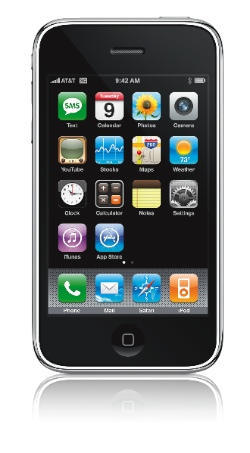
The iPhone 3G became just the latest reason why Motorola is no longer king of U.S. cell phone sales. After losing its market lead Friday to South Korean Samsung, Moto Monday received more bad news: Apple’s iPhone 3G dethroned the slimline RAZR handset as the best-selling mobile phone in the United States.
The RAZR was the last big hit for the Schaumburg, Ill. handset manufacturer which has seen its market share slip away. Motorola slipped to second place behind Samsung, controlling 21.1 percent of the U.S. market, compared to the Korean’s 22.4 percent U.S. market share, according to research firm Strategy Analytics.
Apple’s iPhone 3G outsold the RAZR in the U.S. during the third quarter, according to consumer analysts at NPD Group. For three years, the RAZR was the top-ranked handset.
The move marked “a watershed shift in handset design from fashion to fashionable functionality,” NPD analysis director Ross Rubin said in a statement.
“The RAZR as the best-selling mobile phone for three years represented the consumer’s focus on slim voice-centric handsets at the expense of functionality,” Rubin told Cult of Mac.
The iPhone, along with fashion, provided U.S. cell phone owners the powerful Mac OS X operating system and strong Web capabilities, Rubin explained by e-mail.
“We are seeing a definite shift in consumer purchasing patterns away from 12 button clamshell phones to QWERTY messaging, touchscreen, and data oriented devices,” Avi Greengart, a handset analyst for Current Analysis, told Cult of Mac. Motorola is “heavily-weighted” toward the low-end clamshell devices, he said.
Like the digital divide that separated broadband and dial-up customers, a data divide is emerging among cell phone owners. On one side are those that view Internet access and Web browsing as necessary features and another group that sees little cause to upgrade beyond voice service.
However, the trend toward data is becoming more evident, judging by features now seen as necessary. More than 80 percent of cell phone customers say Bluetooth is required, with 68 percent including music features, according to the research firm. Another 43 percent of phones purchased included cameras. Demand for QWERTY keyboards on phones rose to 30 percent, up from just 11 percent the previous year, according to NPD.
Indeed, four of the top five were optimized for messaging or the Internet, according to Rubin.
“Consumers are starting to turn to their phones for more than just voice in a svelte shell,” he said.
Motorola shouldn’t continue to try to repeat its past glory with the RAZR, the analyst advised.
“Motorola will have to create some compelling attractive and smart devices that embrace Internet access to reverse the market share slide,” Rubin said.
What of RIM? Will it push Motorola even lower in U.S. sales and threaten the iPhone in the fourth quarter? With the merger with Alltel, Verizon will have an even larger audience for the RIM BlackBerry Storm, he told Cult of Mac.

Ed Sutherland is a veteran technology journalist who first heard of Apple when they grew on trees, Yahoo was run out of a Stanford dorm and Google was an unknown upstart. Since then, Sutherland has covered the whole technology landscape, concentrating on tracking the trends and figuring out the finances of large (and small) technology companies.