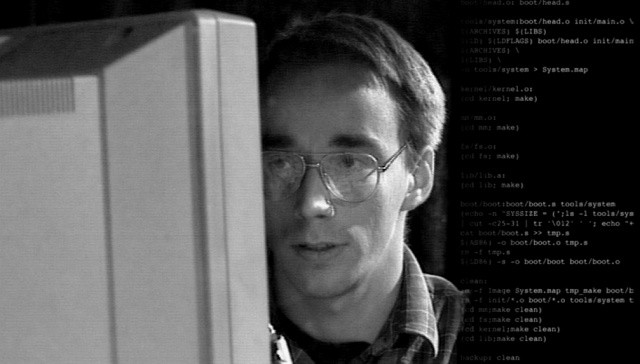
Built upon the DNA of NeXT OS, OS X is already one of the most well known Unix-based operating systems, but it could have been supercharged if the father of Linux, Linus Torvalds, had accepted a job offer from Steve Jobs back in 2000.
Describing Torvalds as the Steve Jobs of engineers for his ability to look at “potentially competing solutions and cut through the bullshit and say, no this is the right one to choose” even if it “means he’s a dick sometimes,” Wired’s Enterprise blog shares this intriguing story.
Torvalds has never met Bill Gates, but around 2000, when he was still working at Transmeta, he met Steve Jobs. Jobs invited him to Apple’s Cupertino campus and tried to hire him. “Unix for the biggest user base: that was the pitch,” says Torvalds. The condition: He’d have to drop Linux development. “He wanted me to work at Apple doing non-Linux things,” he said. That was a non-starter for Torvalds. Besides, he hated Mac OS’s Mach kernel.
Of course, just a year later, Apple released OS X, the next version of their Mac operating system that is still in use today. It seems pretty clear in hindsight that Jobs wanted Linus to head the OS X team, but if there’s one thing Torvalds is, it’s idealistic. Imagine what OS X might be today if he had joined, though!

John Brownlee is a writer for Fast Company, and a contributing writer here at CoM. He has also written for Wired, Playboy, Boing Boing, Popular Mechanics, VentureBeat, and Gizmodo. He lives in Boston with his wife and two parakeets. You can follow him here on Twitter.

38 responses to “Linux Creator Linus Torvalds Was Asked By Steve Jobs To Help Build OS X In 2000”
“… but it could have been supercharged if the father of Linux, Linus Torvalds, had accepted a job offer from Steve Jobs …” Seriously? ‘Supercharged’????
Linux is a bad copy of Unix, OS X is “real” certified Unix and both it’s core and NextStep’s as well were “real” Unix. Everything about NextStep was both better and closer to “real” Unix than Linux is.
I don’t think anyone said that OS-X would then be moved to a Linux base. OS-X and its Next predecessor were already firmly established on BSD Unix at the time.
I wonder if Jobs really thought Torvalds was that good or he just wanted to kill Linux as a competitor to OS X. Probably a little of both, but more of the former because surely, given his experience with Next, he knew a little about how to establish an OS and pretty much foresaw that Linux will forever be an enthusiasts OS (for the desktop I mean).
I imagine it would be monolithic, difficult to maintain, and unstable.
Yeah, unstable, that’s why 95% of supercomputers run linux…
Yes, non-interactive applications running on specialized hardware.
I know, running applications on a petascale is so easy.
I never said it was.
father of the linux is stolman
Richard Stallman created GNU tools, he didn’t make linux, the actual linux kernel was made by Linus Torvalds
let me be clear here.
linux-kernel = father linus.
linux-os = father stolman (he found gnu licence, A LOT of utils etc)
my opinion, this article referencing to the gnu/linux not to the kernel. or author should be more clear (linux kernel or linux os)
Bunch of GEEKs! lol
Stallman did a hell of a lot of what Linux is. A Kernel is a kernel, but everything else is a lot more.
Lol yeah,i didnt understand a thing they were saying.
May I inquire as to your presence given your opinion on the matter?
Not interactive? How do you think Stock exchange and bank computers run? random generated fictional input?
Yeah… that damn crisis hope we get some better random numbers soon.
Ignoring your abuse of question marks, the only thing that makes OS X “real” Unix (whatever that even means anymore) is that Apple maybe somewhere along the line paid SCO or Novell for the right to use the name. OS X is descended in part from FreeBSD, which project itself can’t use the name Unix (presumably because they won’t pay up), and NetBSD, which ALSO isn’t Unix – so your reasoning is specious at best. OS X certainly didn’t come by its lands and titles by birthright.
AFAIC, if you’re POSIX-compliant, you’re Unix. OS X, then, is the best desktop Unix. No argument there. But what do you think drives your shiny little web experience if not Linux servers? Ask the old Unix hackers holding the world up on Linus Torvald’s “bad” kernel. Then shut up. You’re clearly a fanboy. Everything you say is suspect.
I agree 100%. We used Stallman’s GNU text in my 1985 Operating Systems class to build a functional OS kernel and many support utilities. I remember thinking back then that Stallman provided a virtual blueprint for rolling your own flavor of Unix. all you needed was the time and tenacity to chunk out the code. When linux was announced I had flashbacks to Stallman’s text and wondered if Linus got his inspiration from a similar class using Stallman’s text. I would bet money that he did.
after 2008, we might come to the conclusion it was random and fiction!
But what does any of this have to do with the size and shape of the new iPhone! Actually I agree that this is very interesting to us non-techno people.
The Open Group is who decides what is certified UNIX. Apple probably paid to go through the Open Group’s certification process.
POSIX-compliance is not UNIX. Versions of Windows, DOS and OS/2 have been certified as POSIX-compliant, but they’re not UNIX.
Like MAC OS doesn’t run on specialized hardware? lol
Such as?
I have no idea what operating system these “Stock exchange and bank computers” run. My guess is there are many different computers that serve different functions, with certain machines tuned for particular performance needs. I am not sure what you mean by “random generated fictional input.”
Except it is none of those, thankfully. Neither OS X nor Linux. Well, except maybe to someone who is utterly ignorant of what they speak.
Linux is an extremely effective UNIX work-alike that is pretty much POSIX compatible. No one has paid for it to be put through the UNIX certification process because there’s pretty much no point.
OS X, however, was only UNIX for 10.5 as the certification does not propagate.
The NYSE transitioned to RedHat Enterprise Linux four years ago, replacing the legacy UNIX systems that were used previously.
Linus created Linux after taking a class with Andrew Tannenbaum, creator of Minix, and thinking he could do better (as well as create an OS for his brand new 386.)
Both Linux and Minix still exist, code wise and architecturally they share nothing in common.
specialized hardware like a say a mac?
If you say so.
Explain?
Explain?
I’m sure some even run on Windows servers
Pretty sad response from a “technology geek.”
That’s a bull shit caption in the photo. Avie Tevanian was the Godfather of OS X (do your research).
Remaking the whole debate here wastes time when interested parties could just go search the web.
Thanks for the correction on the Open Group. I was thinking of the Single Unix Specification regarding licensing but couldn’t recall the term.
Certain environments (Cygwin, etc) in Windows, DOS and OS/2 have been POSIX-compliant, but not the operating systems themselves, which is what I was going for.
Nice ninja edit. No, your response is bereft of points that are valid in a “debate,” expected to be accepted blindly by those who have mentally sworn loyalty to Apple and no other.
But this is cultofmac. rofl.
Good thing he didn’t.