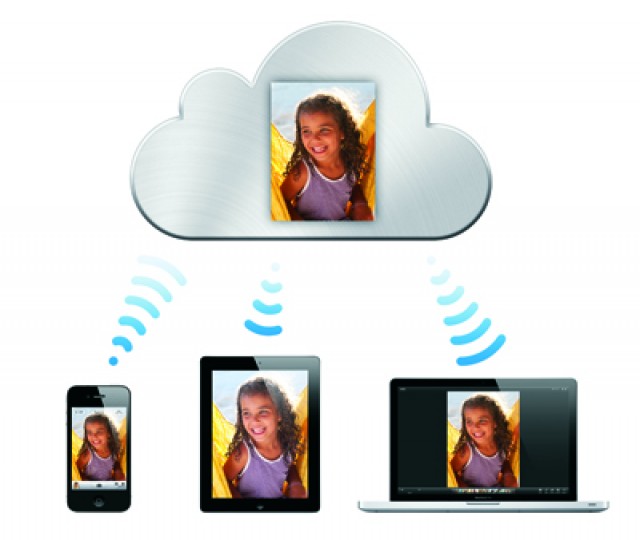
Could Apple’s introduction of iCloud to store music and other data online hurt demand for flash memory? That’s the concern of some who forecast the new service could “make a serious dent” in the NAND marketplace.
The iCloud service, expected later this fall, could decrease the need for flash memory by as much as 100GB per user, according to analysts at IHI iSuppli, which bases its estimate on 4MB per song and Apple’s cap of 25,000 songs stored on iCloud.
Apple currently consumes about 29 percent of the world’s flash memory supply, making any fluctuation in the Cupertino, Calif. firm’s demand worrisome. The tech giant uses flash memory for storage in the iPad, iPhone, MacBook and elsewhere.
“With Apple products like the iPhone and iPad accounting for a disproportionate share of NAND flash demand, any move among Apple users to offload storage to the company’s iCloud service could mean a corresponding decrease in demand for physical NAND flash memory in the future,” IHS memory analyst Dee Nguyen tells industry publication DigiTimes.
By 2015, Apple’s current 29 percent of the flash memory market will fall to about 25 percent, IHS predicts. However, Apple isn’t likely to damage a market it profits from handsomely. As we reported earlier, the company makes huge profits by relying on flash memory for its most popular gadgets, one of the reasons why Apple chose to sync users’ music collections, rather than stream tunes, like Amazon.
Although a consumer pays $100 more for a 32GB iPad versus a 16GB model, Apple pays just $15 – an 85 percent margin, according to the Wall Street Journal. Meanwhile, flash memory prices continue to fall, dropping by 30 percent this year and another 36 percent in 2012.
At some point, there will be a tipping point, when more Apple users store their data online than locally. At that moment – when it doesn’t matter if you device has 16GB or 32GB of flash memory – someone will likely take steps to right the imbalance.
10 responses to “Could iCloud Rain on Flash Memory’s Parade?”
Until they put cellular data or wi-fi in the NYC subway system, all iPhone users in the area will still rely heavily on local storage. The subway is probably the #1 place we listen to music, and you get absolutely no service underground. My next iPhone will definitely have a larger capacity than my current 4 I’ve outgrown.
This is silly. First of all, while I’m excited about iCloud, it’s actual utility is going to be negligible for most people, at least from the get-go. I’m using the beta, and I can tell you that it’s a nuisance to download individual songs to my iPhone when I want them. It’s great if there is a song I really want to hear and I can’t find on Spotify, but in practice, it’s a cumbersome process. Second, the files that take up the most space on a device are video files and large applications, and those simply aren’t going to be offloaded to iCloud. If I’m travelling and I want to take a few movies with me, I’m going to keep them stored locally. When I’m done with them, I’ll take them off my device when I sync. At no time am I going to use iCloud to store a 3.2 GB video file. Third, 3G connections just aren’t fast or reliable enough and WiFi isn’t ubiquitous enough to really allow iCloud to work the way it could.
Five years down the road, I bet that iCloud will offer streaming of music and videos, the ability to sync playlists, and seamless integration with one’s media library on all devices. That will help. LTE will help, too, but it won’t fix all of the problems. iCloud won’t do anything to replace the need for Flash until everyone can connect to the internet at anytime from anywhere.
Keeping everything in the cloud and streaming content works fine for devices like desktops and AppleTV because they are (presumably) always connected to high-speed networks. It doesn’t work that way with mobile devices.
The idea of machines with little to no memory never dies. But it’s unrealistic and unnecessary. Networks are still years and years away from being fast enough to download data users want in real time. Until networks are fast enough to allow you to download an HD movie in 0.2 seconds (the time it takes to open an app), having lots of memory on machines offers an infinitely better user experience. Even when networks are that fast, will it be most to download a song everytime the user wants to listen to it? Not likely, since by the time networks are that fast, memory will also be much smaller and cheaper.
iCloud will help us manage and sync our digital content but i don’t think we will get away from carrying our content with us. It is my understanding that iCloud is not a streaming service, so if you want to listen to your music, it will need to be on your machine, iPad, iPhone or iPod. So the presence of iCloud will not reduce flash memory demand. iCloud will allow us to manage more data on our machines and in our iCloud with the local flash storage we already have.
Actually the story isn’t total nonsense. the naysayers just have the details wrong. It’s not Apple that is going to stop buying. Once iOS 5 and iCloud comes out, everyone else is going to give up. Which is going to mean that Apple won’t have to fight as hard to give flash memory so they can demand lower prices. And then they can lock in even more memory and the vicious cycle continues
(and yes I’m joking. a little)
Ideally, they’ll release a streaming component to iCloud at some point. At that point you’d have a net savings at 25$ a year for iTunes match for two years over $100 upgrade in physical memory.
In the meantime I wouldn’t be opposed to some solid third party solutions to the lack of streaming.
If you just wanted to stream the HD movie, you wouldn’t have to download the whole thing in .2 seconds. Desktops aren’t even capable of that, but they’re used for consuming HD video by downloading faster than they play.
I think mobile devices will eventually be restricted to streaming only with less physical memory, but not in the immediate future.
Most users won’t be able to benefit from this idea though.
1) All the carriers have 3G blackout areas. With AT&T, my building has no reception. The Pentagon which I pass by daily has no reception on the freeway. And along the cooridor unless AT&T builds LTE without errors. Verizon I’m sure has plenty of spots despite their colorful big red map with no holes in it.
2) No reception, no wifi, nada. If you never invested in WiFi before, you’ll need it now and an ISP plan. Not many of which utilize an ISP as they are mobile more than home.
3) Quality of stream music sometimes sucks because they preset their quality on the reception. If you are never on a WiFi service like me, you won’t be able to have perfect quality.
4) Will Apple be streaming video games too? You need at least some of that stored on flash memory. Unless you plan on streaming video games and play racing games over the web.
This is ridiculous… This site is really posting some lame articles lately. Brainwashed by Apple, I guess that’s why they call this cult of Mac.
Flash memory isn’t going any where. In fact, many people are switching from hard drives to SSDs which is going to increase the demand for flash memory. You’re still going to need flash memory in your phone to store your apps… And even cache locally some of the data that its on the server.
Plus, iCloud is NOT going to stream your music for you, so you’re still going to need local storage on your phone to listen to the music…
The usual idea is that you would use NFC to set up the link between the two devices and then do an automatic hand over to a different protocol for doing the actual transfer of data – eg Bluetooth,iphone 5

