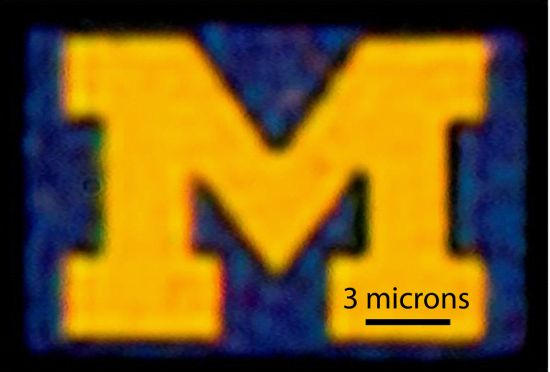
The iPhone 4’s incredible retina display boasts pixels so small and tightly packed that they are almost indistinguishable to the human eye…. but if a new technology created by University of Michigan researchers ever hits the market, the Retina Display might end up looking as antediluvian as VGA.
Using nano-thin sheets of metal with precisely spaced slits that act as resonators, the team of researchers built a tiny high-definition display with pixels eight times smaller than those on the iPhone 4. These nano-resonating displays are incredibly green-friendly, since they don’t require the chemicals needed to make an LCD; better, they’re far more energy-efficient to boot.
Need proof? The above image of the University of Michigan logo might look blurry, but that’s only because it’s magnified up from its original size, which is just nine microns wide. Six of these logos would fit in the width of a human hair.
If this technology ever hits the market, a fully high-definition 1080p display could be fit in the area of a postage stamp. Don’t be surprised if half-a-decade down the line, a grizzled and hunched Steve Jobs holds aloft the iPhone 9 and introduces the world to their hot new marketing buzz term: Nanoresonators.

John Brownlee is a writer for Fast Company, and a contributing writer here at CoM. He has also written for Wired, Playboy, Boing Boing, Popular Mechanics, VentureBeat, and Gizmodo. He lives in Boston with his wife and two parakeets. You can follow him here on Twitter.