The iPad Gets Ready for College

The iPad Gets Ready for College

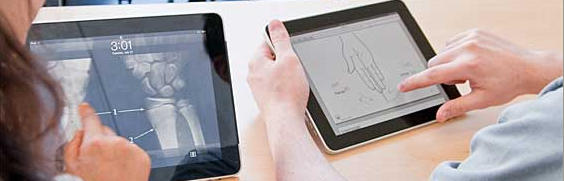
The iPad helps connect the bones for medical students. @Stanford U School of Medicine.

At just four months old, the iPad is preparing to go off to college.

Apple’s “magical” device, which launched April 3, will be handed out during fall 2010 orientation to college students at a number of US campuses, though the tablet computer won’t be replacing old-fashioned notebooks or pencils any time soon.

Stanford is the most prestigious university to announce an iPad program so far. All first year medical students and Master of Medicine students will be provided with an iPad.

“The iPad allows students to view and annotate course content electronically, facilitating advance preparation as well as in-class note-taking in a highly portable, sharable and searchable format,” the Stanford University School of Medicine announced on its blog. “Students will be able to easily access high-quality information at any place, at any time…and replacing printed syllabi with PDF’s is in line with the Sustainable Stanford initiative, which aims to build sustainable practices into every aspect of campus life.”
The iPad Gets Ready for College

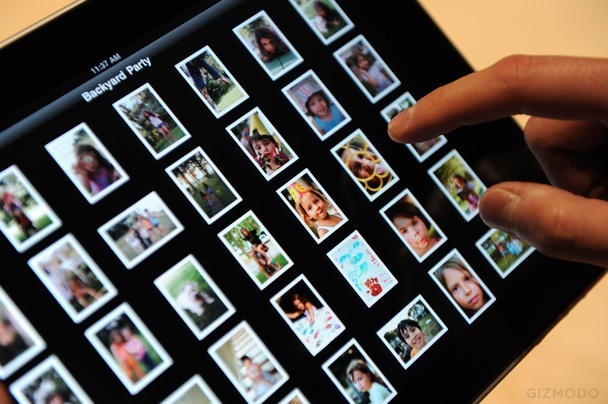
Organize party pics or study? Hmmm.@Gizmodo

A few private institutions opened the hallowed halls of higher learning to the iPad before the device even launched. They include Seton Hill in Pennslyvania, Northwest Tech in Kansas and George Fox University in Oregon.

At George Fox, where incoming students have been handed personal computers along with their orientation packets for the last 20 years, fall 2010 freshmen will be given the choice between an iPad or a MacBook Pro. The cost of the devices are included with tuition.

School officials admit they don’t know how much help an iPad will be for trig or anthropology homework.

“The trend in higher education computing is this concept of mobility, and this fits right in,” Greg Smith,  George Fox University’s chief information officer, said in a press release. “At the same time, we realize there are a number of uncertainties. Will students struggle with a virtual keyboard? Can the iPad do everything students need it to do when it comes to their college education? These are the kinds of questions we really won’t know the answer to until we get started.”

Not all colleges are early adopters. Some, including Princeton, Cornell and George Washington universities preferred to defer admission of the iPad for their students.

Princeton and George Washington have decided to wait over security issues while Cornell allows the device for individual students but has concerns over connectivity and bandwidth. The device also lacks a few other features that college students would find handy, like a USB port and print capability.

Would you like to see an iPad on every desk or do you think it’s not mature enough yet?

DON'T MISS
Colleges Delay iPad Use Over Security, Bandwidth Issues

Sources: Stanford University School of Medicine

The Wall Street Journal

George Fox University

Mc Cook Daily Gazette

Chronicle of Higher Education

About the author

nicole_martinelli

Nicole Martinelli is a San Francisco native who has lived in Milan and Florence, Italy. She's written for Wired.com, The New York Times and Newsweek. You can find her on Twitter , Facebook and Google+.

If you're doing something new/cool that's Apple related, email her about it.

(sorry, you need Javascript to see this e-mail address)| Read more posts by .

Posted in iPad, News |

  • BMWTwisty

    The Stanford use of iPads is a perfect illustration of how the iPad will become ubiquitous in the medical field (think “Halo”). It’s perfect for that situation. eText maturation will also greatly expand the use of iPads in general academic use as well.

  • Philip Handler

    The author quotes a WSJ article from April 19, 2010 saying that Cornell is not accepting iPads on campus. The follow up article in the Cornell Daily Sun on April 23, 2010 states clearly “Contrary to media reports, Cornell is not experiencing bandwidth problems as a result of iPad use on campus.”
    http://cornellsun.com/section/news/content/2010/04/23/cornell-will-not-place-ban-ipad

    Three and a half months is a long time to perpetuate misinformation.

    Phil Handler

  • http://www.zoomata.com Nicole Martinelli

    @Phil — the article (and above post) just says that Cornell’s not adopting the iPad en masse for its students due to connectivity concerns, not that it’s “banned.”
    If the WSJ had run a retraction or a correction we would’ve updated with that info. The story you linked to doesn’t really change that information…

  • Philip Handler

    Since when is the WSJ an expert on Cornell’s ongoing concerns or not about any device?

    Cornell CIT is the authority on whether devices are to be included normally or limited in access to the network. Here is CIT’s directions regarding setting up RedRover for Window, Mac and iPhone/iPod/iPad dated April 19, 2010.

    http://www.cit.cornell.edu/services/redrover/howto/setup/rrssetupiphone.cfm

    Where is there a notice from CIT about concerns, other than third party press?

  • Philip Handler

    Here is a blog called Cornell Insider questioning this WSJ article on April 18, 2010.

    “Can any techies explain the “security issues” related with having iPads on campus?”

    Here is the response on April 19, 2010.

    “Since the iPad was first sold about two weeks ago, more than 68 iPads have registered on the Cornell University wireless network. There are no known problems connecting and using an iPad on campus. Configuration to use the university’s RedRover secure wireless network is easy. Cornell University has a long history of being at the forefront of new technology. After all Ezra Cornell helped pioneer the use of the telegraph in the 1840′s. I imagine he would have really enjoyed using an iPad.”

    http://cornellinsider.com/2010/04/18/ipad-banned/

  • Charlton

    For what it’s worth, I’m a college student who has already started to use an iPad to take notes in class during summer school. My response: the iPad improved my grades. In two classes where I took my MBP, I usually just stayed on Facebook or read stuff on the Internet. In the class where I “tested” the iPad, the professor could see if I was tapping around the screen or reading down into the iPad, so I stayed much more engaged and interested. Plus the fact that the device lies (nearly) flat on the table and not perpendicular means that I physically had to sit up and forward. In the other two classes I tended to slouch back and hide behind the screen. I actually made the highest grade in the class with the iPad and was exempted from the final! Bottom line, I’m taking the iPad to every class from now on.

  • Roy

    You can’t do half of the things on an iPad that you can do on a MBP. It might be more distracting to be able to access the entire internet but that’s not the device’s fault.

    The thing that will really get the iPad going in the classroom is a deal with the textbook giants. I know i’m getting tired of spending 150$ on a book that I have to rifle through to find information rather than a quick automated search.

    By the end of the semester when you sell the book back you get maybe a third of what you paid for it with nothing to show for it. I know I’ve had a few repeats in terms of textbooks from one year to the next with different classes.

    If you cut out the cost of manufacturing and shipping, the price of an eText should be a lot cheaper. And you wouldn’t have to worry about the depreciation associated with “driving it off the lot.” At the end of the day you’d have a library of search-able texts that you could use for a number of different courses.

    I’m gonna graduate soon, so hurry up already.

    How has no one cashed in on this yet???

  • student

    lol textbook piracy has already paid for my college iPad!