Does your Mac also boot into Windows? Mine does, and it’s a pretty great perk of owning a Mac since 2006. But modern Intel-based Macs aren’t the only ones that can dual boot operating systems.
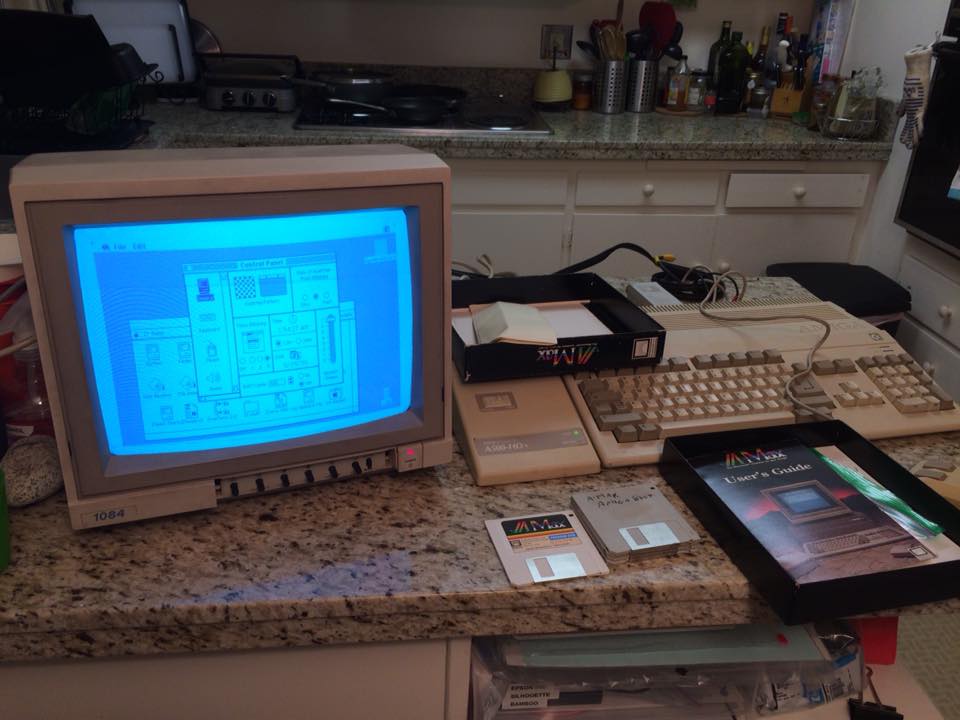
Proof? This Amiga from the 1980s booting up Mac OS 6.0.1, the result of a particularly clever hack from the vintage computing archives.
Usually, when a system like a vintage Mac is seen running on a different computer, it’s done through emulation. Emulation is when you use a faster computer to essentially pretend to be another system. Emulation is comparatively slow, compared to running the same programs on original hardware, but Moore’s Law makes up for it, making it seem just as fast as if it was running on original hardware.
At the same time, though, this means you can only emulate systems older than current hardware. You could never, say, use an Xbox One to emulate a Wii U at full speed. Nor could you see a vintage Mac emulate a vintage PC at full speed: it just doesn’t have the bandwidth to “pretend” to be another system.
So what we’re looking at here isn’t really emulation. Instead, it’s a weird Frankenstein project, in which a vintage Mac’s ROM chips have been connected to an Amiga’s Motorola 68000 processor, which was the same CPU in the Macs back then. It was all accomplished with an old retail app called Amx, “the Macintosh emulator for your Amiga.” The hacker explains:
Worth noting that this is not “software emulation” like how you might run Mini vMac on a modern computer. This setup literally connects two Apple Macintosh ROM chips (from a Mac Plus, in this instance) to the Amiga’s floppy drive, and via some unholy alliance of A-Max controller software + Apple ROM code + the Motorola 68000 CPU in the Amiga (the same chip that powered all the early Macs), this is a “hardware” emulation system. Interestingly, the Mac boot disk I have is too old to be 32-bit compatible, so while it “sees” the full 9 megs of RAM in the Amiga, it can only access 512k of it.
It’s a nutty hack, one that only a die-hard vintage computing fan would try, but it worked: the original Boot Camp Mac of the 1980s.
Source: Reddit

John Brownlee is a writer for Fast Company, and a contributing writer here at CoM. He has also written for Wired, Playboy, Boing Boing, Popular Mechanics, VentureBeat, and Gizmodo. He lives in Boston with his wife and two parakeets. You can follow him here on Twitter.

5 responses to “This is what Boot Camp looked like in the 1980s”
People used to say that the Mac was the younger brother of the Amiga. At the time Amiga ruled.
The better solution was ShapeShifter, a completely software version that does the same just as well.
Also the product you mention was A-Max
Hey, this was my Reddit post! So cool to be featured on Cult of Mac, and I’m happy to answer any questions you guys might have. Also, since I know any weirdo can claim anything on the Web, here’s another pic I shot last night, shortly after repairing a busted wire in my Amiga’s RGB video cable (probably wasn’t helping the terrible flicker it has while running the A-Max emulator):
Mac and Amiga were very similar hardware, which was why it was very easy to emulate a Mac on an Amiga. In fact, Amiga with its high speed blitter chip and other custom hardware could emulate an equivalent Mac faster than the Mac itself. (IIRC Agnus runs at over 20 MHz while the 68k processor ran at 7) The device that connected to the Amiga was really just a dongle holding the Mac ROMs and a means to plug in a Mac floppy drive to the Amiga which was required to use disks made in certain Mac formats. All the real work was done by software which was evidenced by pirated versions of both A-Max and the later Emplant that came out allowing use of software ROMs for the Mac to operate. This was also true of the later Emplant boards which were internal and also had Apple serial ports and allowed connection of dedicated SCSI hard drives to further speed up Mac emulation.
I’ve actually recently managed to pick up both Mac emulators for the third of the ‘trifecta’ of 68000 based home computers the Atari ST.
As you could get Amiga’s fitted with 68060 accelerator boards, you could run 68K versions of Mac OS faster than computers released by Apple themselves. The Amiga also had a fully multitasking operating system, which was heavily based on BSD, rather like Mac OSX today. You could also run versions of Unix, and other Unix-like OSes’ on an Amiga. It was an incredibly capable computer.
Actually, if you have a PPC based Macintosh, like an early Mac Mini, or a G5 iMac, you can dual boot into AROS – Amiga Replacement Operating System – and run classic and PPC Amiga software. So on many ways, things have come full circle.