LAS VEGAS — Everyone hates loudmouth jerks who talk too loudly on their cellphones in public. If this is you know or someone you love, a new startup may have the answer.

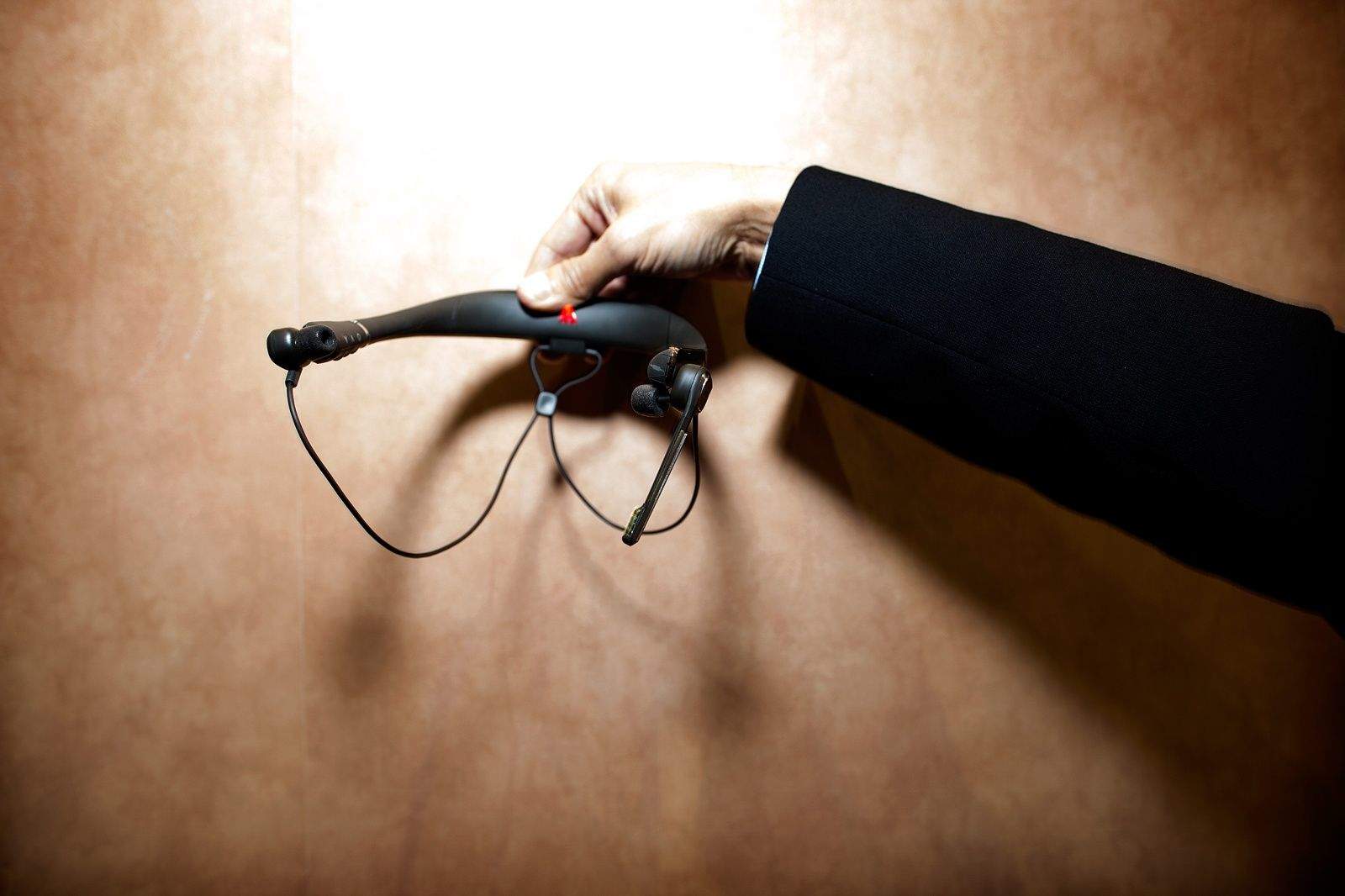
Onvocal’s Mix360 is a Bluetooth headset with a microphone that detects ambient sound. So if you’re talking on your cell, you can hear exactly how loud you are and modulate your voice accordingly.
“It’ll end those annoying calls where people can’t hear how loud they are and are shouting into their phones,” said Ashley Waters, a spokeswoman for the Massachusetts-based startup.
Ending loudmouth calls is just a side benefit. The Mix360 headset is designed for people who need to hear the environment around them while talking or listening on a headset, like frequent travelers listening for announcements at the airport.
The headset ships with an app that allows audio to be mixed from three inputs — source, ambient and voice. The app allows you to adjust the different volume levels of each input. It includes presets that will lower the volume if the wearer is listening to music when a call comes in, turning the music back up when the call ends.
The Mix360 will cost $349 when it goes on sale later this spring, but the company is taking per-orders until the end of January for $299.
I like the idea of the Mix360. I would love to see a pair of sport headphones. I like to listen to music when I’m cycling, but it’s dangerous to block your ears.
But I have concerns about the design. For a Bluetooth headset, it’s big and bulky. It felt like putting a horseshoe around my neck and then I had to fiddle with putting the earbuds with the microphone in my ears. It was a bit of a dance to put it on. It also feels as fragile as hell. Maybe the final product will be more robust, but the one at CES felt pretty flimsy.
The idea is interesting, but the implementation is a commitment.

Leander Kahney is the editor and publisher of Cult of Mac.
Leander is a longtime technology reporter and the author of six acclaimed books about Apple, including two New York Times bestsellers: Jony Ive: The Genius Behind Apple’s Greatest Products and Inside Steve’s Brain, a biography of Steve Jobs.
He’s also written a top-selling biography of Apple CEO Tim Cook and authored Cult of Mac and Cult of iPod, which both won prestigious design awards. Most recently, he was co-author of Cult of Mac, 2nd Edition.
Leander has been reporting about Apple and technology for nearly 30 years.
Before founding Cult of Mac as an independent publication, Leander was news editor at Wired.com, where he was responsible for the day-to-day running of the Wired.com website. He headed up a team of six section editors, a dozen reporters and a large pool of freelancers. Together the team produced a daily digest of stories about the impact of science and technology, and won several awards, including several Webby Awards, 2X Knight-Batten Awards for Innovation in Journalism and the 2010 MIN (Magazine Industry Newsletter) award for best blog, among others.
Before being promoted to news editor, Leander was Wired.com’s senior reporter, primarily covering Apple. During that time, Leander published a ton of scoops, including the first in-depth report about the development of the iPod. Leander attended almost every keynote speech and special product launch presented by Steve Jobs, including the historic launches of the iPhone and iPad. He also reported from almost every Macworld Expo in the late ’90s and early ‘2000s, including, sadly, the last shows in Boston, San Francisco and Tokyo. His reporting for Wired.com formed the basis of the first Cult of Mac book, and subsequently this website.
Before joining Wired, Leander was a senior reporter at the legendary MacWeek, the storied and long-running weekly that documented Apple and its community in the 1980s and ’90s.
Leander has written for Wired magazine (including the Issue 16.04 cover story about Steve Jobs’ leadership at Apple, entitled Evil/Genius), Scientific American, The Guardian, The Observer, The San Francisco Chronicle and many other publications.
Leander has a postgrad diploma in artificial intelligence from the University of Aberdeen, and a BSc (Hons) in experimental psychology from the University of Sussex.
He has a diploma in journalism from the UK’s National Council for the Training of Journalists.
Leander lives in San Francisco, California, and is married with four children. He’s an avid biker and has ridden in many long-distance bike events, including California’s legendary Death Ride.
You can find out more about Leander on LinkedIn and Facebook. You can follow him on X at @lkahney or Instagram.


One response to “This headset could bring an end to loud, obnoxious public phone calls”
If the headset is blasting ambient noise back into your ear, wouldn’t it stand to reason that it would make the phone call harder to hear and make you want to speak louder into the mic? Just a thought. People get louder on the phone in noisier areas.