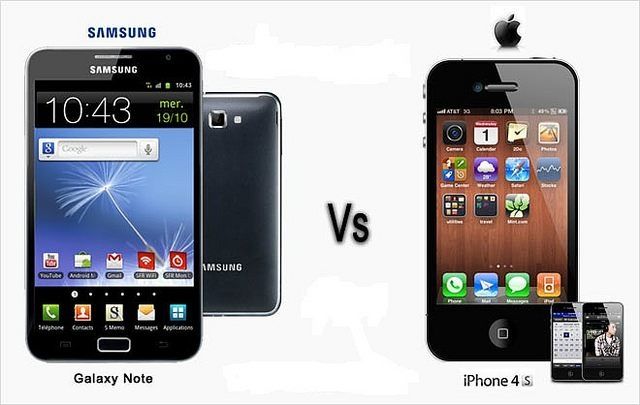
On the sixth day of the Samsung-Apple trial, deeply granular elements of each company’s products continue to be mined for infringement claims. Testimony from industry experts focused on innovations present in scrolling and pinching gestures used on touch-screen gadgets like the iPhone and whether Samsung blatantly ripped them off.
Judging from the cheap seats of the media bench, the claims appear valid. In particular, visual evidence comparing the functionality of the iPhone’s operating system to that of its rival makes similarities pop out. For example, two-finger gesturing to zoom in on web browsers on relevant Samsung and Apple products is practically the same.
But it is up to the nine-member jury to decide. Attorneys for Samsung keep pleading with them to “keep an open mind” in regards to the evidence, perhaps acknowledging one of the trial’s most important elements: the tech business thrives on replicating and improving on previous innovations and many products look and play the same. As we know, everyone from Steve Jobs to Bill Gates to companies like Facebook has been accused of sorts of high-end intellectual thievery. A defining difference Apple counsel seeks to prove in this trial is that Samsung’s line of phones and tablets has gone beyond historical modes of flattering imitation to one of exact duplication that is potentially financially-crippling.
Today’s trial is still in session. Below you’ll find a quick summary of the morning session and I will update the rest of the afternoon in a live blog.
Morning session review:
Apple brought on survey expert Kent van Liere to highlight the confusing effect functionality similarities between the iPad and the Galaxy tablets has on consumers.
Van Liere performed multiple surveys where users watched videos of tablets performing similar scrolling gestures. The survey results noted a large number (about 37%) of respondents experienced some level of confusion between Apple and Samsung products. Samsung counsel countered by intimating the surveys were rigged because they focused entirely on the UI and separated people from using the products. No one survey, in this instance, allowed the users to actually play with the tablets and go through the features. The object of this questioning was clearly meant to bring doubt to the objectivity of the witness. Throughout the day, Samsung attorneys noted, sometimes sarcastically, that Apple’s witnesses are being paid very well and have loyally worked on its behalf in previous legal cases.
Following van Liere, University of Toronto Professor Ravin Balakrishnan talked about the “bounce-back” effect in the iPhone and iPad operating systems. The “bounce-back” effect is the famed little animation that happens when you move around a file or a window halfway through the screen and then release it. Balakrishnan said his analysis showed Samsung copied the “bounce-back” effect from Apple. Attorneys strengthened his testimony by bringing up previously submitted evidence of Samsung self-analysis reports, noting Samsung engineers appreciated this UI effect and warned about its absence in their products. Apple lawyers then slam-dunked the point home by showing Samsung phones which included the same “bounce-back” effect in their succeeding phones.
Afternoon Session
The afternoon session began with the testimony of Dr. Karan Singh, another University of Toronto Professor of Computer Science. Dr. Singh is well-known in the industry for his innovations in programming graphic effects, which he described as a bit of art like “converting physical objects” into usable forms of PC communications.
Apple is using Dr. Singh’s testimony to further highlight differences between scrolling and gesture controls bound by Apple patents. The patent in question basically says Apple’s OS makes a distinction between scrolling and gestures so it can figure out scaling of pages at a super fast rate, making browsing smooth and easy. (Think of the video of the New York Times webpage that was first shown by Jobs in the original iPhone keynote). The difficult part about bringing scrolling features up in a trial is that scaling transformations on modern mobile browsers are not easy to discern by the average user. So it’s not a surprise Samsung lawyers took the opportunity to ding his testimony.
Dr. Singh said he was hired by Apple to study Samsung and that over 20 products infringed on Apple’s scrolling and gesture patent, including the “bounce-back” effect. He also reviewed the source code relevant to the patent. He said the Samsung Galaxy S II (T-Mobile) was most like the iPhone 4 and in a slide, noted similarities between phones in a two-finger scrolling of a news page. Other Samsung phones with “easily replicable gesture operation,” according to Singh, are the Ace, the Captivate, the Epic 4G and the Exhibit 4G.
The patent itself, unsurprisingly, is a bit dense and was used to beat the witness over the head with his own knowledge of finger gestures. Attorneys questioned whether they constituted universal UI gestures that Apple has no right taking claim. This is a valid question Apple’s rival companies have previously brought up. The patent describes the scrolling function as a “machine readable storage medium storing executable program instructions” and that once a device “receives user input…” it creates an “event object in response of the user input.” So it’s also vague. Just a tad. Singh defended Apple’s patent,saying it specifically covered gestures where people use one finger to scroll and another to gesture (such as to zoom in on text), and not use the two fingers at the same time.
At this point, he was confronted by a Samsung lawyer who brought up a video of a Galaxy tab under a projector, showing scrolling using both fingers, moving in the same direction, to scroll a news page on the screen. This was intended to refute Singh’s claim that the Galaxy copied the iPad’s gesture controls. The attorney said the user shouldn’t be able to scroll with two fingers if the Galaxy had the same function as an iPad. But there was an obvious problem for Singh in the presentation. He smiled wryly and noted that tablet’s screen was moving spasmodically, not smoothly, scaling and translating at the same time. Essentially, the Samsung attorney was mistakenly refuting his own claim with his presentation, only it wasn’t as obvious as a stained, shrunken black glove. Dr. Singh offered to use a tablet and show him what he was talking about directly but the Samsung attorney wouldn’t allow that. He claimed that he didn’t see what Singh was talking about with the spasmodic two-fingered browsing: “Maybe it’s a difference of opinion.”
After a short bathroom break, Dr. John Hauser , Prof. of Marketing, Market Research and Analysis at MIT followed. Dr. Hauser is known for applying mathematics to business problems. Basically, he is a marketing research and theory savant who uses his talents to find out people’s inner feelings about their willingness to pay for feature premiums.
His major conclusion was that Samsung consumers are willing to pay a substantial premium for top features, across the board. And he found a good number of these features, which build demand for their products, are the same ones in question in the trial, including iconography, UI controls, and industrial design. His major method of search analysis is through conduit analysis, where a person’s internal and external validations (in this case in buying a gadget) are sought through specific questions. They also predict if people “behave the way they say they are going to behave.” This is important in building gadgets, obviously. If 60% of respondents say they are willing to pay $100 extra for a phone with a larger image sensor, for instance, then the company has direct evidence to push their manufacturing in this direction.
Dr. Hauser noted Samsung owners of a $200 smartphone were willing to pay about $39 more if it included Apple’s pinch-to-zoom feature while buyers of their $500 tablet were willing to pay up to $45. The same users said they were willing to pay twice those amounts if the pinch-to-zoom was combined with the “bounce-back” feature and other similar UI moves in evidence.
Samsung cross-examined Dr. Hauser in the same manner they did everyone else today. They went after his money, his methods, and his presumed lack of objectivity. They forced the Professor to reveal that his income for his Apple research work was a cool $800 an hour or about $40,000 per analysis. Hauser seemed pretty happy mentioning this fact. But Samsung lawyers weren’t pleased when the professor refused to answer follow-up details on his survey methods. They repeatedly complained at the end of the testimony that Hauser was merely present to waste some of their precious allotted time. Each side has a total of fifteen total hours.
Before the session ended for the day, one of Apple’s managers for computing patents took the stand for a few minutes.
He explained Apple’s licensing and why they want to “safeguard Apple’s differentiation and experience.” He proudly boasted that Apple’s UX design helps “keep the brand up” and why it is financially important to hold on to their trademarks and patents. He is expected to continue his testimony on Monday describing the architecture on android phones that infringe on Apple patents.
Until next week, when this gorefest of technological minutia of a trial moves from three days a week to an every day grind.

Jose Fermoso is a freelance reporter and researcher. He has written freelance for many tech and business publications. He is a former writer for Wired.com and GigaOm. Loyal Oaklander. Twitter @fermoso.