The man behind the popular iA Writer app, Oliver Reichenstein, has posted some interesting observations on the App Store ecosystem. In a Google+ post titled “Revenue = X,” the founder of Information Architects explains how his decision to drop the price of iA Writer on the Mac and iPad has resulted in a way to “increase exposure without affecting profit.”
Dropping iA Writer’s price has resulted in more purchases than expected, and Oliver’s profits have largely stayed the same since he made his app cheaper.
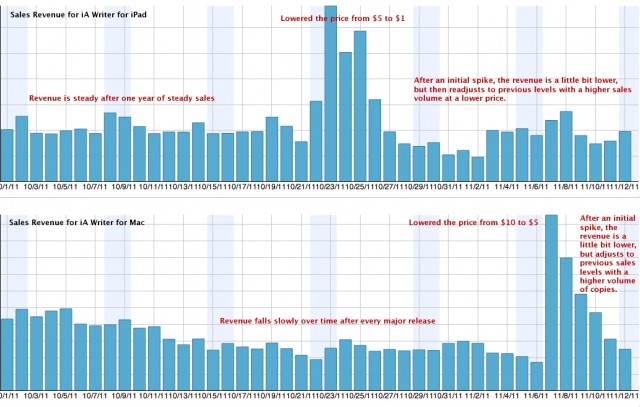
iA Writer for iPad’s price was recently dropped from $5 to $1, and Oliver is selling exactly 5x more apps than he was before. On the Mac, iA Writer’s price drop from $10 to $5 has resulted in the same sales behavior. Oliver notes that, “No matter what price we choose, we always make the same revenue.”
What I expected was that at a certain point the price change would impact the sales profit positively or negatively but it never did.
I’m happy to be able to offer iA Writer to more people without losing too much money (see below), but I’m still puzzelled: It seems that cutting the price is a way to increase exposure without affecting profit. Either the app store is rigged, or the market seems to magically decide in it’s invisible head quarters how much money is going to be spent on an app. (I don’t think that the app store is rigged).
Oliver also says that app growth is affected by many factors, including, “support costs, the probability of super rare bugs and negative comments (not just on the App Store.)” Therefore, “unless your goal is to grow a big user base, cutting the price is not a recipe to increase revenue but to inflate your app.”
What do other developers think of this phenomenon? Do low-cost apps end up providing steadier profit in the long run?
(via AppAdvice)
42 responses to “Developer Realizes That He Can Cut App Prices And Not Lose Money In The App Store”
The article said:
“Oliver is selling exactly 5x more apps than he was before.”
If he’s selling exactly 5x more apps, he’s selling exactly 6x as many apps. Or did you mean to say that he’s selling exactly 5x as many apps?
You are the least fun person ever
What’s the matter?
Didn’t you like math classes?
no one sane actually *likes* math class.
This is why I conducted market research using survey monkey, turns out the best price for m app was 1.99
I beg to differ…
His data set looks a little too short to be exclaiming this to be true.. Leave it there for another 2 weeks, and then let’s see the graph….
Yeah, but is he going to be hit with 5x the support calls and emails?
Of course lowering the price works – I don’t think twice about dropping $1-2 on an app I may or may not like. It’s a cup of (cheap) coffee or a soda.
$5? That’s a Happy Meal… and if I don’t like the app, I don’t get a little toy to put on my desk after.
Muahaha I love when people cant easily find out their statistics and market research info correctly/easily it makes me feel like the world isn’t just a bunch of data and shows hey guess what WE’RE ACTUALLY PEOPLE!?
Welcome to basic economics!
Race to market saturation.
I cut Sleep Sounds (shameless plug) from $1.99 to $0.99 and sold roughly 5x more, so my revenue increased significantly. I also now have a prominant position in my category so the initial spike didn’t go away. It’s been this way for a little over a month and I actually get more reviews that are almost all positive.
I am going to download this app tonight, for no other reason than this dude lowered the price. Less expensive = More better :)
Thanks buddy for thinking bout the little people
developers should read economics for dummies.
says the “Professor”!
Seriously!? That’s amazing! More copies sold because it was cheaper… mindblowing
what are you, a retard?
…no, you stupid shit…
I shouldn’t even have to explain this, oh divinely pre-pubescent gremlin-esque one, but I was being facetious in my response to the article. And yes, I am 34.5% retarded, thanks in part to my dealings with individuals such as yourself.
Next time, use your inner voice.
i cant believe that we needed a whole article to explain to us “economy of scale” . If you can monetize demand, which it happens, it means that in one way or another, a constant, “preset”, amount money is going to be spent for a product. If that number is a total of $100 let’s say, and if the price 50$ a piece, i am sure 2 “rich” persons will purchase it. On the other hand, if it’s 1$ a piece, then it’s quite expected to a 100 people to spend $1 because its 50 times easier to do so! What’s so wow with that?