The phrase “putting a genie into the bottle” comes to mind as reports surfaced Monday of a malicious offspring of a prank aimed at owners of unsecure jailbroken iPhones. Dubbed the “Duh” worm, the latest security threat targets the financial data of customers using online bank ING Direct.
The worm redirects ING Direct users to a phishing site. Those phones also come under the control of a botnet in Lithuania, reports said. The attack searches for iPhones that use the default secure shell (SSH) root password of “alpine.” The jailbreaking process often requires a person to install SSH, but many fail to change the default – opening the door wide for malicious hacks.
Update: A new Apple Store Black Friday “ad” leaked again to Boy Genius Report – this time from what the site described as a “pretty credible” source bearing “more reasonable” sale prices. Among the items, iMacs and MacBook Pros starting at $1098, iPod nanos for $138 and iPod touch for $178. Apple TV reportedly going for $208, Airport Express for $88 and the Magic Mouse and wireless keyboard for $64 each.
Apple today unveiled a teaser ad on its U.S. and UK online stores, offering no details on what bargains could be available for Mac fans. The official announcement comes just days after a purported flyer (later shot down) indicating up to a 30 percent discount on items.
“Come back to the Apple Online Store this Friday for a special one-day-only shopping event,” the ad urges. “You’ll find lots of iPod, iPhone and Mac gift ideas – all with free shipping.” Unlike the UK, where the upcoming holiday is not commonly observed, the U.S. online store mentions “the day after Thanksgiving.”
App Store approvals issues continue to grate, despite Schiller's assurances.
BusinessWeek ran late yesterday an interesting article interviewing Phil Schiller about the App Store. While it’s good to see Schiller again talking publicly about the approvals process, it’s sad to see Apple still ignoring key issues.
Rumors about Apple’s still-unannounced but wildly anticipated tablet are flying like crazy at the moment, in a fashion not unfamiliar to the last few months before we finally got to see the iPhone. And, as Ed told you last week, content providers are making pronouncements about getting their stuff on the device, believed to be optimized for reading newspaper and magazines.
Conde-Nast and our old friends at Wired, in particular, are announcing that they’ll be on the Apple Tablet and have already developed a special multi-touch magazine format just dying to be present at launch. They’re so confident about this, in fact, that the holidays-only Wired Store in Manhattan features a concept mock-up of the tablet and its interface, which you can watch in the above video.
Some things to note:
The design concept is…a big iPhone, more or less.
The interface actually looks quite nice, and I could imagine reading it.
There is no way that anyone at Conde has handled an Apple Tablet. They couldn’t possibly be this publicity-seeking or bold about their pronouncements if they had been brought behind the Steve curtain.
Also, the fact that Wired worked with Adobe to create the new format is a clear sign that they’ve had no contact with Apple. Anything based on AIR or Flash is unlikely to be compatible with the Tablet, for all the reasons there is no Flash or AIR on the iPhone
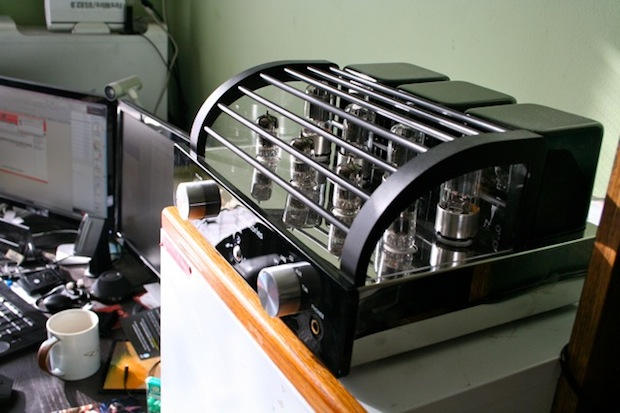
Until I tried Neuhaus Laboratories’ T-2 vacuum tube amp, I thought I had a pretty good speaker system hooked to my Mac. It was a three-piece ensemble with a pair of nice satellites and a honking big subwoofer. It pumped out 200-watts and I thought it sounded great.
But then I hooked up the T-2 Amplifier, and it’s literally night and day. I know this sounds like an old cliche — but it’s true. Even a half-deaf old punk like me (too many ear-piercing concerts) can hear the difference. It’s striking — and it’s absolutely glorious.
Maybe you’re a budding musician working at a nightclub and don’t know what to do with all the misplaced iPhones left behind. Or maybe you’re just brilliant and a wee bit inebriated.
Either way, we figure this is how you might be spending your time (uh, just don’t forget to activate “Airplane Mode” on ALL the phones). And unlike other hey,-watch-me-turn-a-phone-into-a-musical-instrument performances, this one doesn’t seem quite so much like a peek into Bizarro World.
Next up: Chef Ramsey hosts a Hell’s Kitchen episode where the only cooking utensils are iPhones.
“You know, if you saute scallops on a non-stick iPhone screen, they won’t stick. That’s why it’s called fucking non-stiiiiiiiick!”
Cover Up is a new $0.99 iPhone app that masks embarrassing bathroom noises with other bathroom sounds, like running water, a hand dryer or blow dryer.
Trying to mask the sound of a giant anal raspberry is like spraying deodorant to mask a pooey smell: it never really works. But it may be useful if you’re known to the person in the next stall.
There’s nothing better than gazing up at the stars on a night out. For $3, Pocket Universe: Virtual Sky Astronomy, using sorta-augmented reality, lets the astronomically impaired among us impress our dates.
We close out the week and prepare for the long flights, long waits and long lines as Thanksgiving rears its head. To get you ready (maybe even point out a stocking-stuffer or two), we offer our top trio of deals. First up, nothing beats a good set of in-ear “headphones.” This deal features ‘phones from Apple that slice $6 from other offers. Next up: more and more of us take the office wherever we travel. To make work-at-home easier, there is a $50 deal on Apple’s iWork ’09 suite of applications. To relax, there is always the iPhone or iPod touch – and what are they without some apps. Apple has unveiled another batch of apps that’ll cost you nada – the perfect price as you compare this year’s shopping list with your always shrinking budget.
For details on these bargains and more (like a Samsung Luxia HDTV), check out CoM’s “Daily Deals” page after the jump.
Journos on Macs at Microsoft's Mobius event. @windows phone thoughts
It’s not an easy time for Microsoft — with Steve Ballmer having to field questions about being “buffoons” and an “evil empire” at the shareholder’s meeting (.doc) — so when they get together “the world’s most influential technology pundits and online writers” (nb: we weren’t invited) for Mobius to discuss super-secret mobile tech you’d think they’d have a more sympathetic crowd.
If this pic posted by Jason Dunn over at Windows Phone Talk is any indication, most journalists, even the best and brightest from sites like Engadget and Slash Gear are Macs, at a non-scientific ratio of five to three.
Sorry guys. It looks like we’re mostly interested in covering you, not using you.
In a sign of the iPhone’s power to attract, China Unicom Friday said it expects to have 10 percent of the nation’s 3G users by 2012. The comments by an unnamed executive of the country’s second-largest wireless carrier to China Daily echo those made publicly earlier this week.
China Unicom Chairman Chang Xiaobing told reporters recently he expects the iPhone will be the best-selling smartphone in the country. China Unicom sales of iPhones coincided with the introduction of the carrier’s 3G network. Although much was made of China Unicom adding only 5,000 when the iPhone launched in late October, the carrier said the iconic smartphone boosted 3G subscribers to over 1 million in just one month.
Microsoft CEO Steve Ballmer fielded heated questions from the software giant’s shareholders Thursday concerned about losing younger consumers to Apple. Responding to a question on how best to market to the “next generation” of computer users, Ballmer remarked that there “is a group of people with whom our market share is less.”
Although Apple CEO Steve Jobs was recently voted the “most admired entrepreneur” among the 12 to 17 year-old age group, Ballmer told the audience “it is important to remember that 96 times out of 100 worldwide, people choose a PC with Windows – that’s a good thing,” according to Seattle, Wash.-based TechFlash.
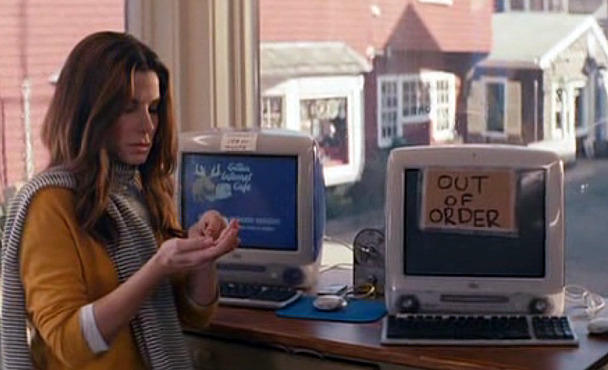
In “The Proposal,” Sandra Bullock plays a Canadian-born, bulletproof book editor who finds herself stuck in Sitka, Alaska while waiting to marry her assistant to get a green card.
After her cell phone gets stolen by an eagle, she picks up a replacement at the town general store — what could be more Alaska? — and then goes to the only Internet cafe around.
And has to answer all of her 37 urgent messages with a handful of dimes on a coin-operated modem system — via a iMac G3. This in stark contrast to the late-model iMac she had in her New York fiefdom.
It was one of the only bits in the movie that made me smile. I kind of wish I hadn’t sold mine, old as it was…
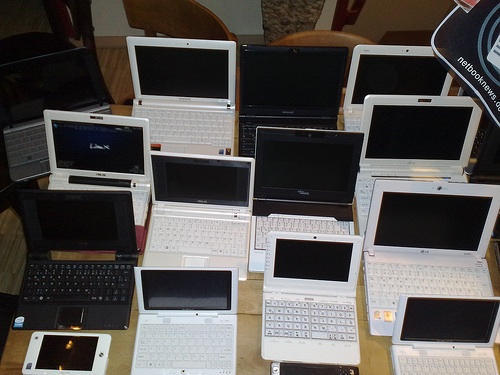
Hackers have bypassed Apple’s desire to remove support for Intel’s Atom processor from Mac OS X 10.6.2, allowing the increasingly popular netbooks to run Cupertino’s latest operating system. The complicated hack replaces the Mac OS X kernal, according to reports.
The low-powered Atom processor from Intel is often used by low-cost netbooks. Apple currently offers no hardware officially supporting the Atom chip.
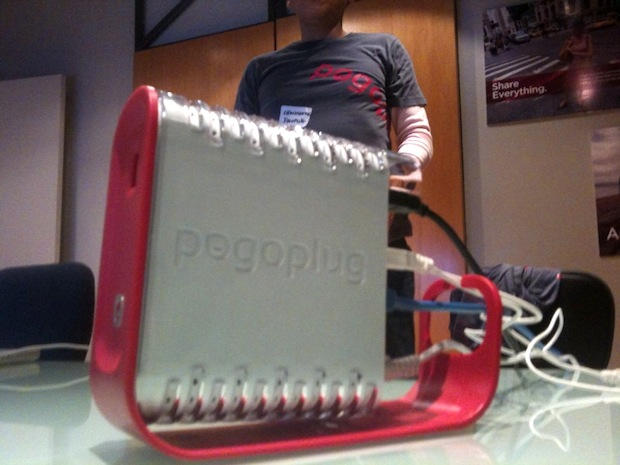
The Pogoplug is a fantastic little gizmo that turns any USB hard drive into your own little cloud server accessible over the Internet. We gave it a very enthusiastic review.
Now the company behind the device has issued version 2 — updating both hardware and software — and it’s all about multimedia.
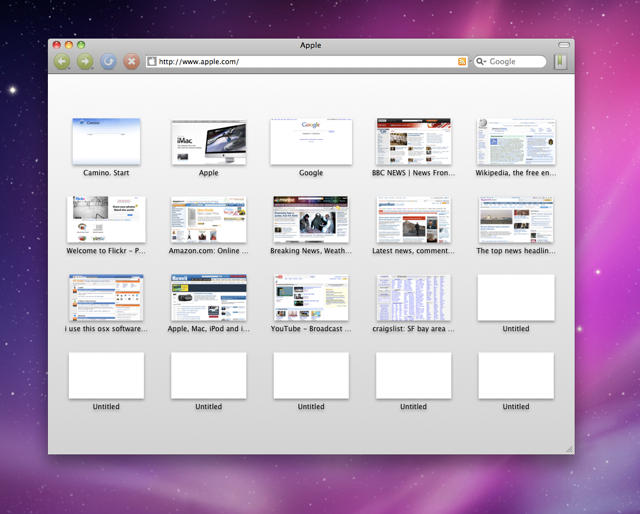
You know, even after all these years, Mozilla Firefox still isn’t great. The interface looks un-Mac-like, the performance is worse than on Windows, and it just feels like an after-thought. Fortunately for those who still have a lot of love for the Gecko rendering engine, the folks behind the Camino Project continue to do brilliant work on their independent Camino browser, the 2.0 release of which shipped yesterday.
I’ve been an avid Camino user since it was known as Chimera, and the new version has lots to offer, particularly in terms of stability, security, and one totally unique feature. Needless to say, it remains (in subjective experience) the fastest browser on the planet, and it’s finally caught up to Safari with annoyance blocking, malware/phishing protection, tab re-ordering and Keychain support. But the headline addition here is Tab Overview, a very cool idea that works like Exposé for your browser tabs. Basically, you just type CTRL-CMD-T, and you get a dynamically resizing window with snapshots of everything you have open. It’s quick and nearly flawless.
I want to use it steadily for a few days before I render a final verdict, but I might just be in love.
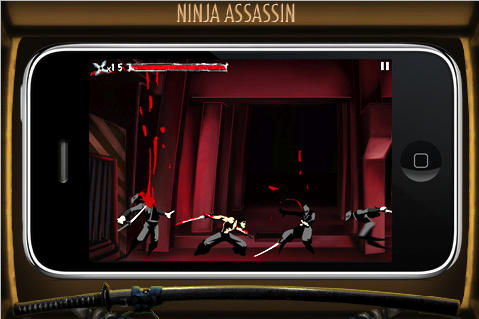
Ninja Assassin the movie is an anticipated Hollywood swords and sandals epic from James McTeigue, director of V for Vendetta, with a story from J. Michael Straczynski, the creator of Babylon 5 and the only Spider-Man comic in which Dr. Doom cries (though the artist allegedly came up with that last bit).
It’s also now an iPhone game, and a quite nicely produced one, at that. It might, in fact, be the bloodiest game to ever come to the platform, if that’s your thing. Seriously — you get measured on the number of successful decapitations per level.
Here’s a guide for finding the best bargains on Apple-related gear during the infamous Black Friday sales on November 27. We’ve compiled a comprehensive list of gear from leaked photos of sales flyers and descriptions of sales.
The bargains include a 2.26 GHz MacBook + $150 gift card at Best Buy for $999.99 ; a 32GB iPod Touch + $30 Gift Card for $295.00 at Target; and a Sony Speaker Dock Clock Radio For iPod/iPhone for $79.99 at Office Depot.
We’ll continue to update this guide as more retailers announce their Black Friday offerings in the run up to the big day.
This is what you’re about to ask: Is Star Wars: Trench Run so good that it’ll have you wondering how magically your iPhone becomes an X-wing fighter? Answer: No. It’s better — it’s actually so good, you’ll be trying to figure out why your X-wing looks suspiciously like an iPhone.
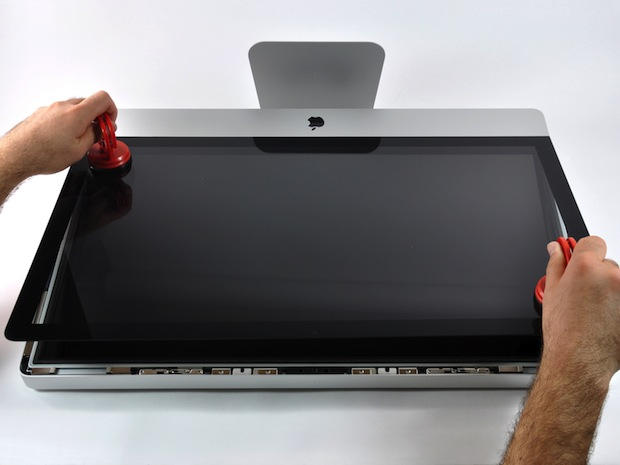
The repair and teardown experts at iFixit are releasing more than 240 repair guides for every Mac mini and most iMacs produced since 2004. The company is also now selling iMac repair parts, from hard drives and RAM to power supplies and disassembly tools.
“The repair manuals include in-depth disassembly guides, model identification tips, troubleshooting techniques, and upgrade information. The 241 new repair guides use 1,452 photos to clearly communicate each step of the repair. iFixit repair guides are well known for world-class photography and clear, concise step-by-step directions.”
iMac repair manuals — cover all 17″ and 20″ iMacs manufactured since 2004, including both G5 and Intel models.
Mac mini repair manuals — cover all Mac minis since its inception in 2005.
Looking at Google’s Chrome OS demos today, I noticed a giant omission that bodes ill for its future: it’s not optimized for touchscreens.
Chrome looks like a nifty version of a desktop OS, like a version of OS X or Windows, that pulls a lot of data from the cloud. Yeah, it’s slick, thoughtful and forward thinking, at least in one sense: Cloud apps are clearly the future, so why not the OS also?
But it looks like a traditional WIMP OS (window, icon, menu, pointing device). Why isn’t Chrome optimized for finger controls? The future of computing is mobile devices; and the future of mobile devices is touchscreens. As far as I can tell, Google didn’t mention touch at all, and none of the press asked about it.
Google says the Chrome OS will be launched by this time next year, by which time Apple will probably have reinvented the mobile computing experience with a multitouch tablet.
Apple’s tablet will do for netbooks what the iPhone did for cell phones — make the competition look hopelessly antiquated, whatever OS they run. Google says the UI is still under development and is subject to change; they’ll have to change it radically if they want a chance of competing with Apple, which has already adapted Snow Leopard for touchscreens.
Like Steve Jobs says, quoting hockey player Wayne Gretzky, Google needs to be aiming for where the puck’s going to be, not where it’s at now.
By this time next week, millions of American’s mouths will be watering in anticipation of turkey, stuffing and cranberry sau…oh, heck with that. What’ll really get the salivation going is anticipation of Black Friday.
So don the battle armor, lace up and get ready for the most brutal shopping day of the year. Oh, and you’ll probably want to arm yourself with the following pair of razor-sharp iPhone shopping apps.
Black Friday Wish 1.0 lets you create a shopping list, then receive details downloaded to your iPhone/iPod Touch on the best deals that the app’s human-powered research team has found for the items on your list.
Then Mall Maps will guide you to all the dazzling bargains through its mall database, listing of what stores are in each mall, mall floor plans and use of the iPhone’s GPS to tell you what malls are nearby if you suddenly find yourself mall-less.
Black Friday is a buck, Mall Maps is $3. Probably no Black Friday deals on these two, though.
We have an eclectic group of deals to head today’s list of bargains. Insignia has a clock radio alarm for your iPod priced at just $13. There is the usual clock radio alarm specs, plus a remote. The Groove Silicone Skin for your iPhone 3G or iPhone 3GS will brighten your day – and at just 99 cents, it won’t lighten your wallet. We see all sorts of iPhone apps pass through here, but here’s something unique: a barcode reader for your iPhone or iPod touch. Just scan a product’s barcode and you’ll receive information from local or online merchants.
As always, details on all these items and more are available at CoM’s “Daily Deals” page after the jump.
Apple’s iPod touch will play an even greater role within the Cupertino, Calif. company’s chain of retail stores. Along with dumping Pocket PC-based checkouts, the touch will now be seen more in the hands of employees working on the floor and in the stockroom, a report said Thursday.
The increased exposure comes as Apple readies distribution of three exclusive iPod touch applications designed to make life easier for Apple Store employees during the expected hectic holiday season, according to AppleInsider. One application will allow any employees to exchange iPhones or iPod while on the store floor, rather than only at a Genius Bar tech support area.