UPDATE: This now looks like a Javascript alert buried on a webpage, not a push notification. See below.
The iPhone’s Push notification system may be vulnerable to spam and malware popups.
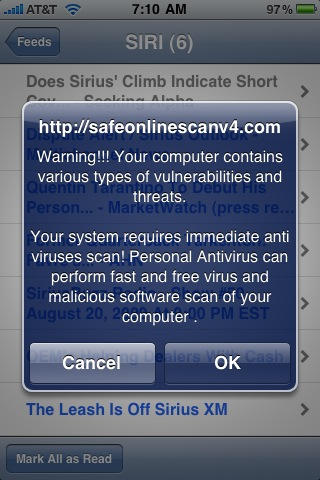
CoM reader NyxoLyno Cangemi was using NetNewsWire RSS reader on his iPhone when what appears to be a push notification for anti-virus software popped up. See the screenshot above.
The popup message says his computer has “vulnerabilities and threats” and needs an immediate virus scan.
The popup is a notorious “rogue anti-virus” message, designed to trick naive websurfers into surrendering credit card details to fake anti-virus vendors. The unsuspecting websurfer see the message, follows the link and buys fake anti-virus software that steals their credit card number and installs malware.
The website URL in the iPhone popup points to a known rogue site, safeonlinescanv4.com, according to security firm MacAfee’s SiteAdvisor service.
The iPhone 3.0’s push notifications allow messages or alerts to be pushed to the user — incoming IM messages or new e-mails, for example. Apple billed the system as an alternative to battery-draining background processes. NetNewsWire for the iPhone does not offer push notifications. I’ve contacted the developer, NewsGator Technologies, for comment.
Have spammers and spyware frauds found a way to spam iPhones using push notifications? Anyone else seen this?
UPDATE: I asked CoM reader Cangemi what he was doing when the message popped up. Cangemi says he was browsing a folder of links, not any particular site, which was showing a list of headlines from his Sirius radio RSS folder. “I was scrolling through the list at the time it happened, which leads me to believe it was a push notification and could have occurred no matter what I was doing,” he says. In the comments, reader Matt J. reports he got a similar popup while using Safari, which again suggests push.
NewsGator Technologies forwarded an email from NetNewsWire’s lead developer, who also says it looks like a push notification.
He says: “I haven’t seen this before. NetNewsWire doesn’t use the push notification system. But other apps do, and a notification can appear in front of any other app. So I have no way of knowing where this notification came from. Another possibility is that he’d gone to a web page in NetNewsWire that has a JavaScript alert that put up that popup. It would be great to know exactly what pages he’d visited, but I realize it’s hard to find out after-the-fact.”
As Cangemi says, he wasn’t visiting a particular page, but browsing a folder of links. So it looks like push notification is the culprit.
UPDATE 2: In the comments readers Michael Weisman and DerekS say it’s more likely a Javascript alert dialog. “The default buttons on a push notification are ‘Cancel’ and ‘View’ where ‘View’ would launch the pushed-app,” notes DerekS.
“NetNewsWire has an integrated browser for reading stories,” notes Weisman. “This probably was designed to come up when the user navigates away from a page, so it popped up after the user went back to the story list. Also, the push notification system has a ton of security. The whole thing is encrypted, and the user needs to approve an app before it will even send them. There is no way for an app to send malicious notifications without your approval.”

Leander Kahney is the editor and publisher of Cult of Mac.
Leander is a longtime technology reporter and the author of six acclaimed books about Apple, including two New York Times bestsellers: Jony Ive: The Genius Behind Apple’s Greatest Products and Inside Steve’s Brain, a biography of Steve Jobs.
He’s also written a top-selling biography of Apple CEO Tim Cook and authored Cult of Mac and Cult of iPod, which both won prestigious design awards. Most recently, he was co-author of Cult of Mac, 2nd Edition.
Leander has been reporting about Apple and technology for nearly 30 years.
Before founding Cult of Mac as an independent publication, Leander was news editor at Wired.com, where he was responsible for the day-to-day running of the Wired.com website. He headed up a team of six section editors, a dozen reporters and a large pool of freelancers. Together the team produced a daily digest of stories about the impact of science and technology, and won several awards, including several Webby Awards, 2X Knight-Batten Awards for Innovation in Journalism and the 2010 MIN (Magazine Industry Newsletter) award for best blog, among others.
Before being promoted to news editor, Leander was Wired.com’s senior reporter, primarily covering Apple. During that time, Leander published a ton of scoops, including the first in-depth report about the development of the iPod. Leander attended almost every keynote speech and special product launch presented by Steve Jobs, including the historic launches of the iPhone and iPad. He also reported from almost every Macworld Expo in the late ’90s and early ‘2000s, including, sadly, the last shows in Boston, San Francisco and Tokyo. His reporting for Wired.com formed the basis of the first Cult of Mac book, and subsequently this website.
Before joining Wired, Leander was a senior reporter at the legendary MacWeek, the storied and long-running weekly that documented Apple and its community in the 1980s and ’90s.
Leander has written for Wired magazine (including the Issue 16.04 cover story about Steve Jobs’ leadership at Apple, entitled Evil/Genius), Scientific American, The Guardian, The Observer, The San Francisco Chronicle and many other publications.
Leander has a postgrad diploma in artificial intelligence from the University of Aberdeen, and a BSc (Hons) in experimental psychology from the University of Sussex.
He has a diploma in journalism from the UK’s National Council for the Training of Journalists.
Leander lives in San Francisco, California, and is married with four children. He’s an avid biker and has ridden in many long-distance bike events, including California’s legendary Death Ride.
You can find out more about Leander on LinkedIn and Facebook. You can follow him on X at @lkahney or Instagram.