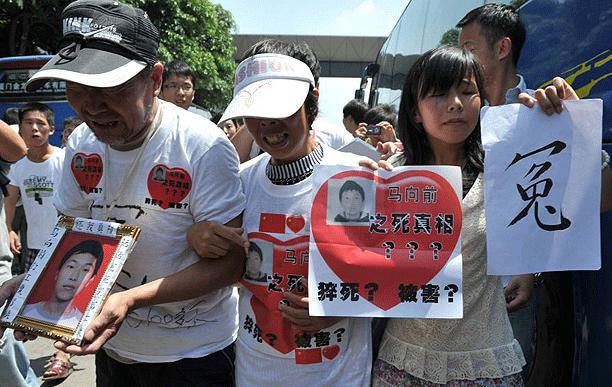
The rash of suicides at Foxconn are not due to harsh working conditions but the plight of China’s migrant workforce, says an open letter signed by a dozen Chinese sociologists.
The letter blames the string of Foxconn suicides on the social problems faced by China’s vast class of migrant workers.
Originating from poor rural areas, Chinese migrant workers are often rootless and isolated, cut off from friends and family. Instead of finding good jobs in urban factories, they are often too poorly paid to settle in their new cities, and have limited access to education and healthcare. With no prospects at home, they are stuck. The sociologists call it the “path of no return.”
We have made them live a migrancy life that is rootless and helpless, where families are separated, parents have no one to support them, and children are not taken care of. In short, this is a life without dignity.
The sociologists note that at the end of 2008, the population of Shenzhen exceeded 12 million, but only 2.28 million were registered as permanent residents. The giant Foxconn plant, which employs upwards of 600,000 workers, is located in Shenzhen.
The sociologists call on Foxconn and the Chinese central government to boost wages, and improve access to housing, eduction and healthcare. They also say demand workers be given a “voice,” which presumably means unions.
We call on every enterprise, to make a conscientious effort to increase migrant workers‘ pay and rights, and allow migrant workers to become true “citizens of the enterprise”.
Here’s the full text of the open letter:
Appeal by Sociologists:
Address to the Problems of New Generations of Chinese Migrant Workers,
End to Foxconn Tragedy Now
社會學者的呼籲︰解決新生代農民工問題,杜絕富士康悲劇重演
18th May 2010
(original text in Chinese is posted online at https://tech.sina.com.cn/it/2010-05-19/13214206671.shtml; see also the blog at https://t.sina.com.cn/1743939945?retcode=0)
Since January of this year at the Foxconn Group, nine workers have already attempted suicide by jumping from buildings, resulting in the tragic death of seven, with two injured. Why would these young people, roughly all in their twenties, choose to leave this world in life’s most beautiful time? This loss of life is so distressing, and makes us think deeply about the new problems of the second generation of migrant workers and the status of China as the “world’s factory.”
Over the last thirty years, China has depended on huge numbers of cheap laborers, mainly from rural areas, who have forged an export-oriented style “world factory”, and fueled the rapid growth of China’s economy. But at the same time, the basic survival rights of the work force have been overlooked; we have denied migrant workers’ dignity, paid them at wage levels below the average for third world countries, made it impossible for them to settle and live in the cities, while leaving them to drift back and forth between cities and the countryside. We have made them live a migrancy life that is rootless and helpless, where families are separated, parents have no one to support them, and children are not taken care of. In short, this is a life without dignity. From the tragedies at Foxconn, we can hear the loud cries for life from the second generation of migrant workers, warning society to reconsider this development model that has sacrificed people’s fundamental dignity.
We call on the central government to immediately end the model of development that has sacrificed people’s basic dignity.
Some of our country’s industrial production now occupies a bigger and bigger market share in the low-end global production chains. We have noticed that, with the increase in GDP, there is also an expanding wealth gap and a drop in the price of labour, following the pressure to find jobs. We have also seen that laborers’ right to express their opinion has been constantly ignored.
The use of cheap labour to develop an export-oriented economy may have been a strategic choice for China in the first period of its reforms, given restrictions and capital deficiencies due to historical conditions. But this kind of development strategy has shown many shortcomings. Low wage growth of workers has depressed internal consumer demand and weakened the sustainable growth of China’s economy. The tragedies at Foxconn have further illustrated the difficulty, as far as labour is concerned, of continuing this kind of development model. Many second generation migrant workers, unlike their parents’ generation, have no thought of returning home to become peasants again. In this respect, they have started out on a road to the city from which they won’t return. When there is no possibility of finding work by which they can settle in the city, the meaning comes crashing down: the road ahead is blocked, the road back is already closed. The second generation of migrant workers are trapped. As far as dignity and identity are concerned, there is a grave crisis, from which has come a series of psychological and emotional problems. These are the deeper social and structural reasons we see behind the Foxconn workers who walk on the “path of no return”.
We think that development based on a strategy of “poor-human-rights competitiveness” is unsustainable. Today China’s capital is sufficient, the country’s national strength is powerful, and conditions and capacity exist to transform its development model. By relying on the common effort of the country, business, and workers, to conscientiously solve the problem of the second generation of migrant workers, surely it can effectively prevent this kind of tragedy from recurring.
We call on every enterprise, to make a conscientious effort to increase migrant workers‘ pay and rights, and allow migrant workers to become true “citizens of the enterprise”.
Since 1988, when Foxconn founded a factory in Shenzhen, China, it has rapidly developed and expanded, with factories extending to the Pearl River Delta, Yangtze River Delta, the Bohai Sea region and the midwestern region. It employs more than 600,000 workers. Foxconn has become one of the world’s largest electronics manufacturers, a global final assembling-supplier which occupies the position of 109th in the world’s top 500 businesses. For 7 consecutive years it has ranked as the number one export corporation on China’s mainland. Foxconn’s situation today is inextricably linked to the blood and sweat of migrant workers. To serve as a business leader which stresses Corporate Social Responsibility, which claims to contribute to society, and value workers, Foxconn ought to pay laborers a dignified wage, provide basic material conditions for a normal, dignified life, and allow migrant workers to become true “citizens of the enterprise”.
We call for local government to protect migrant workers’ housing, education, medical care and other such social needs, to allow migrant workers to become true “citizens”.
Migrant workers’ pay and dignity are not limited to one enterprise, but are rather a universal problem in China. When migrant workers settle and live in cities, the biggest barriers they encounter are housing, their children’s education and healthcare and other such problems. We call on national and local government to take realistic measures which help migrant workers take root in cities, allow them to become true urban workers, and to share the fruits of the economic development they have personally created. Serving as an experimental zone for economic reforms, Shenzhen’s rise to prominence could not have occurred without the painstaking efforts of tens of millions of migrant workers. At the end of 2008, the actual population of Shenzhen city exceeded 12 million, but only 2.28 million were registered as permanent residents. It is migrant workers who made the major contribution to create the rich, strong and prosperous Shenzhen as it is today. As the beneficiaries of the reforms, the Shenzhen city government should improve migrant workers’ living conditions, and take concrete plans to solve migrant workers’ needs for housing, education, healthcare and so on. Shenzhen served as a leader since the 1980s in economic development, and should once again strive to serve as an example of social development and social fairness in the new century.
Finally, we call for the new generation of migrant workers to value their own lives, to value one another’s lives, to use positive methods to respond to the difficult position of laborers today, to strive for basic labour rights and interests, to protect themselves and their families’ rights to a decent life. Like brothers and sisters, unite and help each other, increase your ability to help yourselves when in danger, increase your self-preservation and self-management capability. And we call on all circles of society to work hard together, to participate in and promote the great endeavor of social progress, to build together a harmonious society that lets every laborer live with dignity.
Signed:
Shen Yuan, Professor – Tsinghua University, Sociology Department
Guo Yuhua, Professor – Tsinghua University, Sociology Department
Lu Huilin, Associate Professor – Beijing University, Sociology Department
Pun Ngai, Associate Professor – Hong Kong Polytechnic University, Applied Social Science Department
Dai Jianzhong, Research Fellow – Beijing Academy of Social Sciences
Tan Shen, Research Fellow – Chinese Academy of Social Sciences, Sociology Department
Shen Hong, Research Fellow – Chinese Academy of Social Sciences, Sociology Department
Ren Yan, Associate Professor – Sun Yat-sen University, Sociology Department
Zhang Dunfu, Professor – Shanghai University, Sociology Department
=======================
Translated by Kate Alexander
Edited by Ellen David Friedman

Leander Kahney is the editor and publisher of Cult of Mac.
Leander is a longtime technology reporter and the author of six acclaimed books about Apple, including two New York Times bestsellers: Jony Ive: The Genius Behind Apple’s Greatest Products and Inside Steve’s Brain, a biography of Steve Jobs.
He’s also written a top-selling biography of Apple CEO Tim Cook and authored Cult of Mac and Cult of iPod, which both won prestigious design awards. Most recently, he was co-author of Cult of Mac, 2nd Edition.
Leander has been reporting about Apple and technology for nearly 30 years.
Before founding Cult of Mac as an independent publication, Leander was news editor at Wired.com, where he was responsible for the day-to-day running of the Wired.com website. He headed up a team of six section editors, a dozen reporters and a large pool of freelancers. Together the team produced a daily digest of stories about the impact of science and technology, and won several awards, including several Webby Awards, 2X Knight-Batten Awards for Innovation in Journalism and the 2010 MIN (Magazine Industry Newsletter) award for best blog, among others.
Before being promoted to news editor, Leander was Wired.com’s senior reporter, primarily covering Apple. During that time, Leander published a ton of scoops, including the first in-depth report about the development of the iPod. Leander attended almost every keynote speech and special product launch presented by Steve Jobs, including the historic launches of the iPhone and iPad. He also reported from almost every Macworld Expo in the late ’90s and early ‘2000s, including, sadly, the last shows in Boston, San Francisco and Tokyo. His reporting for Wired.com formed the basis of the first Cult of Mac book, and subsequently this website.
Before joining Wired, Leander was a senior reporter at the legendary MacWeek, the storied and long-running weekly that documented Apple and its community in the 1980s and ’90s.
Leander has written for Wired magazine (including the Issue 16.04 cover story about Steve Jobs’ leadership at Apple, entitled Evil/Genius), Scientific American, The Guardian, The Observer, The San Francisco Chronicle and many other publications.
Leander has a postgrad diploma in artificial intelligence from the University of Aberdeen, and a BSc (Hons) in experimental psychology from the University of Sussex.
He has a diploma in journalism from the UK’s National Council for the Training of Journalists.
Leander lives in San Francisco, California, and is married with four children. He’s an avid biker and has ridden in many long-distance bike events, including California’s legendary Death Ride.
You can find out more about Leander on LinkedIn and Facebook. You can follow him on X at @lkahney or Instagram.