Interview: Apple’s Gigantic New Data Center Hints at Cloud Computing

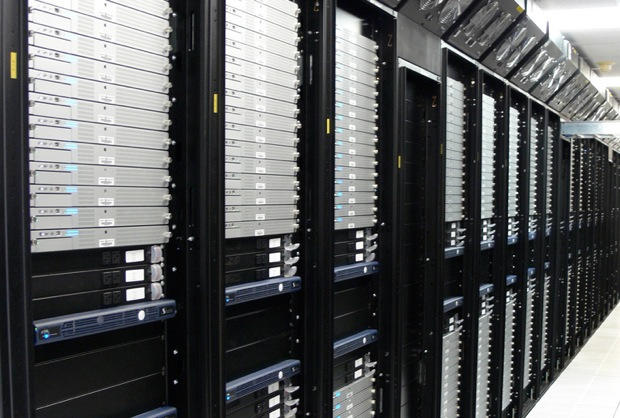
System X, an Xserve G5 supercomputing cluster. CC-licensed pic by Christopher Bowns: http://www.flickr.com/photos/cipherswarm/2414578959/in/photostream/

System X, an Xserve G5 supercomputing cluster. CC-licensed pic by Christopher Bowns: http://www.flickr.com/photos/cipherswarm/2414578959/in/photostream/

Google’s Eric Schmidt “resigned” from Apple’s board because Chrome and Android were encroaching on Apple’s core business, or so Steve Jobs says.

But what if the opposite were true? What if Apple is encroaching on Google’s core business?

Later this month, Apple is expected to break ground on a massive new data center in Maiden, North Carolina.

In terms of size, Apple’s data center is as big as they come.

“Apple is planning about 500,000 square feet of data center space in a single building,” says Rich Miller, editor of Data Center Knowledge. “That would place it among the largest data centers in the world… This would qualify as a big-ass data center.”

Question is, what will Apple use it for? Apple’s plans are secret, of course, and some have speculated it’s to support Apple’s growing  MobileMe business and online iTunes stores.

But Miller says the size of the data center hints at something else. Companies building centers this big are getting into cloud computing. Running apps in the cloud requires massive infrastructure: Google-size infrastructure.

“The companies that are building the biggest data centers tend to also have the biggest cloud ambitions,” says Miller.

The full interview with Miller after the jump:

Rich Miller is editor of Data Center Knowledge, an online trade magazine devoted to the data center industry.

CoM: First, any idea why Apple is building this new data center?

Miller: Apple has said very little about the North Carolina facility, beyond the fact that it will serve as the company’s East coast data hub. Apple also has a West coast data center facility in Newark, Calif. Local officials I’ve spoken with say they believe the space is primarily to support Mobile Me and digital content for the iTunes store. The most interesting question is whether Apple needs a much larger facility to support growth in its existing services, or is scaling up capacity for future offerings.

CoM: Could Apple be building it for cloud computing apps — cloud versions of its iLife apps for example?

Miller: One of the leading theories about the size of the NC project is that Apple is planning future cloud computing services that will require lots of data center storage. Cloud computing is a hot trend, and I’d be surprised if Apple isn’t thinking hard – and thinking differently – about cloud computing. Many cloud enthusiasts say that cloud computing will eliminate the need for data centers. In reality, the only thing will change is the owner of the building. All the applications and data that are moving into the cloud will live on servers in brick-and-mortar data centers. The companies that are building the biggest data centers tend to also have the biggest cloud ambitions.

CoM: How big is Apple’s new North Carolina data center — big, small, medium?

DON'T MISS
Apple’s Massive NC Data Center Coming Online Next Year: Execs

Miller: The early site plans indicate Apple is planning about 500,000 square feet of data center space in a single building. That would place it among the largest data centers in the world. For comparison purposes, Apple’s existing data center in Newark, Calif. is a little more than 100,000 square feet. Most new stand-alone enterprise data centers are in the range of 100,000 to 200,000 square feet. So this would qualify as a big-ass data center.

CoM: What’s it comparable to? Do you know of any specific examples?

Miller: In the past several years we’ve seen a handful of new facilities that are redefining the scope of modern data centers. These include Microsoft’s new facility in Chicago, the SuperNAP in Las Vegas and the Phoenix ONE colocation center in Phoenix. All of these facilities house at least 400,000 square feet of space. These data centers are designed to support an enormous volume of data, and reflect the acceleration of the transition to a digital economy. All those digital assets – email, images, video and now virtual machines – drive demand for more and larger data centers.

CoM: Why did Apple chose NC? Are there particularly big pipes in NC? A big powerplant nearby?

Miller: The choice of rural North Carolina suggests that the bottom line for Apple is cost, rather than connectivity. The site in Maiden, NC is not far from a large data center by Google, which usually chases cheap power and tax incentives. Power from Duke Energy is about 4 to 5 cents per kilowatt hour, compared to 7 to 12 cents in California. The company also maximized its incentives by pitting Virginia and North Carolina against one another in trying to wring the best tax incentives out of both states (a popular strategy in data center site location).

Some large companies use distributed data centers to manage their latency and content delivery costs. That may be part of Apple’s thinking, since they’re a major customer for CDNs (I believe they use both Akamai and Limelight Networks). Facebook cited latency to Europe as a key factor in its decision to add data centers in Virginia. Before that, MySpace added a data center in Los Angeles to reduce its reliance on CDNs. But in both cases, those companies sought out Internet hubs where they could connect with dozens of other networks to manage their Internet traffic. You don’t get that in rural North Carolina, so Apple seems more focused on cost and scale than on connectivity – which again would suggest a cloud focus.
About the author

Leander Kahney

is the editor and publisher of Cult of Mac, and author of three books about technology culture: Inside Steve’s Brain, the New York Times bestseller about Steve Jobs; Cult of Mac; and Cult of iPod. Leander has written for Wired, MacWeek, Scientific American, and The Guardian in London. Follow Leander on Twitter @lkahney and Facebook.

(sorry, you need Javascript to see this e-mail address)| Read more posts by .

Posted in Apple, News, Software |

  • bk

    What ever happened to the iwork.com? maybe they need that to help host it once it gets out of beta

  • Lucas

    here’s my thought
    for now it is to support mobileme, iwork.com, itunes etc. these need help and spreading the load is a way to do that.

    but they also want to have room to grow so that they aren’t having to build another center within 5 years. that growth might include cloud computing, might not. but such an idea isn’t really feasible unless they have the support in place before they make a go at it. otherwise it could be another fiasco like the mobileme launch

  • Rune Solberg

    Will we see a Europe based datacenter from Apple you think? MobileMe is extremely slow in Norway. iDisk is useless for all purposes, would be great if my subscription to MobileMe would give a bit more value than syncing only.

    /Rune

  • http://www.theotherdrummer.com The Other Drummer

    If Apple does intend to jump into cloud computing (beyond its feeble MobileMe offerings) they’re WAY behind in the game. They’re just STARTING to build a data center to facilitate this? How many years before it is built and functioning? Meanwhile, web-based applications are already abundant (and free).

    While I think the idea of getting into cloud computing is wise, Apple doesn’t exactly have a great track record in this category. .Mac (then MobileMe) and iwork.com? Not exactly a great legacy to build on.

    I wish them the best and hope they do something stellar, but I’m not optimistic that’s going to happen.

  • Louis Wheeler

    What if the reason for that Data Center is not the cloud? Or only partially the cloud? Perhaps, it has to do with the expanding Mac ecosphere?

    The cloud is more Google’s forte, because it needs to sell advertising and searches. It’s data centers across the country are mirroring the web, placing all information on its servers, so that when internet congestion eventually strikes, it can charge high prices to the ISP’s for locally cached data Thus, the video revolution will become a big money maker for Google, but not yet.

    Apple needs to sell computers and for that, it needs applications which utilize its hardware. History has shown that the computers with the widest application base wins the customers.

    “There’s an App for that!” is Apple’s iPhone slogan, not Microsoft’s “Developers! Developers! Developers!”

    The iPhone App store has done very well. It has over 65 thousand applications and over 1.5 billion downloads after a year of existence. The App store is valued by the developers because they get paid, they don’t have 60 to 80% of their software ripped off. Thus, they can charge a smaller fee which limits the thefts. The App store is a cheaper means of promoting their applications than any other. The iPhone App store is a very efficient market place; what if it is extended to Macintosh applications? The Mac App Store?

    The iPhone Apps are small, so they don’t demand much bandwidth. They could be handled by Apple’s current data centers. But, Mac Applications are large and would need more servers.

    What if Apple opens a one-stop shop for Mac software? What that would do is revitalize the Mac software market. It would shift revenues into Apple’s pocket which are currently going to Amazon and the other on-line venders. There would be a rush into Mac Applications, just as there has been for iPhone Apps.

    Next, the current Cocoa applications will be upgraded easily to 64 bit code, this year. That code will run faster than the 32 bit code, because it utilizes the extra registers in the Intel Core 2 processor chips. Next year, an inordinate number of 64 bit Mac Apps will be sold. This data center is likely to be built too late to gain much of that surge, but will take the strain off Apple’s over burdened servers as the store grows.

    I also find it interesting that Apple is building very close to Google. Google has very fat pipes of dark fiber that it has been buying up for the last four years. There has always been questions of what Google intends to do with those still un-utilized pipes.

    There may be some sharing arrangement between Apple and Google. I do not see Apple and Google as adversaries; each company wants different parts of the computer market and for different motives. Hence, they are natural conspirators in taking down Microsoft.

  • Jocca

    Makes a lot of sense.

    Between Google, Apple and Microsoft, I believe that Google will present a far greater threat to Microsoft than to Apple. Cloud computing is the name of the game and it may gain traction amongst the smaller business people who will find the price of entry to a Google solution very appealing. Meanwhile, Microsoft’s cash cow resides in its hard copies software business which incidentally will have to change (most likely with a big price cut) in order to counter the advent of cloud computing.

    Apple is a different beast altogether. It is a software/hardware consumer computer company, more in competition with itself than with any other box makers. It is in full control of its destiny with millions of captive consumers, many of them perpetually looking forward to the next great thing coming out of Cupertino. Just look at the number of articles that are being written on the mystical (or really) iTablet/iPad to issue forth from the bowels of the Apple campus……hopefully soon. The suspense is just unbearable.

  • http://www.kpbonline.com Ken Berger

    Apple was one of the earliest major Cloud users and is growing fast!
    Only they do not use the browser as the primary front end for Cloud services.
    They use apps on the Mac, Windows and the iPhone!
    iTunes, moble.me are all Cloud based!
    DOn’t forget they have WebObjects the most mature and powerful framework for Cloud Services it is light years ahead of MS or Even Google.

  • Constable Odo

    Hoho. Big-ass data center. Apple should provide free cloud services for all buyers of their mobile devices. I guess Apple’s data center is bigger than Google’s, since that wasn’t mentioned as being at the top in terms of storage.

    Unfortunately, this data center will probably take at least year to be built and that’s a long way off. Apple may be their own best buyer for X-Serves.

  • Chris Weiss

    The comment about the iPhone app store/data center usage is an interesting one. There’s rampant speculation about the ‘iTablet’ and while iPhone apps are small, tablet-based apps would likely be much larger, on the order of tens (or hundreds) of megabytes per app.

  • Garbanzo

    Who the hell else wants to buy an XServe in this area of cheap, virtualized iron? In a darkened datacenter, no one cares about pretty boxes.

  • kirasaw

    Apple names it’s OS’s after big cats and one of the few big cat names left? Cloud Leopard – THINK ABOUT IT !

  • Louis Wheeler

    Garbanzo, the Mac OS has virtualization in Snow Leopard server; in fact, the entire Mac OS will be sand boxed in virtual spaces. Linux is a good server OS but Windows is an expensive joke. I don’t expect Apple to use either.

    The only alternative to Apple’s blade servers would be mainframes. I expect Apple to eat its own dog food. It will be good advertising, if nothing else.

    If Apple goes with its own hardware in this new data center– which seems the cheapest route, then each server blade has 16 threads it can use. That means 16 requests that each blade can field from the web simultaneously. Each rack of 48 servers can handle 768 contacts from the web. Then we can add in 10 thousand or more racks in a data center of that size, so that means about 7.5 million requests for information simultaneously. I don’t see that on the horizon soon, but it does give Apple room to grow.

    I had wondered if Apple had an arrangement with Google to deliver its content, like it has had with Akamai and Limelight.

    What Google has done is site server farms in every nook and cranny of America where there is sufficient power and data lines. What this means is that Google intends to take advantage of the fact that America will have a data crunch when wholesale downloads of video become common. The Internet will become seriously congested. Google plans to overcome the resulting long delays by siting tractor trailer rigs full of servers to supply mirrored content locally. Google had been buying dark fiber for the last five years, so its cables won’t be overloaded.

    Apple intends to be in the Video download business, big time. The problem has been broadband speeds, which aren’t yet fast enough. Google’s local siting of mirrored content overcomes a problem which has not yet appeared, so this is a very long run strategy.

    Apple and Google have different parts of the market in mind, so I don’t see any conflict with Apple buying space in Google’s local data centers for music, video and application downloads.

    If this is so, Why does Apple need such as huge data center? There are two parts of internet : web server operations and content delivery. The first is reacting to a request from the web. Usually, this load is not hard to field. It just takes a lot of cores talking to the Internet.

    But Downloads are very computer, backbone and disk drive intensive. It makes sense for Apple to off load content delivery onto someone else. At present, Apple has no need for more than Akamai, and recently Limelight, can deliver. But, if huge loads are necessary, then Google may become necessary for Apple.

  • astaroth

    Es probable que apunte a una infraestructura como la de RIM

  • overboost

    It could be a disaster site. Calif will get a big quake sometime. If Apple does end up hosting customers data (itunes online etc, video) anything customers pay to get streamed or held in the cloud then having all the data wiped when the CA centre goes dead would be a catastrophe for Apples image. Google might be in CA also but you can bet if disaster strikes, no data will be lost as Google is replicating everywhere. Also helps with latency with better east coast and Europe traffic to its servers. Msoft built a big centre in Dublin and you can be sure that the source code is held there (with military encryption levels) as well as there customers data they pay to hold for them

  • http://www.gigenetcloud.com Chris Armer

    Apple is moving on up. I would buy as much apple stock as I could right now.

    Chris Armer
    VP of Operations
    http://www.gigenetcloud.com
    http://www.gigenet.com

  • Pete Lundin

    Siting is definitely one of the most important factors that affect the energy consumption and environmental effects of a server farm. There are cooler climates than in the continental US and with more green electricity available. I would recommend anybody considering siting a datacenter to take a look at the Finnish website on these issues: http://www.fincloud.freehostingcloud.com/

  • http://www.achetermed.info/ georgesanders

    t

  • notebookkk

    For more information on these police notebooks, click here. District 1: The City (not covered in police notebooks); District 2: Strand and St Giles …Shop Toshiba innovative laptops, netbooks and notebook accessories today. Computing solutions for any home, school, small or large business.

  • http://stye-treatment.com Stye Eye Treatment

    Wow that is really huge! Apple is best as always..

    • http://www.facebook.com/people/Chance-Seagle/100000066915702 Chance Seagle

      Damn it…I hate Apple but love the town I grew up in…why did it have to be Apple