Top stories

Microsoft’s My Documents Folder Makes Triumphant Return – On iPad

20100209-mydocuments.jpg

Earlier today, I was reading Infoworld’s article, The iPad questions Apple won’t answer. The first question they listed was “Can you save and transfer documents to the iPad?”, and their assumed answer was “No”; they suggested that the only way to do this would be to open a document from an email message.
I read that [...]

Top 5 Things To Check Out at Macworld 2010

Macworld 2010 opens today. It is the 25th annual gathering of Mac users. That’s right, 25 years!
But thanks to the absence of Apple this year, this “Mecca for Mac Heads” may be the last. So check it out while you can.

The show runs for 5 days. The Expo showfloor opens on Thursday at noon.
For the [...]

Opinion: MacBook, or iMac + iPad?

20100208-imacipad.jpg

The announcement of the iPad has done a lot of things: it’s stoked up excitement in the Mac using community, it’s got a bunch of developers feverishly coding exciting new stuff, and it’s got retailers and cell phone companies the world over drooling over the money they can make from it.
And it’s also somewhat upset [...]

In Depth: 30 Days with the Nexus One

It’s been a month since my review of Google’s “SuperPhone”, the Nexus One. Since that time, we’ve surfed, updated facebook, navigated, called, played endless hands of cribbage and even tried to freeze it to death on a trip to Dayton Ohio. Follow me after the jump to find out does the “SuperPhone” stand the [...]

Report: Google Suffering Microsoft-Like Headaches With Fragmented Android Platform

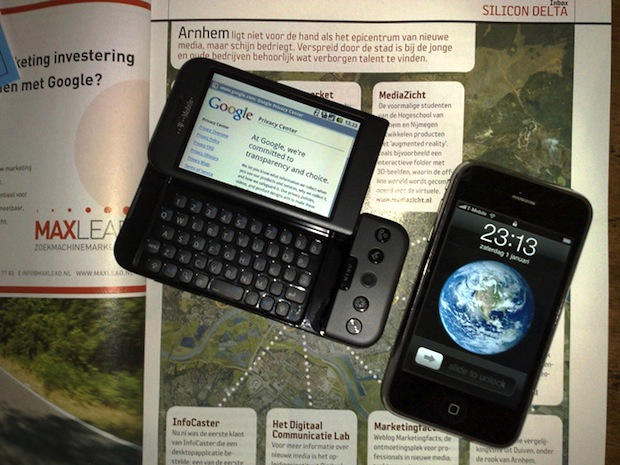
androidiphone

Uh, oh. Looks like there’s trouble in Android land. The rapid growth of Google’s smartphone OS is causing developers conniptions as they struggle to support multiple versions of the OS and different hardware configurations. With more than a dozen Android phones on the market, all the different configurations are leading to serious platform fragmentation, Wired.com reports:

“A slew of problems have made managing Android apps a “nightmare,” they say, including three versions of the OS (Android 1.5, 1.6 and 2.0), custom firmware on many phones, and hardware differences between different models.”

For users, it means buggy apps that sometimes won’t work on their hardware at all. One developer tells Wired.com that instead of concentrating on adding new features, he spends all his time making sure his apps work on all the different hardware and software configurations.

Looks like Google might be wandering into Microsoft territory. Microsoft had exactly the same problem with it’s now-discontinued “Plays For Sure” music-player platform, which became known as “Plays For Shit” because of the difficulty supporting multiple hardware and software configurations.

Just goes to show that there’s distinct advantages over owning both the hardware and the software, like Apple. Apple has released just three different hardware versions of the iPhone, and does a pretty good job of making sure most iPhone owners are running the latest software. In addition, the tightly-controlled App Store ensures a high-level of software compatibility. Even Android developers say its a good idea, according to Wired.com:

For developers, Apple’s autocratic ways may be frustrating, but they can pay off.

“Apple maintains an iron grip on what they do and there’s an advantage to that,” says Kelly Schrock, owner of Fognl, which has three apps on the Android market. “IPhone developers don’t have to worry about fragmentation and creating apps for the iPhone is much easier.”
About the author

Leander Kahney

Leander Kahney is the editor of Cult of Mac, and author of three books about technology culture: Inside Steve’s Brain, the New York Times bestseller about Steve Jobs; Cult of Mac; and Cult of iPod. Leander has written for Wired, MacWeek, Scientific American, and The Guardian in London. Follow Leander on Twitter @lkahney and Facebook.

Email the author | Read more posts by Leander Kahney.

14 comments

    Sort of similar to the articles on android vs iPhone from RoughlyDrafted Magazine.

    The exact reason why the OS-X desktop is so rock solid, total control has a good side for consumers.

    Sadly the exact reason why Linux is taking so long to make any impact, fragmentation. You open the platform and people start forking it. Only when companies like RedHat, Novell and Oracle got hold of a version of a version of Linux and fixed it down that it started getting into server rooms. Linux will never make any serious dekstop penetration, too much fragmentation. Ubuntu is starting to some impact because they have started to follow a similar idea to iPhone Apps, Canonical have their own fixed and confirmed software repositories, which is starting to pay dividends.

    Total control may seem draconian to some but Apple proves time and again, draconian control works to assure the consumers that the platform is safe and can be trusted.

    What Fuzzypig said.

    Suck it, haters!

    Awwhhhh.., what’s a matter MrCrispy? YOu buy yourself a brick did ya?

    Apple is sending out talking points …. In the last few days I’ve seen this story in several forms … I like Apple , I own multiple Apple products but in general I have a dislike for PR weenies & bloggers trying to spin me.

    Uh.., I don’t think so Alex.

    Droid = Broken (fragmented) Robot?

    It didn’t take long at all.

    Now you see…this is why Apple is so strict about its app approval process for iPod/iPhone. All these developers are whining about the approval process taking too long…they’ll really be whining when nobody wants to buy their buggy apps for droid. Maybe droid needs an approval process like apple and these developers need to shut up and be happy for what they get!

    >Now you see…this is why Apple is so strict about its app approval process
    >for iPod/iPhone. All these developers are whining about the approval process
    >taking too long…they’ll really be whining when nobody wants to buy their
    >buggy apps for droid.

    The double-edged sword goes two ways. Yes, the droid developers will be in HELL because of the app fragmentation, and the stupidity of developing for an infinite combination of discordant devices, some have physical keyboards, some don’t have physical keyboards, whatever. But what the droid developers hate (fragmentation due to choice) is exactly what their consumers crave (freedom of choice). So it’s not really a Lose-Lose situation. It’s more like a Lose-Win situation for Droid.

    The reverse is true for Apple and iPhone’s tight integration. It’s a Win-Lose situation here. The developers “win” because they will appreciate the tight integration of hardware software. But the customers “lose” a little bit because they don’t have as much freedom of choice to choose a boatload of hardware.

    Neither side is perfect. Neither side will ever be a Win-Win situation. Both have their pros and cons. I am Matilda the Fair. I call it like it is, bubba!

    “does a pretty good job of making sure most iPhone owners are running the latest software”

    Didn’t a statistic come out a few months ago saying that only about 30% of people had updated to 3.0???

    now you see why windoz is such an amazing accomplishment

    I predicted long ago that success would ruin android. No control of hardware equals pain.

    Man, I love iPhone and everything, but android seemed so promising! No slowdowns for app approval, etc… Google will figure this out some how, that’s why they live in the cloud! But it does show that Apple may have been smart to keep their hardware and software under their complete control.

Add your comment

Name(Required)

Mail (required, but not published)

Website

Comment

Buy Inside Steve's Brain Buy from Amazon.com Buy from Barnes & Noble