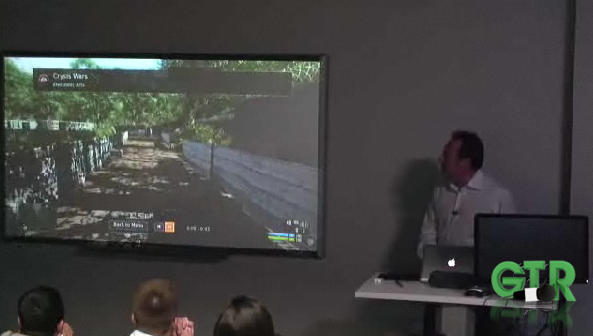
Former Quicktime guru Steve Perlman has been flogging his latest startup, OnLive, for awhile now. He’s hawking a thin client for gaming, which requires a bit of explanation: think of gaming in the cloud. Instead of installing an MMORPG or FPS on your Mac, you instead logon to a central server with beefy hardware, which pumps out the game to you over the Internet.
In very loose theory, that means that you can play the hottest and most technically advanced games on even the lowest-specced computers or handheld devices: the server does all the rendering, and basically streams to the user a live video of the game being played according to his or her button and mouse clicks. In even looser theory, you could play even the most graphically demanding PC games on your iPhone.
Last week, Perlman demonstrated the OnLive technology to his alma mater, Columbia University. It’s an impressive demonstration, but there’s plenty of reason to be skeptical of Perlman’s claims.
Perlman says that OnLive will roll-out with data centers all over the country, and that if a data center is within 250 miles of a gamer, they can guarantee a round-trip ping of only 80 milliseconds. According to Perlman, that means that, for all intents and purposes, the action is instantaneous.
This is where thin gaming clients always start looking less attractive. If you’ve ever played an online shooter like Counter-Strike or Team Fortress 2, you know that a ping of 80ms, while pretty good, still puts you at a significant disadvantage compared to the host, who is playing with a 0ms ping. 80 milliseconds isn’t “instantaneous” at all: in twitch games like shooters, it’s enough lag for controls to feel swampy.
And that’s the best case scenario. In the real world, there’s a lot of other factors beyond OnLive’s control that can multiply the latency to the point where a game becomes unplayable. Moreover, OnLive would likely have to make serious compromises in regards to a game’s graphic resolution to keep both the latency and bandwidth down: standard definition 480p is my guess.
I’m intrigued by Perlman’s startup, and I’ve been dreaming of thin clients ever since the days of BBS door games, but I’m skeptical we’re there that. Still, any new technology that has the potential to level the gaming playing field between Macs, PCs, consoles and mobile phones is worth keeping an eye on.

John Brownlee is a writer for Fast Company, and a contributing writer here at CoM. He has also written for Wired, Playboy, Boing Boing, Popular Mechanics, VentureBeat, and Gizmodo. He lives in Boston with his wife and two parakeets. You can follow him here on Twitter.