Microsoft admits it was “caught napping” by the iPhone

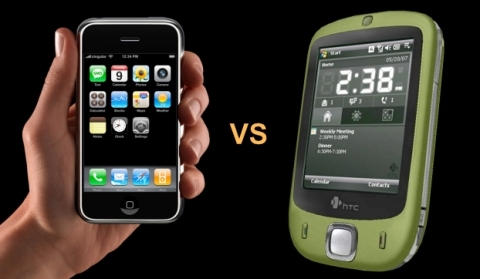
iphone_vs_touch

Remember way back in 2007 when Steve Ballmer famously yanked on his oligarch’s suspenders, chomped down on his cigar and told USA Today: “There’s no chance that the iPhone is going to get any significant market share. No chance?” Ballmer then went on to muse that Apple would only ever succeed in getting two or three percent market share, while Windows Mobile would own sixty to seventy percent of the market.

No. Wait. Stop chortling and high fiving each other for a second, I’m trying to make a point here: those are the words of a man who firmly believes his predictions. History has shown otherwise: Microsoft obviously got caught sleeping at the wheel when the iPhone came on the scene and utterly destroyed Windows Mobile’s place in the smartphone arena. Two years later, and Microsoft still hasn’t released a version of Windows Mobile that is even competitive with iPhone OS 1.0, let alone 3.0. But at least Microsoft is no longer feeling complacent about it: speaking to attendees of the Connect! tech summit in London, Microsoft UK’s Phil Moore made a frank appraisal of Windows Mobile when compared to the iPhone.

“We’re still playing catch-up. When Apple came on to the scene a couple of years ago, it threw away the rulebook and reinvented it. We unfortunately don’t have that luxury. It’s true, Apple caught us all napping. It launched something that was very iconic, new and unseen with a very good user interface,” said Moore.

That’s certainly true: Windows Mobile’s current share of the smartphone market is a miniscule 7.9 percent to Apple’s 17.1. Microsoft knows that unless Windows Mobile 7 is an absolute game changer, it’s lost. So there must be a lot of internal pressure to rush it out the door, right?

DON'T MISS
WSJ: Microsoft workers have to hide their iPhones from management

Unfortunately, no: Moore admits that Windows Mobile 7 has been pushed back until the end of 2010. In other words, Microsoft’s response to the iPhone OS is coming out almost three years too late. No wonder Microsoft’s all but lost the consumer market: they seem to be getting better at admitting their past mistakes, but they are no where nearer to actually delivering.

[image via iPhone Hacks]
About the author

John BrownleeJohn Brownlee is news editor here at Cult of Mac, and has also written about a lot of things for a lot of different places, including Wired, Playboy, Boing Boing, Popular Mechanics, Gizmodo, Kotaku, Lifehacker, AMC, Geek and the Consumerist. He lives in Cambridge with his charming inamorata and a tiny budgerigar punningly christened after Nabokov's most famous pervert. You can follow him here on Twitter.

(sorry, you need Javascript to see this e-mail address)| Read more posts by .

Posted in iPhone, News |

  • Gazzer

    They were caught napping by the iPod, Google, the cloud, the Web, mapping, search. Pretty much anything relevant to computers since 2000.

  • Jcee

    In addition to a better OS, Apple has made the smartphone market about applications. I now have applications that I rely on like NeuroMobile and Dictionary.com and would not switch to another phone even if the handset/OS was significantly better. Until other phones have the most popular iPhone apps available on their platforms it will be difficult for them to compete.

  • http://www.mr2.org.nz John

    Windows Mobile was terrible to use and hard to get good apps for long before iPhone came out.
    Personally I think it was due to the “Race to the Bottom” for the cheapest phones. It meant WinMobile had to run on devices with tiny screens, and no touch. It couldnt promise any handset had expandable memory, fast enough flash, good enough sound and a fast enough CPU to do anything other than the basics.
    The Video chipsets were primitive, and the interfaces were clunky, and patchworked.
    My Palm Treo 750 is a case in point. It had a lower res screen than the PalmOS Treo in the same shell, Songs would helpfully stop playing when a call came in, but you ha to fish the phone out of a pocket to resume. Battery life was terrible (iPhone not much better, but I do use it a whole lot more so still incredible it lasts the day) and i basicly found my phone to be a complete surrender monkey – crash, after crash and some random hangs in apps, and slowed to a crawl after opening Scheduler, mail and anything else. Oh, and would not synch calendar contacts and mail with anything other than Windows, Windows Mail, and Outlook.
    iPhone rewrote the book by saying – we cant do everything on the handset – we have to leverage online services, and not just ours. Support for iCal, iMAP, synch for contacts etc all wirelessly to yahoo, google, activesynch, your own Exchange server if you have it at work.
    For me now, iPhone is the perfect pocket computer. Synch my mail, contacts and calendar (personal and work, and keep them seperate), Several GB of music and video, eBooks, RSS news clients and the best rendering mobile browser currently available. Oh, and I can also use it to make and receive phone calls occasionally.
    Some say Apple doesn’t make a netbook – but personally, I think they make the smallest, fastest booting netbook with the longest battery life on the current market. They just called it a Phone instead. Thats where Windows mobile lost, they kept thinking they were making a phone for business drones.

  • Church of Apple

    2nd that, Gazzer.

  • http://www.140moviereview.com faddah

    i wonder how long it will take before poor phil moore is either locked in a back room until retirement or handed the sack by microsquish (tiny, flaccid) and is out on his keyster on the curb thumbing for one of those lovely london black taxis? and then u.s. microsoft releases the massive hounds of PR flakery to deny anything he ever said. after all, this is what they do any time one of their UK branch execs goes all palin rogue on them and starts shooting their mouth off and dare to tell the truth! oh, horrors!

  • skan

    Gazzer, you have to take a look at where they were coming from. Circa 2001, their biggest threats were Oracle in DB, Linux on servers, and Sony in the video game space. They did pretty well with regards to their top priorities, but obviously they got beat elsewhere. I wouldn’t say they failed with regards to computing since 2000, just perhaps the (admittedly important) consumer space.