Why’s Apple Messing with Google? (App Store rejections)
10:24 pm, July 27th, 2009, Pete Mortensen

For the second time in less than a week, news has leaked that Apple has rejected a Google app for the iPhone. First was the location-awareness tool Google Latitude (which is fun but just as good in a browser), and today came word that the official app for Google Voice has been turned down. Worse, two prior client apps for Google Voice, GV Mobile and Voice Central, have both been withdrawn from the App Store (though it appears Apple hasn’t deleted them from users’ phones; yet).
All of this is incredibly puzzling. Nothing has happened suddenly today that suggests in any way that Apple suddenly discovered new information that disqualified GV Mobile (which was approved personally by Phil Schiller) and Voice Central from sale. And this antagonism toward Google in general is deeply troubling. Yes, the official Google Voice app includes a dialer, as do the other apps, which technically replicates functionality on the iPhone. But so does Skype, and it’s still on sale. Apple also cited duplicate functionality as reason to reject Latitude, but no one sophisticated enough to use Latitude could possibly confuse it with the built-in Maps program.
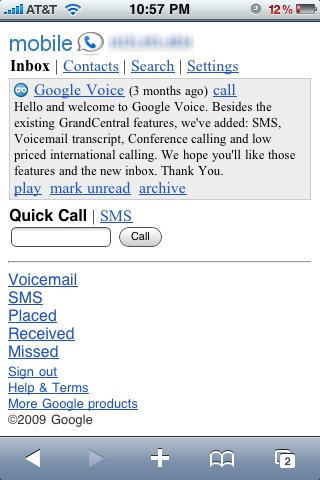
And it’s all fairly pointless, anyway, because all of the functionality Apple might be obstructing by holding these apps back is available through Mobile Safari right now. Latitude is currently functional through a custom web app, and the Google Voice website can place calls and send free texts from the iPhone. It could use a new interface, but the full capability of the technology is there — I called my wife with it, and it works perfectly. Screenshot’s from my phone.
No, something else is going on here. And as I see it, it’s one of two possibilities. The first is that Apple is finally starting to feel some heat from Android (I know it’s ridiculous, but hear me out) and wants to prevent Google from dominating two mobile platforms. Actually, I’ll just reject this one. If Apple wants to stay ahead of Android, there’s no better tactic than to get great Google apps on the iPhone.
So that leaves the other alternative, spelled AT&T. We know, with some certainly that Ma Bell is the reason that SlingPlayer only works over WiFi on the iPhone, and we know that it, not Apple, wanted Skype kept off of 3G. Worse, we know that AT&T’s battered 3G network is struggling to keep up with the incredible data traffic generated by iPhones. Now, Google Voice isn’t data intensive, but it does allow you to send free text messages (AT&T charges 20 cents a pop) and insanely cheap international calling (India is 7 cents a minute, a full two cents cheaper than Skype). When your network is in trouble, you might as well make sure people don’t find ways to get around your punitive fees, right?
Now, if this were AT&T’s app store, I wouldn’t have a problem with the carrier dictating which apps were approved and which weren’t. But this is supposed to be Apple’s show. Worse, other phones on the AT&T network are allowed to get Google Voice, full SlingPlayer and other functionality that is being held off the iPhone for fear of the traffic burden. If AT&T is behind this, I understand it, but I’m incredibly frustrated. If Apple’s hand is on the switch, I have serious doubts about the company’s ability to hold onto a developer community much longer.
TechCrunch: Apple is Growing Rotten to the Core
TUAW: GV Mobile and Voice Control Pulled from App Store
Apple Screws Google Over ‘Latitude’ iPhone App
Posted by Pete Mortensen in Apple, Opinions, Software, Top stories | Comment on this article
If you enjoyed this article:
Subscribe via RSS or email, or follow us on Facebook and Twitter


I agree completely. This is very worrying. Apple, as they have often done in the past, is skirting very close to the edge of what users will tolerate. With luck, they will step away. They really have tied themselves too close to AT&T. The relationship is now turning more hindrance than advantage for Apple.
ElectoBoy, on July 28th, 2009 at 3:28 am
What i imagine Apple will do is shorlty start to announce multi-cellular partners come September. Orange in the UK apparently is ready to start selling the iphone 3g not the 3gs mind. Surely Apple’s main concern should be with getting handsets in as many hands as possible?
Lets remember Apple would have made a pretty fortune by the network operators paying for both exclusivity and also from the revenue kick backs. But with so much global attention on anti-competitive practices Apple need to simply rely on unit sales and then getting those users spending in the App store.
Matt Edwards, on July 28th, 2009 at 5:57 am
This may be the best way to benefit users.
First we have to remember that using all these great apps isn’t free. I don’t mean to the user, but to the carrier. Any time you use the AT&T network for one of these, it costs AT&T money. These are relatively high-end apps, so they use a lot of resources. Every dime AT&T spends on supporting these apps is a dime less they can spend on improving the 3G network and begin work on 4G. Yaking the long view, it’s sort of shooting yourself in the foot if you’re an iPhone user. All those androids running on Verizon will be able to use 4G while you’re stuck on antiquated 3G. But at least it will be able to handle the reduced traffic easily.
Do I think AT&T is sticking it to iPhone users with some of their fees? Of course. Do I think these Google apps are competition to AT&T? You know it. Do I think Apple has the obligation to support their business partner by keeping competitors off their (shared) platform? More than ever.
One of the ways Apple made sure the iPhone would be a financial success was through the single carrier model. Like iTunes, they extended their market further out of hardware, and this time it took almost zero investment. Now, by prohibiting iPhone apps but ignoring their availability through Safari, they can have the best of both worlds – good partner to AT&T and still making the apps available to users.
This is also good for users. The drams of prohibiting the apps creates a brouhaha that educates users that there are alternatives that cost a lot less. They can use Safari for the services, pressuring AT&T to reduce tariffs to a reasonable price, until it’s both convenient AND affordable to use AT&T’s services.
Apple wins. AT&T wins. Users win. All thanks to Google’s R&D dollars and a little patience.
imajoebob, on July 28th, 2009 at 6:54 am
Is anyone really surprised by this? Do you remember how hard the US cellular corps fought against number portability?
All the way back to Alexander Graham Bell, the US telco biz has always been all about vendor lock-in. Apple’s exclusive deal with AT&T won’t last forever, and AT&T knows it. Together with number portability and Google Voice, and the commodification of their service will be complete.
It’s inevitable, of course, that cell service will become a commodity; but just like the media companies, they’ll go to extremes to protect their inefficient and outmoded business model to the bitter end.
Gryffin, on July 28th, 2009 at 8:29 am
>>First we have to remember that using all these great apps isn’t free. I don’t mean to the user, but to the carrier. Any time you use the AT&T network for one of these, it costs AT&T money.<<
Which is why AT&T supposedly "has" to charge 50% more for unlimited service than Sprint charges.
Those ridiculously high data fees and charges are supposed to be going towards those "costs" while also making AT&T a hefty profit (which they are, judging from their financials).
The reality is that Apple thinks they own the market and can screw their customers, and AT&T may or may not think they're along for the ride.
But Sprint is waiting with its own unlimited plans — without restrictions — for $50 less a month… and building out the country's first 4G network at the same time.
So the excuses for Apple (and AT&T) don't pass muster.
Brian, on July 28th, 2009 at 10:28 am
[...] Cult of Mac [...]
Google Apps News – Daily Roundup – 7/28/09 | Susan B. Cline, on July 28th, 2009 at 7:02 pm
“First we have to remember that using all these great apps isn’t free. I don’t mean to the user, but to the carrier. Any time you use the AT&T network for one of these, it costs AT&T money. These are relatively high-end apps, so they use a lot of resources.”
No way is this about bandwidth, at least for the Google apps (maybe for SlingPlayer). There are lots of streaming audio apps that use more continuous bandwidth.
APP, on August 3rd, 2009 at 7:21 am
[...] ma anche con Skype (esempio ancora disponibile) è possibile fare le stesse cose. Inoltre decine di altre applicazioni da sempre accettate su App Store replicano cose che il melafonino sa già fare. Senza per questo [...]
iPhone toglie la voce a Google di Claudio Tamburrino giovedì 30 luglio 2009 Roma – Apple ha ufficialmente bloccato Google Voice su App Store, con la motivazione che “duplica le funzioni già integrate nell’iPhone”. Dopo aver tolto, on August 25th, 2009 at 6:04 am
And Nevile sure as hell shouldnt be curing them. ,
Daddy88, on October 10th, 2009 at 7:12 pm