Top stories

Commuter Delays? iPhone Tube Refund App Pays for Itself

Londoners stuck in the tube now have a handy iPhone app to request ticket refunds.
Tube Refund, which costs $0.99, zaps off the request for riders whose journey is delayed over 15 minutes.
Depending on where you go and what time of day, a one-way tube ticket can cost from £1.80 to £4.00 ($2.75 – $6 circa) [...]

What’s Next For the iPad? A Tabletop iPad, According to Xerox PARC Circa 1991

Way back in 1991, just as Apple was transitioning from 68k to PowerPC chips, the braniacs at Xerox PARC were predicting it’s entire iPod, iPhone and iPad strategy. And next up for the iPad is a blackboard-sized device.
Nearly 20 years ago, just as personal desktop computers were taking off, researchers at Xerox started thinking about [...]

iPhone App Arms Users With Silent Panic Button

A new app called Silent Bodyguard features a panic button that sends an SOS distress signal with GPS coordinates to potential rescuers without alerting onlookers.
While the $3.99 app, available on iTunes, isn’t the first ICE (in case of emergency) app, this one is backed by Dr. Clint Van Zandt, former FBI chief hostage negotiator and criminal [...]

Early Apple Employees Auction Killer Collectibles

If there’s a good thing about the recession, it seems to be bringing some fine Apple memorabilia out of storerooms and closets.
Cliff and Dick Huston — ex-Apple engineers, for the record employees 27 and 25 — have decided to part with a treasure trove of Cupertino collectibles by auctioning them on eBay.

What’s on the block:

Apple [...]

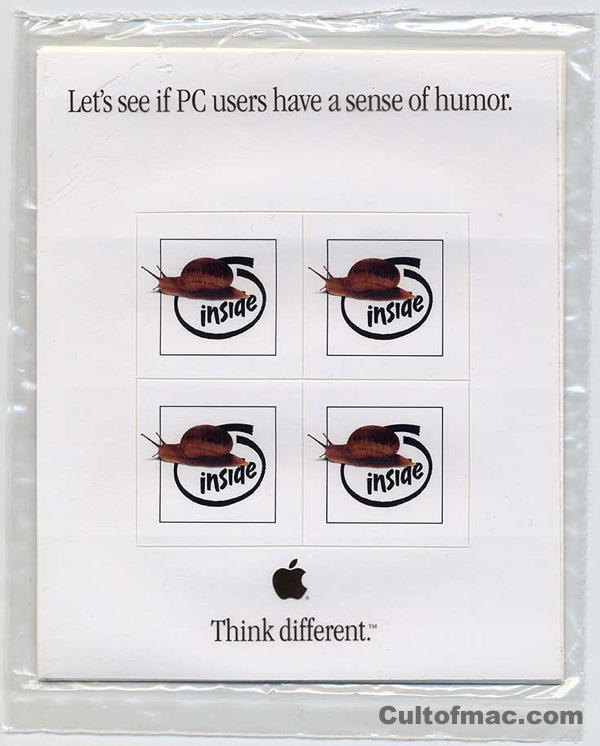
Think Irony

think_irony

My friend Jeffy picked up this pack of stickers at a Macworld past. Do Mac users have a sense of humor ? Should they be printed up as stickers for MacBooks?

If you enjoyed this article:
Subscribe via RSS or email, or follow us on Facebook and Twitter

About the author

Leander Kahney

Leander Kahney is the editor of Cult of Mac, and author of three books about technology culture: Inside Steve’s Brain, the New York Times bestseller about Steve Jobs; Cult of Mac; and Cult of iPod. Leander has written for Wired, MacWeek, Scientific American, and The Guardian in London. Follow Leander on Twitter @lkahney and Facebook.

Email the author | Read more posts by Leander Kahney.

17 comments

    i don’t get it. Mac’s have intel inside as well. What’s the deal? Is it because of stickers on every PC?

    Since Macs and PCs use the exact same processors, I don’t see the point.

    LOL. Well, the fact that I can laugh at this is what I hope makes the difference between a fanboy and a plain ol’ mac-luva.

    The real irony is that while these stickers were being printed, Apple was probably also working on Marklar – the Intel version of OS X.

    The point is, that one can still have an Intel Mac (because these days you simply cannot get a new Mac without Intel proc) and at the same time be aware of the PowerPC story — an architecture that has always been superior to x86, but had to be abandoned by Apple because there simply ceased to be companies that were interested in R&D of desktop PPC procs (and had enough steam to do that), because Apple needed to be able to offer Windows support to attract switchers and finaly because Intel’s Megahertz Myth marketing frontal assault was extreme and worked (people around me still regularly refer to processor’s frequency as “speed”, which really infuriates me). Thats it.

    What if Windows ran on PPC and there was a company with an Intel-like budget interested in PPC desktop chips R&D…? x86 chips would sit in technical museums all over the world, reminding us of one technological blind alley…

    To those confused about the stickers: Back when they were printed there was no such thing as a Mac with an Intel processor.

    @Daniel lol…no. The fact that the powerpc ended up falling into the same trap that the P4 did (too hot/clockspeed for power) was not because of poor R&D budgets… Also, the MHz Myth was clearly handled by AMD’s superior (for the time) architecture which intel then reacted to, creating the Core2Duo and now the Corei7. The fact of the matter is that market consolidation and the shift at IBM (itself a very large company, that once invested capital like intel) away from that kind of chip prodcution/design (itself a byproduct of market forces) created an ecosphere where Apple could not keep up with a speed race not based on MHz but Flops. It was wonderfully inevitable.

    Also, I’m pretty damn certain there is a version of windows that runs on PPC… sure it was NT 3.5, but what the hell right?

    The processor wars seems so silly, in retrospect. A processor is only as good as the software that runs on it, which is why my Aluminum MacBook runs faster on a slower Core2 Duo than my work ThinkPad with 2.53 Ghz Core 2 does.

    And what doomed the PPC architecture is that we reframed performance totally about five years ago. Steve’s whole performance per watt metric? It’s absolutely true. You can get a whole lot more power out of an Intel Core-family processor by watt than you can PPC. For our mobile future, PPC took itself out of the game.

    I would totally plaster that on my machine — maybe over the Apple logo…

    Ooh, Can I have some for my G5. It’s slooow when compared to my Macbook.

    @Ted: well, yeah, that’s what I’m saying :) there was no company interested in desktop PPC (that’s the case of IBM — was not interested, just agreed to build G5 and clearly had no motivation to push the dev, which is why it was such a junk when talking performance per watt — maybe Apple already knew they were going Intel when they asked IBM to build G5) and the second thing — not enought steam (and not interested at the same time, actually) — that’s the case of Freescale. G4 was clearly superior to x86 in it’s times. But the pressure from Intel and AMD was more and more intense and Freescale simply couldn’t compete. But that has nothing to do with the architectue itself.

    The P4 (one of the worst processor lines ever, actually) was a product of just The Megahertz Myth I’m talking about… “look, people, it runs at 3 GHz! sooo fast! omg!” …performance per watt, performance per hertz… who cared about that?

    Yes, NT ran on PPC, but the decision to discontinue that was all about marketing and business. What x86 chip could compete with PowerPC in the times of NT?

    I want one for my macbook.

    These were secretly put out by the guys at Apple. They were for us to go around to various retailers and sticking them over the “Intel Inside” stickers as a joke. I have mint condition ones and might sell them by the sheet if the price is right. They are a collector’s item and a fun part of Apple’s history when Apple’s PowerPC processor was faster than the Intel processor.

    Others will disagree, but being able to dualboot windows and OSX was probably the biggest thing in Intel’s favor. Everything else could be done on PPC, which hasn’t gone away, try to buy a game console with x86.

    @Tim – game console with x86? i think they call it the xbox. in fact its “PC” architecture had a lot to do with some of the software exploits discovered for it. (rehash old hacks) fun times.

    First, the power pc always was and still is a superior architecture for power consumption and also heat dissipation.. You compare the battery life and heat of todays intel macbooks and the older power pc ones, you can really see the difference. Apple’s and Steve Job’s argument that that the power pcs are too slow was exposed as bogus after it was found that OSX was compiled for size and not speed. At one time, Apple could boast about having the best hardware with their power pc offerings. Now, they can just boast about having the best advertisements.

    Judging by these comments, Mac users mostly don’t.

Buy Inside Steve's Brain Buy from Amazon.com Buy from Barnes & Noble