Thanks To iPhone, The Future Is Touchscreens, Report Says
8:14 am, May 20th, 2009, Leander Kahney

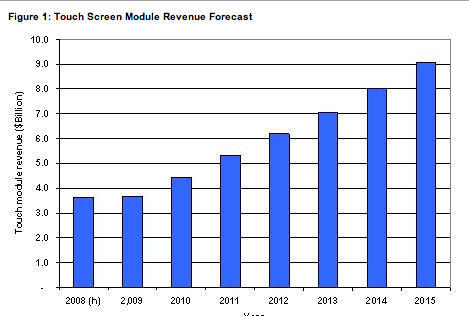
Source: DisplaySearch 2009 Touch Panel Market Analysis
Thanks to the success of the iPhone, touchscreen technology will see explosive growth in the next few years.
The touchsreen market will nearly triple in the next few years, growing from $3.6 billion now to $9 billion in 2015, predicts a new report by market research firm DisplaySearch.
“With the success of the iPhone, the touch panel market has entered a dramatic new growth phase.,” the DisplaySearch report said.
The report predicted big growth in projected capacitive touchscreens — the technology used in the iPhone and iPod touch.
“Projected capacitive touch screens have increased substantially and become the second biggest touch technology following closely behind resistive touch,” the report said. “About 27 touch screen suppliers manufacture it. Not only have more resistive touch screen manufacturers moved to produce projected capacitive, but projected capacitive technology has evolved to single layer or film type, and can serve sizes larger than 100-inches.”
Whoa — a 100-inch iPhone in 2015.
Mobile phones and smartphones will be the most popular application of touchscreens, but they will also be the primary interface for media players, navigation devices, and games. More than 40 percent of mobile phones will have touchscreen interfaces by 2015, the report predicts, up from 16 percent now.
Touchscreens will also become popular in applications like retail, ticketing, information kiosks, and education and training terminals, the report said.

Posted by Leander Kahney in Hardware, News, iPhone, iPod, iPod Touch | Comment on this article
If you enjoyed this article:
Subscribe via RSS or email, or follow us on Facebook and Twitter


A few provisos & comments (from someone in the Touch Industry for the last 13 years).
Small Projected Capacitive (as in iPhone & similar devices) tends to be good at up to about 8″ at the moment. The Large format that they talk about has embedded visible wires. If you’re in the UK, look at one of the BT Internet Phone Boxes, and you’ll see what I mean.
When they talk about Touchscreens will also become popular in applications like retail, ticketing, information kiosks, and education and training terminals, that’s been the core business for touch for years! Go to an airport, and chances are you’ll check in at a kiosk. Go to your local supermarket/grocer, etc, and the till will most likely be a touchscreen. Go into a bar/club/pub, and the till there will be touch enabled. If there’s a bar-top entertainment unit, where you can play games, that’ll very likely be touch. Touch has been around for almost 40 years in one form or another, and in the general marketplace for different applications for at least 15 years. The key area of growth now will be the move to consumer applications such as in-car controls, GPS, phones, remote controls, basic controls for white goods such as cookers, etc. The technology for that used to be resistive (think of the old Palm PDAs. Now it’s Proj Cap. Partly, this has been driven by Apple and the iPhone, but also by other companies who are also doing this technology, and have been for years.
Yes, the idea of Touch has been given a boost in the public eye due to Apple, but the idea was out there already, and was in already being developed by a number of developers and companies. Much as I love my Apple gear, as a techie, I do get frustrated when good marketing masks the true history of something….
Fearless Fred, on May 20th, 2009 at 8:42 am
@Fearless Fred. Thanks for the informative comment. You know anything about “in-cell, force sensing” and “combination-type touch panels?” The report said these are new touch technologies reaching commercialization this year, but no more info than that.
Leander Kahney, on May 20th, 2009 at 9:16 am
“Touchscreens will also become popular in applications like retail, ticketing, information kiosks, and education and training terminals, the report said.”
Personal touchscreens I like. Public touchscreens, not so much.
yebot, on May 20th, 2009 at 10:17 am
Oh, trust me, Leander, I can go on for quite a while about all the different touch technologies that are out there! I’ll try and do it in as few sentences as possible
In cell is a system that a couple of the LCD manufacturers are working on. There’s been some demos in the 3″ and lower size. In essence, it uses the display panel itself as the sensing surface. It generally uses the same idea as an iPod Touch/iPhone mechanism of the finger altering an electrical signal in the pixels that the finger touches, where the finger draws some electrical charge away from individual cells, and the ratio of charge drawn allows the chip running the touchscreen to determine where the touch has happened. A good part of this is that there’s no extra layer on top of the display, so you get brilliant optics. The drawback is that you don’t have a layer on top of the display, so it’s easier to damage the LCD panel. Commercialization is probably a few years off for this.
Force-sensing is just that. You use small piezo sensors around the edge of the screen. Piezos are cute in that if you put a voltage into them, they vibrate, or if you compress them, they create an electrical current. The stronger you press them, the more current you get. In small handheld things, you can away with just measuring the different currents, and triangulating the touch position. On larger screens, then things get a little more complex, and you start sensing the “ripples” created in the touchscreen when you touch the screen. There’s two of the biggest touchscreen companies who already sell systems based on this, in sizes ranging from 15″ up to 46″ diagonal. This is something that’s out there already.
The “combination” type could, to be honest mean a number of idea. I’ve heard it mentioned in the form of Projected Capacitive and an “active” pen that allows for drawing & writing on the screen, or sometimes a combination of surface capacitive and resistive. There’s a few floating out there.
Well, hope this helped!
Fearless Fred, on May 20th, 2009 at 11:54 am
[...] research firm Display Search now projects the touchscreen market will triple in the next few years, from $3.6 billion to $9 [...]
3 Aug – Wired – Why 2010 Will Be the Year of the Tablet « Today’s News, on August 4th, 2009 at 1:42 am