Developers cheer potential success of iOS, begin abandoning RIM and BlackBerry.
You’d think after recent events that RIM executives might have learned not to make public comments that fall somewhere between the categories of misleading and delusional. After all, as the New York Timesrecently reported, RIM’s new CEO could face litigation for misrepresenting the state of the company to its shareholders. Apparently even that lesson and the fact that half of CIOs and IT managers plan to migrate away from RIM’s BlackBerry Enterprise Server (BES) over the next year isn’t enough to prevent RIM from sticking its foot in its mouth.
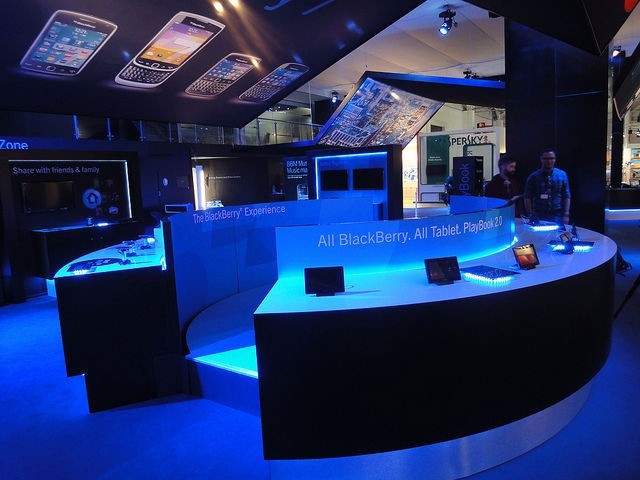
The latest drama surrounds a report that developers are quickly losing interest and/or confidence in developing apps for the current BlackBerry OS or its BlackBerry 10 successor. Alec Saunders, RIM’s vice president of developer relations – who’s rarely tactful when giving his opinion – took to RIM’s developer blog on Friday to defend the company.
Study: Majority of IT managers are planning migrations away from BlackBerry enterprise systems.
RIM’s trouble seem to be mounting exponentially these days. There’s been a lot of discussion in the tech media about companies significantly invested in BlackBerry devices and services drawing up contingency plans in case of a prolonged outage or service disruption should RIM go belly up or get bought out by another company. The situation for RIM is going to get even worse over the next few months as many companies put some pieces of those plans into action.
According to a survey conducted this week by finance-oriented research firm ThinkEquity, 50% of IT managers have decided to replace RIM’s BlackBerry Enterprise Server (BES) systems within the coming year. 70% plan to do so within the next two years.
If RIM falters, iPhone/iPad pilot projects become the contingency plans.
Enterprise customers form the backbone of RIM. Many of them are now preparing contingency plans in case the BlackBerry maker goes out of business or is bought by another technology company. Many enterprises first began thinking about contingency plans in the wake of RIM’s large-scale outages last year.
What those contingency plans look like varies. Some companies are soliciting advice from leaders in the mobile management like MobileIron. Some are revisiting their agreements with RIM. Others have already begun migrations away from the BlackBerry.
If RIM does go belly up, can Apple be ready to meet the security needs of RIM’s customers?
It’s getting almost painful to read reports about RIM. The ongoing hype about how great BlackBerry 10 will be mixed with the reports of layoffs, inventory sitting around warehouses, the company’s share price plummeting – it all reminds me of the time one of my high school friends broke her ankle in gym class and hobbled around for nearly half a day trying to convince herself that she’d only sprained it.
Among all that news, however, is a question – can organizations that need incredible security manage in a world without RIM and the manageability made possible by its BlackBerry Enterprise Server (BES)? Is iOS up to that challenge? Is Apple up to or interested in making a major play for the enterprise market?
Toshiba can sleaze it up all they want. If you don’t show why customers should want your tablet, they won’t buy it.
Despite all the talk about Android, Windows, and other tablets being iPad killers and expected to steal both consumer and business market share from Apple, not one has managed to make a real dent in the iPad’s dominance – particularly in the business space.
There are, of course, plenty of factors that I could point to and say “this is why the iPad is still number one” – IT folks know how to secure and manage iPads, there’s a single form factor, there’s a great selection of apps. I could go on, but one of the biggest reasons Apple that retains the market share that it does has nothing to do with specs, brand loyalty, app choices, or integration with existing enterprise systems.
As this absurd and rather sleazy ad for a Toshiba Windows tablet makes obvious, virtually all Android, BlackBerry, and Windows device commercials don’t tell me anything about what a device can actually do for me.
Back in May, shortly after Research in Motion’s BlackBerry 10 unveiling, iOS developer Mario Hros announced that he was working on bringing the operating system’s nifty predictive keyboard to our iOS devices with a tweak called Octopus Keyboard. It’s a little over a month late, but Octopus Keyboard is now available to download from Cydia.
Mobile companies without strong customer appeal could lose big time as more and more businesses adopt BYOD.
Most discussions around BYOD and costs focus on one of two areas. The first is the cost reduction that a company might see if employees provide their own iPhones (or other devices) and pay for their own mobile plans. The second is the cost for mobile management solutions to secure and manage those personally-owned devices along with the apps and data stored on them.
Those are major concerns, but research company ARCchart recently identified a completely different cost of the BYOD trend – the revenues that device manufacturers and carriers are likely to lose as BYOD becomes a standard practice across the business world. According to ARCchart, the worldwide mobile industry could take a hit as big as $40 billion over the next four years as a result of BYOD.
iMessage and related services are gaining critical mass compared to text messaging.
Apple has put a lot of work into developing its own secure messaging platform. With Mountain Lion and the Messages app that Apple rolled out in iOS 5, Apple is setting up its iMessage platform with a lot potential advantages for consumers and business users alike. For business, the always available and secure messaging is huge. Messages and conversations can be found on an employee’s iPhone, iPad, home iMac, work MacBook Air – that’s taking the concept of RIM’s BlackBerry Messenger service to a higher level.
For consumers, the great features are the integration of non-phone devices like the iPad and iPod touch and reduced reliance on carriers for texting, which can translate to cost savings (depending on mobile carrier/plan).
While most of us still use SMS to send text messages, there’s a distinct trend in shifting to using solutions like Apple’s Message platform.
Going from BlackBerry to iOS management is a culture shift, but that can be a good thing.
Despite its continuing downward spiral, many IT professionals continue to acknowledge that RIM’s BlackBerry platform — or more accurately its BlackBerry Enterprise Server (BES) — remains the most secure mobile platform on the market. That’s a fact RIM hypes every chance it gets. Usually RIM points out that BES supports over 500 security and management policies. That’s roughly ten times the number of discrete management options that Apple has built into iOS.
While that number sounds impressive, the real difference between BlackBerry management and iOS management isn’t really about the number of policies. In many ways, it isn’t even about what IT can or can’t manage. The real difference is a cultural divide in the way mobile devices and mobile management is perceived.
Majority of Americans won’t even consider buying a Microsoft Surface.
According to a poll conducted by discount site CouponCodes4u, less than one-quarter of American consumers will consider buying Microsoft’s newly unveiled Surface. The discount site used the poll to study the overall tablet space and to determine brand awareness and perceptions across the U.S. market. It found that only 22% of respondents would consider buying one of the Surface tablets.
The survey, which was taken by 1,578 Americans in the 21 to 35 age bracket, also found high brand loyalty among tablet owners for both the iPad and for Android.