Oracle looks set to acquire the United States operations of TikTok, according to people familiar with the matter, speaking with the Wall Street Journal.
According to the report, the deal will not be an outright sale. Instead, Oracle will be announced as TikTok’s “trusted tech partner” in the U.S. — hopefully doing enough to satisfy security concerns on the part of the White House. Financial terms have not been revealed.
The stink bomb is coming soon to Battle Royale. Photo: Killian Bell/Cult of Mac
Close your eyes and hold your noses because stink bombs are coming soon to Fortnite: Battle Royale.
The new throwable, which will damage opponent players who get caught up in its cloud, will be added in this week’s content update. Epic has already introduced the new Omen outfit and Oracle pickaxe, which can be found in the shop now.
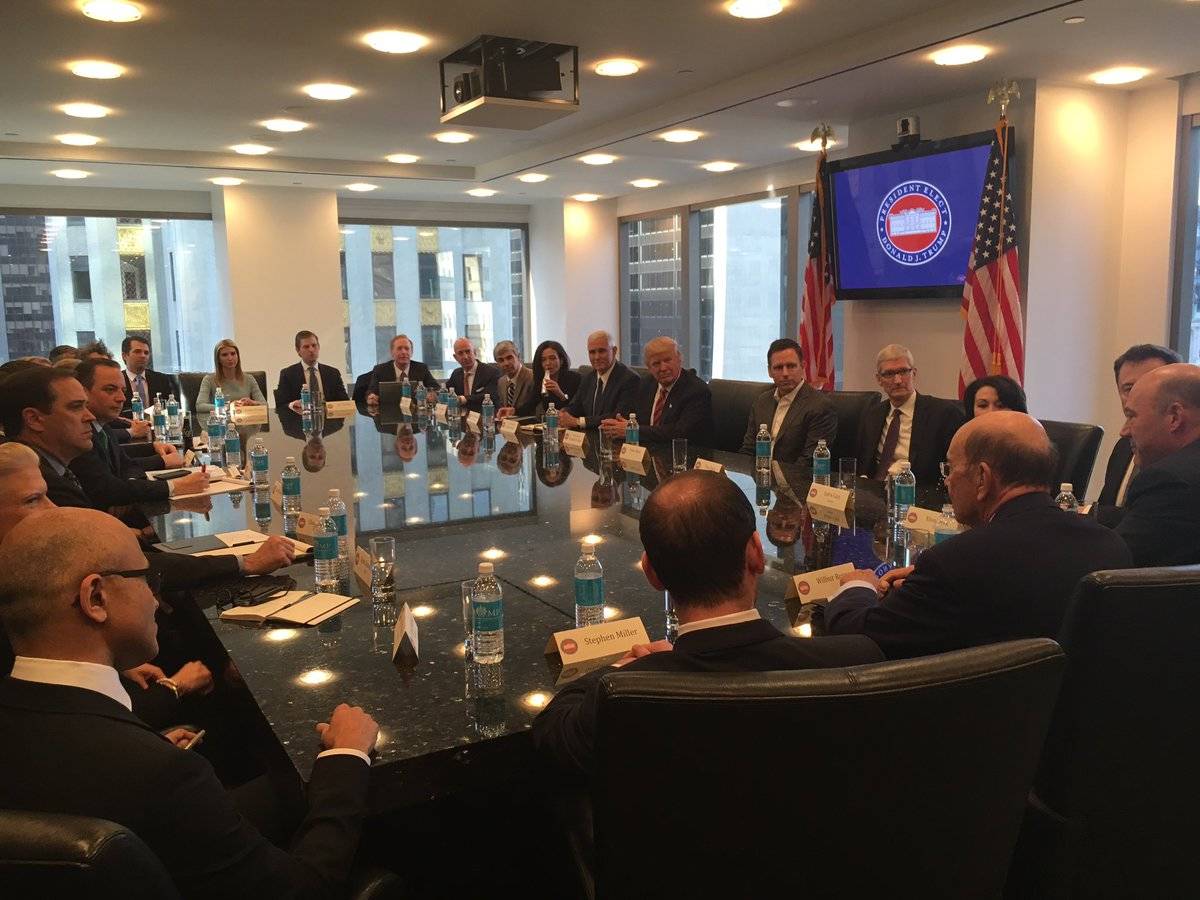
Peter Thiel separates Tim Cook and Donald Trump at tech summit. Photo: Sean Spicer/Twitter
Trump Tower in New York City became the site of the biggest meeting of tech figures in years Wednesday, as President-elect Donald J. Trump called together Silicon Valley’s elite for a meeting of the minds.
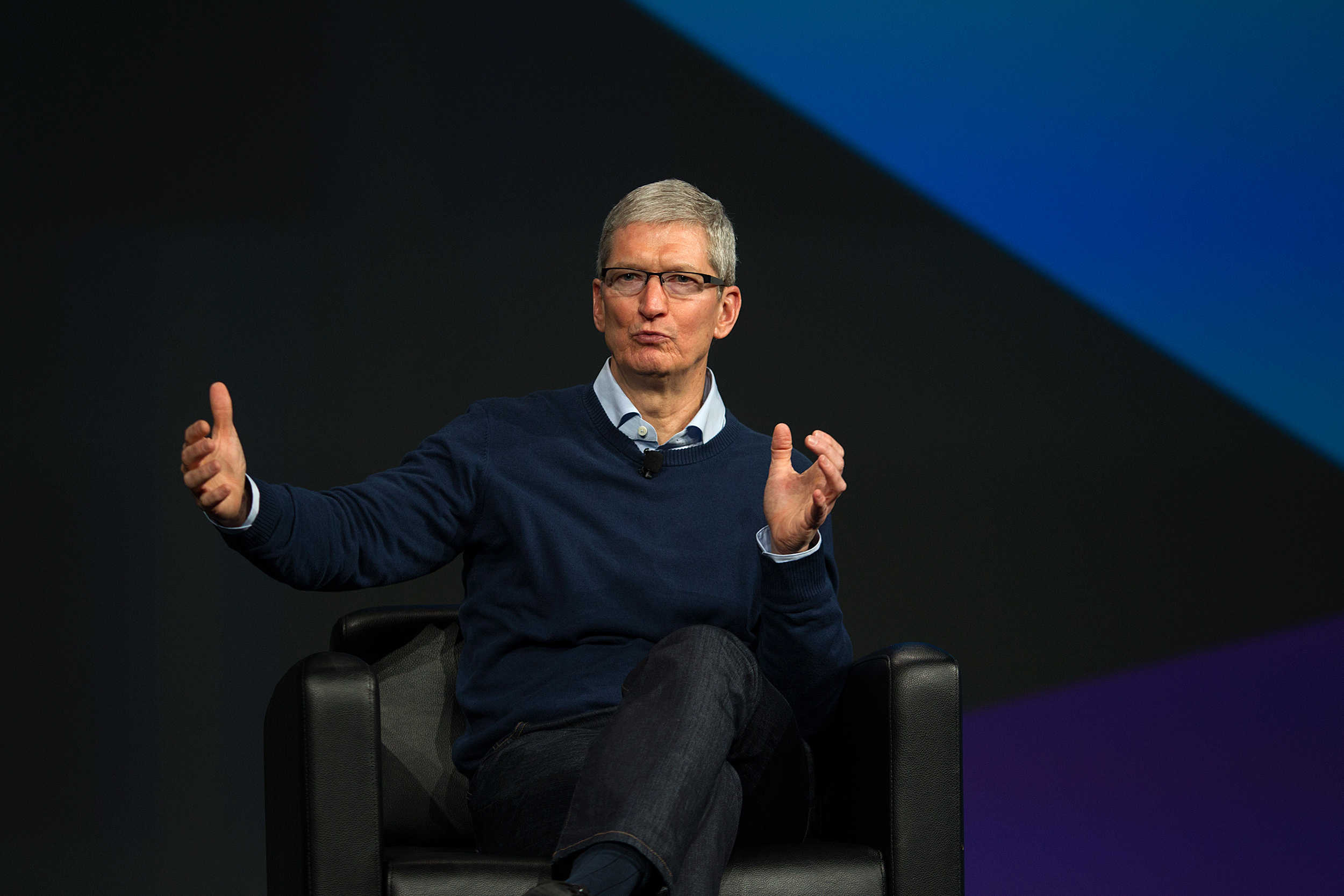
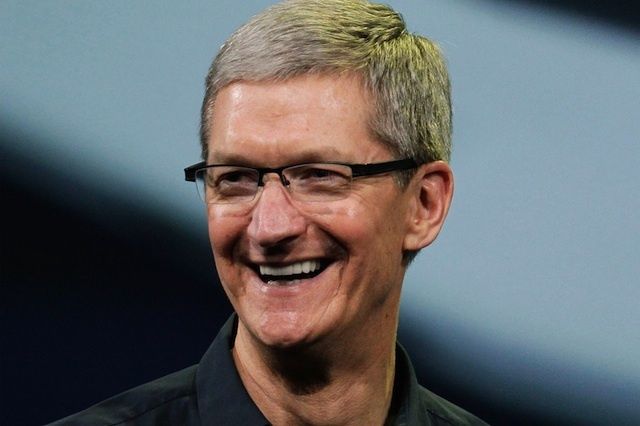
Apple CEO Tim Cook was among those in attendance and was seated within arm’s reach of the Trump, even though Cook previously has been criticized by the recently elected Republican. Trump also called for a boycott against Apple products during the blistering presidential campaign.
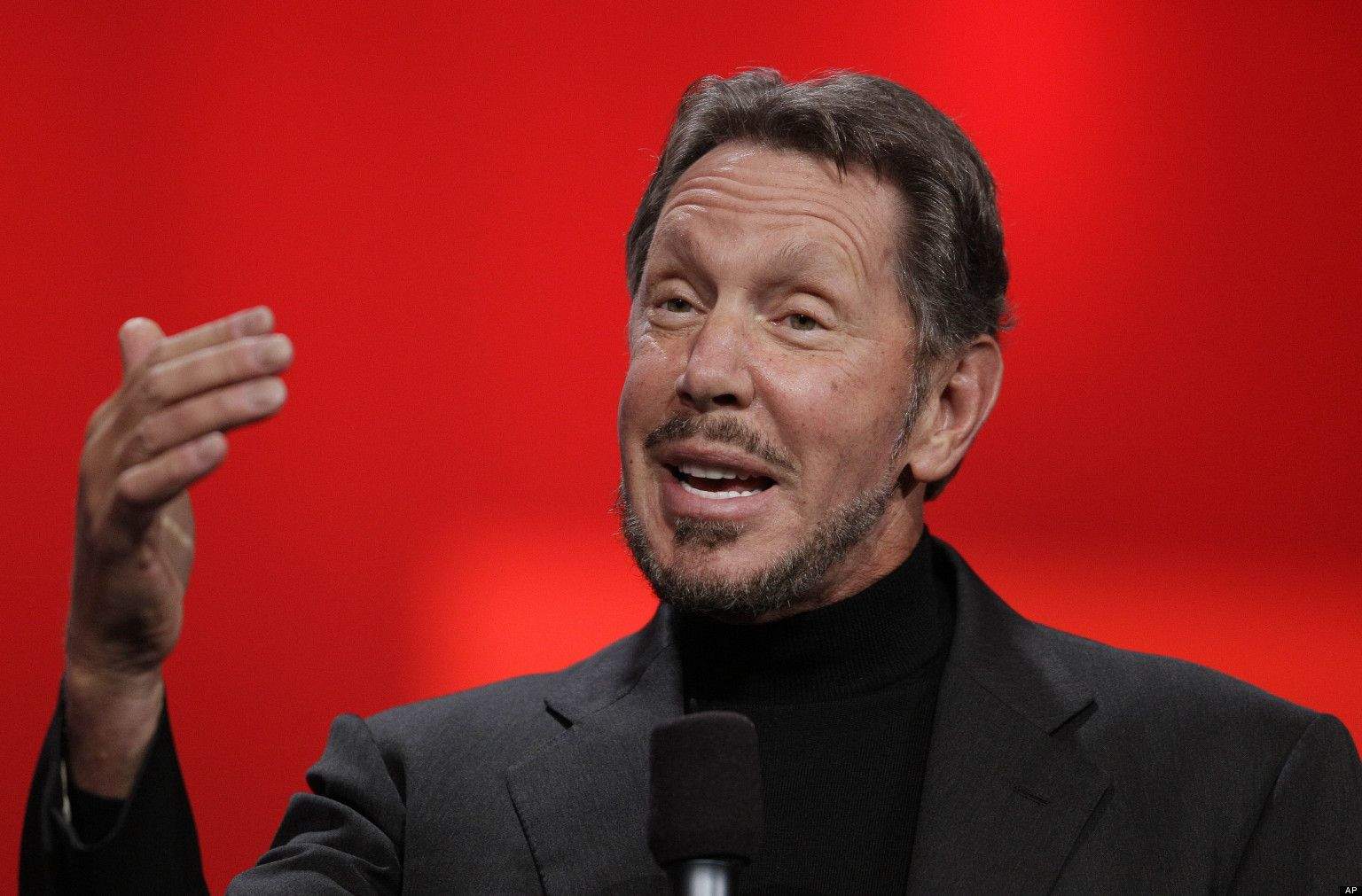
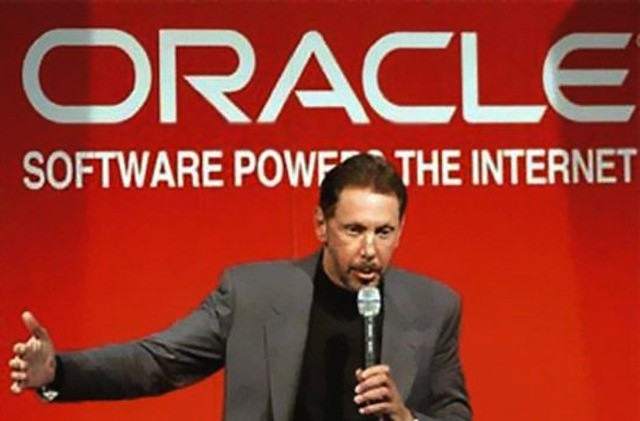
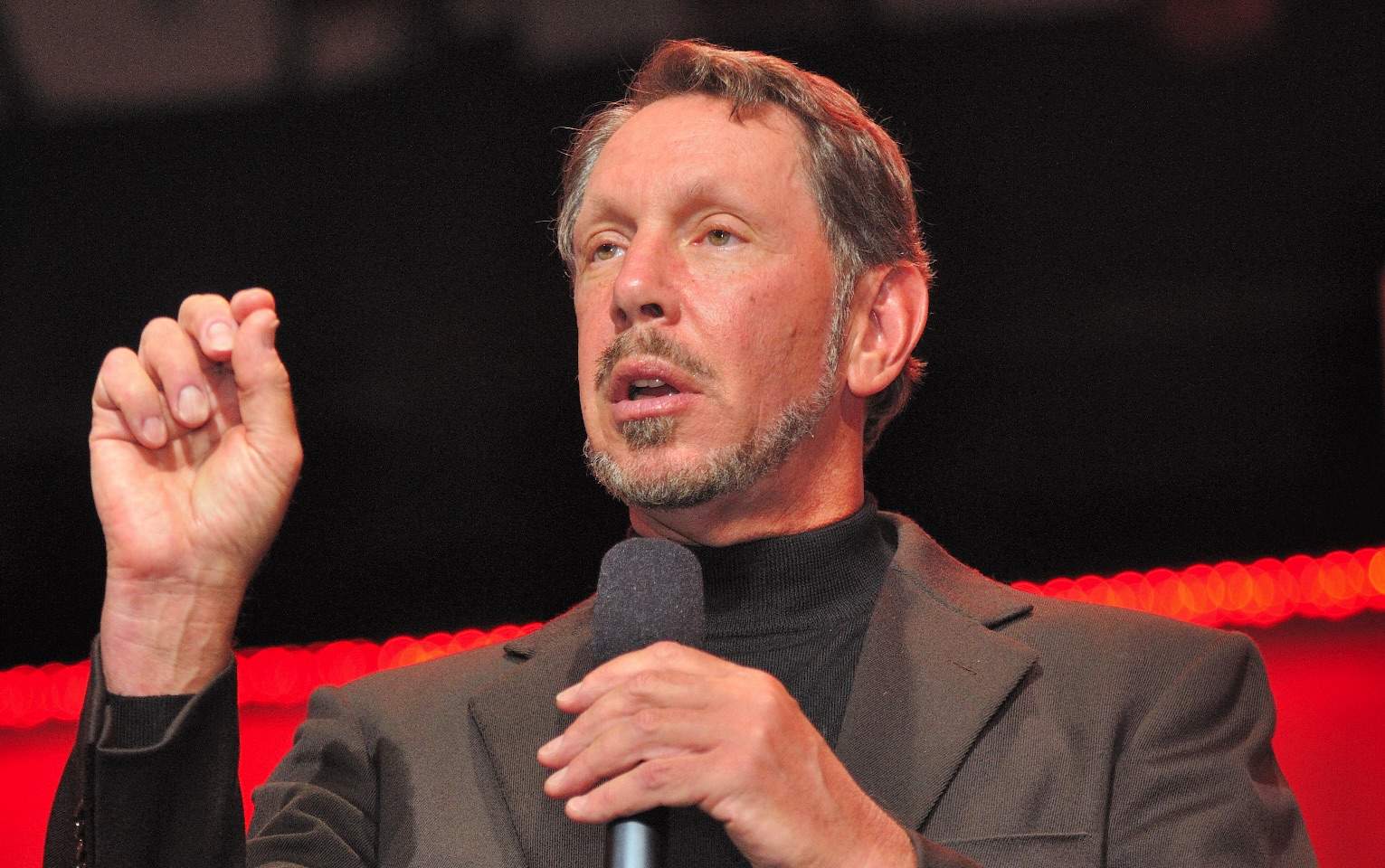
August 17, 1944: Larry Ellison, billionaire co-founder and former CEO of Oracle, and Steve Jobs’ best friend, is born.
A later member of the Apple board of directors and the closest thing Jobs had to a confidante, in the 1990s Ellison even considered staging a hostile takeover of Apple to reinstall Jobs as CEO during his time away from the company.
Jobs’ son, Reed, reportedly referred to Ellison as, “our rich friend.”
Is Tim Cook underpaid? Photo: Jim Merithew/Cult of Mac
Apple is the most valuable publicly traded company in the world, but when it comes to CEO pay, Tim Cook is conspicuously absent on the latest list of top 200 paid CEOs in the US.
Breaking news: There's big money in search. Photo: Killian Bell/Cult of AndroidBreaking news: There’s big money in search. Photo: Killian Bell/Cult of Android
Android and iOS may be mortal enemies in some ways, but Google clearly realizes the value of having Apple’s hundreds of millions of customers use its search engine.
So much so, in fact, that in 2014 Google paid Apple a massive $1 billion to keep its search bar on the iPhone.
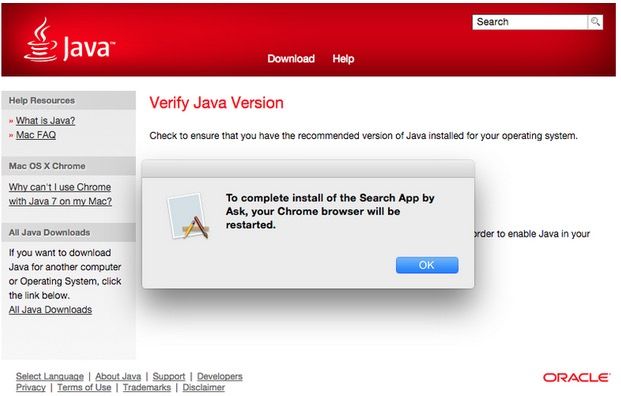
Mac users have had it pretty good when compared to Windows users, at least on the adware and nuisanceware front. Even Oracle, who has bundled the Ask.com search toolbar with Java for Windows for years, has abstained from infecting its Mac users with adware.
Sadly, though, that era now seems to be an end, with Oracle opting to bundle its most recent versions of Java for Mac with the Ask.com search toolbar.
Tech pundits across the web have been arguing for years about whether Apple can succeed without Steve Jobs, but Steve’s close friend, Oracle CEO Larry Ellison, says that we already know what the future holds for Apple.
In an upcoming interview with Charlie Rose on CBS, Ellison says we don’t need to postulate what’s going to happen to Apple because we’ve already seen the after-Jobs experiment:
Well, we already know. We saw — we conducted the experiment. I mean, it’s been done. We saw Apple with Steve Jobs. We saw Apple without Steve Jobs. We saw Apple with Steve Jobs. Now, we’re gonna see Apple without Steve Jobs.
Things haven’t been going all that well for HP on the PC shipment front, but it’s hoping to make up for that with its new high-tech Project Moonshot servers. In fact, HP CEO Meg Whitman is so jazzed about her company’s new servers that she’s even going around bragging that Apple might be considering HP for its iTunes services.
Thanks to Samsung and the International Trade Commission, Apple will be banned from importing the iPhone 4 and the iPad 2 into the United States from Sunday, August 4. The Cupertino company has been trying to fight the ban since it was confirmed last October, but it’s had little success.
Now it is seeing unlikely support from Microsoft, Intel, and Oracle, which all agree that the use of standards-essential patents to ban products should not be allowed.
Four out of the five highest-paid executives in the United States work for Apple, Bloomberg Businessweek reports, but not one of them is CEO Tim Cook.
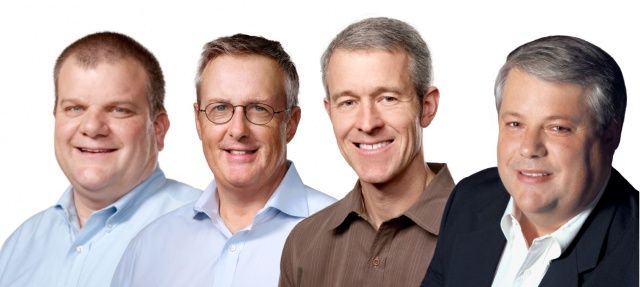
According to fiscal 2012 compensation figures for top earners filed with the U.S. Securities and Exchange Commission (SEC), Apple’s Bob Mansfield, Bruce Sewell, Jeffrey Williams, and Peter Oppenheimer join Oracle CEO Larry Ellison to make up the top five corporate earners last year.
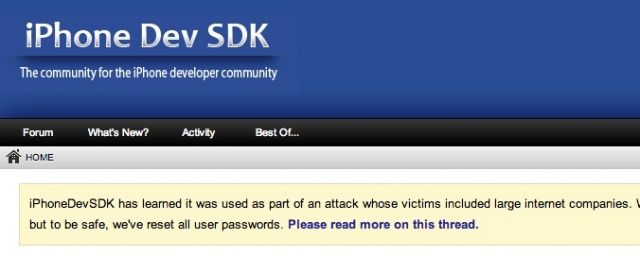
Following yesterday’s surprise announcement that multiple employee computers within Cuptertino had been compromised by a malicious zero-day Java exploit that was uploaded to an iOS developer forum, the owner of the attacked site has spoken out, claiming that not only did he have no idea he had been hacked… Apple never even contacted him to tell him.
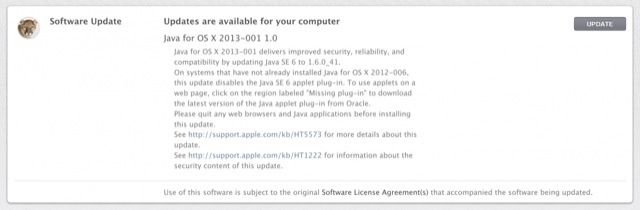
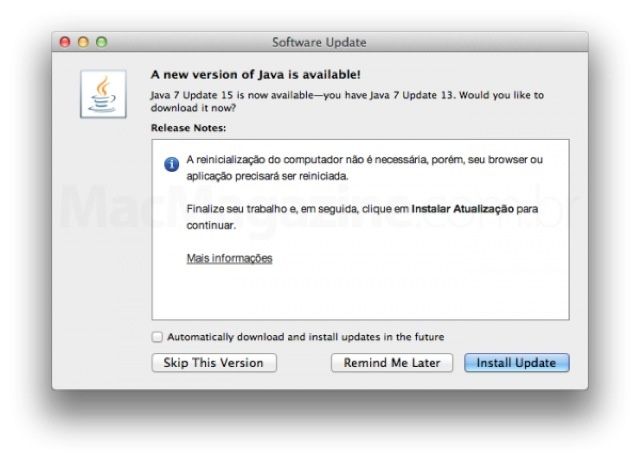
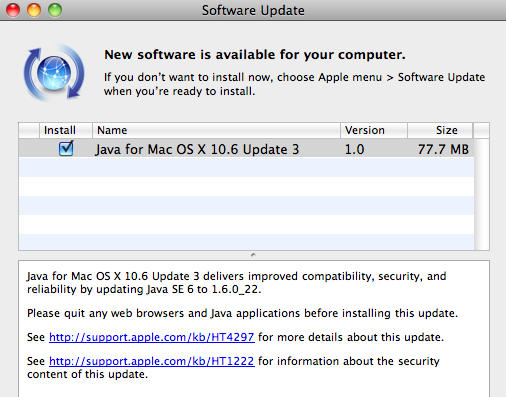
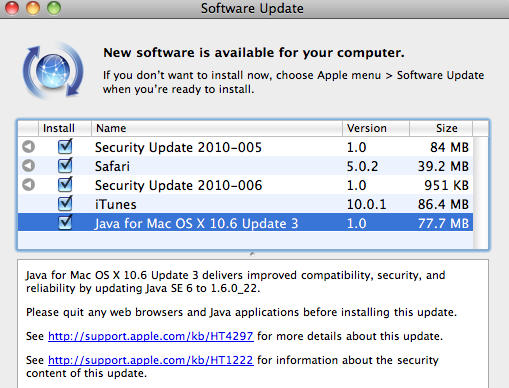
Following today’s big story that a number of employee computers within Apple were compromised following a zero-day Java exploit, Oracle has just released update 15 for Java 7 and update 41 for Java 6.
While there’s no specific mention of what has been updated, there’s excellent reason to believe it fixes the vulnerability that compromised both Apple and Facebook.
According to Apple, a “small number” of its employees computers were compromised due to a vulnerability in Java.
How Did It Happen?
It appears that this zero-day exploit is the same one that resulted in a number of Facebook employees having malware installed on their laptops as a result of visiting a mobile developer website that had been compromised: Apple says their employees were infected “through a website for software developers.”
Despite taking control of Apple just 18 months ago, Tim Cook has been named by CNBC as the highest paid CEO in America. With an average annual compensation of around $95 million, Cook beats Oracle’s Larry Ellison and JC Penney’s Ron Johnson to the top spot.
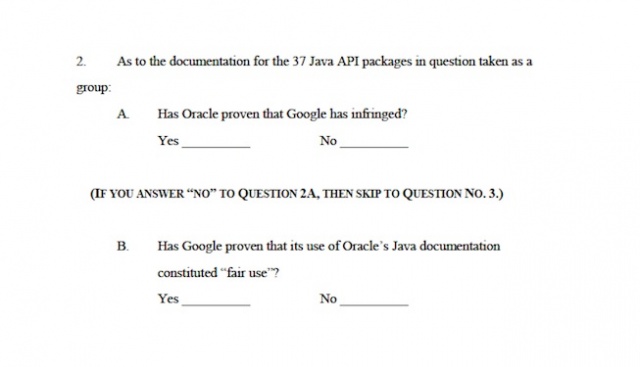
After a weekend deliberation, a federal jury in San Francisco handed Oracle a partial victory by finding Google guilty of copyright infringement yet remaining deadlocked on whether Google’s use of the Java APIs fell under “fair use.” The jury found that Google infringed a minimal amount of Java source code with Judge William Alsup indicating that Oracle would only be entitled to statutory damages as a result. This certainly wasn’t what Oracle was hoping for and when Oracle’s lawyer seemed to suggest they were entitled to more than just statutory damages, Judge William Alsup quickly put the kibosh on that notion based on the minimal amount of code infringed, stating what they’re seeking as “bordering on the ridiculous.”
Larry Ellison acknowledged recently that Oracle considered buying RIM
One of the interesting tidbits to emerge from testimony during Oracle panent infringment trial against Google is that Oracle had considered producing its own smartphone and buying either RIM or Palm. The testimony came from Oracle chief Larry Ellison, who was a close personal friend of Steve Jobs. Ellison is, in fact, quoted as describing their relationship as “best friends” in Walter Isaacson’s biography of Jobs.
The news raises some interesting questions – not the least of which are whether Jobs knew of the plan and what impact Oracle jumping into the smartphone game against the iPhone might have had on their friendship. Jobs was obsessed with the idea that Google and its former CEO Eric Schmidt (also a former Apple board member) had ripped off Apple’s iOS design work in creating Android.
Think Apple's software is free from vulnerabilities? You couldn't be more wrong.
Apple’s operating systems and its software are generally believed to be the best available in terms of security and stability, but a new report from Trend Micro reveals that’s a huge misconception… at least in recent months. In fact, the Cupertino company suffered more vulnerabilities during the last quarter than rivals like Oracle, Google, Adobe, and even Microsoft.
Quick, what makes more money for Google: iOS or its own Android operating system? If you didn’t know anything about what a farce Android has become, you’d assume that Google was making more advertising revenue out of its own platform and ecosystem, but you’d be wrong: the search giant makes up to four times more off of iOS. Ouch.
Macs don’t really get viruses very often, but there’s more than a few anti-software firms who’d like you think they do… and sell you some software to help squash them.
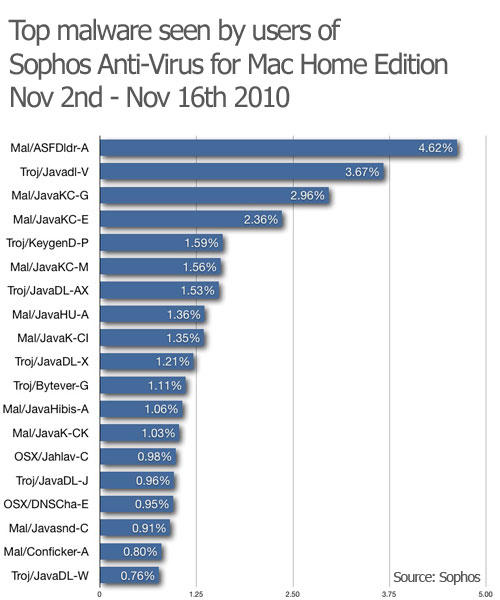
Anytime we write about Mac viruses, then, it should be done with some salt dissolving on the tongue, and anti-virus firm Sophos’ latest report showing a surprising amount of malware on the Mac is no exception.
The data was culled from 50,000 malware reports generated by 150,000 users of Sophos’ free Mac anti-virus software during the first two weeks of November. The chart looks bad, but in actuality, it’s not really very dire… a fact that Sophos themselves are being upfront about.
When Steve Jobs was asked why Apple was deprecating in-house Java development for OS X, he explained: “Sun (now Oracle) supplies Java for all other platforms. They have their own release schedules, which are almost always different than ours, so the Java we ship is always a version behind. This may not be the best way to do it.”
Yesterday, Apple announced how it planned on passing the Java torch back to Oracle: they would be partnering together for the OpenJDK project to make sure that both Oracle and the open source dev community had the tools they needed to keep Java on the Mac alive past Java SE6.
Ostensibly, Apple’s move to deprecate Java would be good for Mac security, in that users will no longer be forced to wait for Apple to update their home-baked Java when Oracle fixes some security vulnerabilities in their build.
According to Charlie Miller, co-author of The Mac Hacker’s Handbook, though, this may make the Mac even less secure than it was before.
Yesterday, Apple quietly announced that they would cease future distribution of their own custom Java packages, concerning some Java developers. But no need to worry, Steve’s already already explained Apple’s thinking on the matter, and it makes sense to us.
First, Apple’s announcement of Java deprecation. According to the updated developer documentation for the Java updates for OS X released yesterday, Apple will no longer be maintaining their Java runtime at the same level, and it may even be removed from future versions of Mac OS X.
So does that mean that Macs will no longer have up-to-date Java? A concerned Java Developer from Portico Systems emailed Steve Jobs, asking that very question.
Jobs’ response:
Sun (now Oracle) supplies Java for all other platforms. They have their own release schedules, which are almost always different than ours, so the Java we ship is always a version behind. This may not be the best way to do it.
In other words, Apple’s leaving Java to the company that does it best… that is, if Oracle decides to step up and produce their own version of Java for Mac, as they do for every other platform. My guess is they will quickly fill the void and it’ll be a win for everyone: Apple no longer has to spend the money to produce custom-baked, already-obsolete versions of Java, and Mac users will get Java of the same level and quality as it is available on other platforms.
Subscribe to the Cult of Mac newsletter
A daily blast of Apple news, reviews, how-tos and deals, delivered straight to your inbox.



 August 17, 1944: Larry Ellison, billionaire co-founder and former CEO of Oracle, and Steve Jobs’ best friend, is born.