Top stories

Security Expert: “Mac OS X Is Safer, But Less Secure”

20100319-ipwned.jpg

Tech site H-Online has an interesting story today, quoting security expert Charlie Miller about his forthcoming talk at the CanSecWest conference next week.
He says OS X is full of security holes. There are lots more than in Windows, he claims.
And yet: OS X is a safer system to use. Why? Because, in the words [...]

Apple Devotes Entire Home Page To Jerome York Obituary

20100318-york.jpg

If ever you needed a sign that Apple was a different kind of technology company, this is it.
What other computer manufacturer would remove its top-selling, hype-inducing, industry-altering new product from the prime spot on its website home page, and replace it with an obituary to an investor?
This is one of those “Here’s to the [...]

Coming Soon: Steve Jobs, the Sitcom

Fake Steve creator Dan Lyons just signed a deal to bring Steve Jobs to another small screen near you.
The half-hour series called “iCon” is billed by the presser as “a savage satire centering on a fictional Silicon Valley CEO whose ego is a study in power and greed.”
Making sure the barbs prick will be the [...]

What’s Next For the iPad? A Tabletop iPad, According to Xerox PARC Circa 1991

Way back in 1991, just as Apple was transitioning from 68k to PowerPC chips, the braniacs at Xerox PARC were predicting it’s entire iPod, iPhone and iPad strategy. And next up for the iPad is a blackboard-sized device.
Nearly 20 years ago, just as personal desktop computers were taking off, researchers at Xerox started thinking about [...]

On iPhones and Game Data Back-ups: Restore Data With MobileSyncBrowser

I lost all my game progress, and all I got to show for it was this lousy dialog box.

I lost all my game progress, and all I got to show for it was this lousy dialog box.

One of the dumbest decisions Apple made regarding iPhone and iPod touch is devices wiping all traces of an app when it’s deleted, but providing no means for saving preferences and progress. Unless you use an uninstaller to remove an app or game from your Mac, you can usually pick up where you left off after a reinstall; savvy Mac owners can also fiddle around with preferences, moving them between Macs to ensure consistency across machines in app environments or videogame progress.

iPhone and iPod touch don’t allow such things. Spend hours making headway in Peggle and then, for whatever reason, delete and reinstall Peggle (by accident, or through having a restore go wrong), and your progress is gone—you have to start again. It’s like 1980s arcade games after the plug has been pulled, or cheap, miserly Nintendo DS games that lack a battery back-up in the cartridge, erasing progress and high scores when the device is powered down. For a platform Apple’s pushing as the best solution for handheld gaming, it’s asinine that you cannot export and import videogame progress and save states.

There is a workaround, however, using the shareware app MobileSyncBrowser, but it’s not for the faint-hearted…

For this to work, you need the Plus version of the app, which enables you to delve into the files in your back-up. [CORRECTION: Developer Vaughn Cordero notes: "While the Photos & Other Files category is the (logical) interface to CoreRestore, this latter feature is available across both Classic and Plus versions. Using Photos & Other Files to selectively preview and extract the files themselves is a Plus feature." Therefore, aside from exporting files, the other steps should work with the standard version of the app.]

1. Select files for backing-up

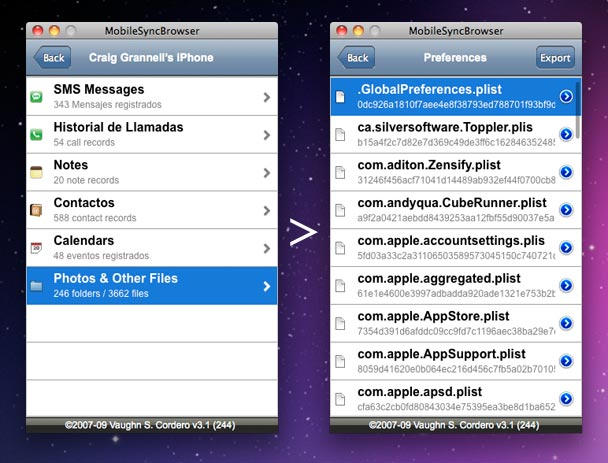
Navigating an iPhone back-up

Navigating an iPhone back-up

Open Photos & Other Files and navigate to Library > Preferences. Within, you’ll find a bunch of plist files. If you like, you can select and export them to poke around with them in the likes of BBEdit, to see what information they contain. Typically, this folder is where most games seem to store progress information.

You then Option-click the components you’d like to create a back-up for and go to File > CoreRestore > Save. This creates a date-stamped folder with ‘CR’ (standing for CoreRestore) also appended. You should note down somewhere what game/files this back-up refers to.

2. Delete and reinstall apps
If you delete an app, its save is now (hopefully) saved in your CR back-up. Reinstall it later and it’ll be fresh, without your progress.

3. Start a restore
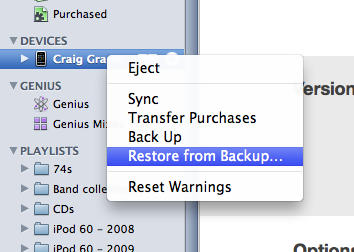
Starting a restore from iPhone.

Starting a restore from iPhone.

Connect your iPhone to your Mac and Control-click it in the iTunes sidebar. Select Restore from Backup.

4. Select a back-up
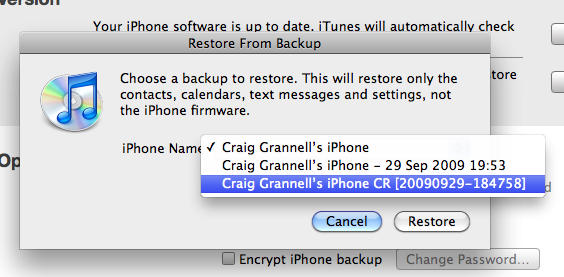
Selecting a back-up for restore.

Selecting a back-up for restore.

Select the relevant CR back-up from the Restore dialog. Click Restore.

5. Wait

For a very long time.

Quick caveats:

  • I highly recommend you take a full copy of your back-up folder in ~/Library/Application Support/MobileSync/Backup before mucking about with partial back-ups. If something goes wrong, you can switch your copy back and do a full restore.
  • If your iPhone explodes, or—worse—you lose your Peggle saves, too bad. This is an ‘at your own risk’ tutorial.

Overall, I’m impressed a developer has taken the time to figure out how to create partial back-ups, notably of game data, but the process leaves a lot to be desired (which isn’t really the fault of the dev). There’s no guarantee you’ll pick the right files, nor even that a game’s save data is within the Preferences folder, although this was the case with the games I tried. And although it was brown trousers time during the restore process (which took well over an hour—seemingly, the iPhone did a total restore, with the CR back-up then adding specific files), it did enable some ‘lost’ scores and progress to be ‘rescued’.

What this most highlights, though, is the simple fact this kind of thing shouldn’t be necessary. Already, some developers get around the problem of app deletion/reinstallation by housing scores and progress online via user accounts, but I’d sooner see Apple provide a simpler back-up process itself. Given that Apple’s current stance is that iPhone and iPod touch can do all sorts of things the PSP and DS can’t, it’s a huge shortcoming that the thing most important to many gamers—the safeguarding of game data—is one of the weakest aspects of Apple handhelds.

Note: MobileSyncBrowser also provides the means for backing up and restoring things like call logs and SMS messages. The CoreRestore feature is just one component highlighted for this particular article.

If you enjoyed this article:
Subscribe via RSS or email, or follow us on Facebook and Twitter

About the author

Craig Grannell

Craig Grannell is Cult of Mac's designer and an occasional contributor. He also runs iPhoneTiny.com, a Twitter-driven reviews site for iPhone apps and games. Follow Craig on Twitter @CraigGrannell and visit his website, Snub Communications.

Email the author | Read more posts by Craig Grannell.

6 comments

    “One of the dumbest decisions Apple made regarding iPhone and iPod touch is devices wiping all traces of an app when it’s deleted, but providing no means for saving preferences and progress.”

    Its your personal opinion which I find shitty. :-/

    iPhone is after everything a phone. If it saved all the data it would turn into a WinMo garbage. Can you imagine how slow it would get on an 8GB iPhone if it started saving truckloads of data ?

    You *can* restore your iPhone from an iTunes backup. In any case, why would you want to delete your game if you wanted to play more anyways ? Doesn’t make sense. Its a phone. Not a computer.

    “You *can* restore your iPhone from an iTunes backup. In any case, why would you want to delete your game if you wanted to play more anyways ? Doesn’t make sense. Its a phone. Not a computer.”

    Your argument is flawed. Would you call the iPod Touch a phone too? No? Then what? Aren’t the Touch and the iPhone basically the same thing with the major difference being a phone component on one.

    My computer can dial out, does that make it a phone and not a computer? …you should get my point by now.

    In addition to that example here’s another:

    On several occasions I’ve kept games I’ve been playing on my phone strictly because I didn’t want to lose the progress in them, knowing full well I didn’t intend to play them for a while, but would have loved to remove them from my phone temporarily to free up space, until my life became a little less hectic and I had more time for entertainment-based things – like those games I set aside.

    I for one have always felt it would be a great boon to be able to save my data somewhere, knowing that I can delete the app and have the saved data available somewhere to restore or otherwise make available to me again should I decide to reinstall the app.

    This all makes perfect sense – and I agree with the author – I think it’s a very logical and warranted gripe.

    I don’t understand one part. How does the backup of one individual preference file take an hour to restore?

    What if I backed up several games preferences. Then later after say a month of using my phone, want to restore those games preference files. How do I restore that game data without losing all my current data that I accumulated over a month?

    Can you please clarify the backup and restore process with more details?

    On another note, can you use PhoneView from eCamm to do something similar? I know PhoneView has the ability to view Disk files as well when enabled by a checkmark in preferences for the app, but don’t know if it allows you to drag and drop plist files.

    @Observer: Exactly.

    @Fat Gorilla: iPhone is basically a small computer, rather than a phone, and Apple’s the company now pitching its mobile devices directly against the PSP and DS, not me. I don’t really see how providing an optional save for gamers would suddenly turn Apple devices into “WinMo garbage”.

    @Alex: The reason it takes ages to restore is because it appears that the app does an entire restore but then over-rides the most recent back-up with the custom install.

    As for PhoneView, that’s, in my opinion, a stronger app for back-up of core data (SMS, notes, etc.), but it cannot access preferences for things like games—at least on a non-jailbroken device.

    I’d like to see app developers use photos to store that kind of thing. Apps have access to the photo library so any one can store a photo or retrieve a photo. The just need to encode the data into a photo.

    Alex: Craig hit on an important point that I had not fully realized in testing, because I don’t keep a lot of apps on my phone.

    While MSB can tinker around with the data files, the APP portion of the custom restore remains unmodified, so if you have a lot of apps, they are transferred back as part of the custom restore process, which explains the lengthy restore.

    When I looked into the matter, I attempted to circumvent this, but ran into a brick wall, as Apple digitally signs certain files to avoid tampering, which is ‘a good thing’ from a security standpoint, partcularly for executable code.

    It looks as if we’ll all have to ‘grin and bear’ the extra wait until further notice.

    In response to your other question, the iTunes restore only overwrites the files included in the backup, so any other files (SMS, Calls, other setting etc) remain untouched.

Add your comment

Name(Required)

Mail (required, but not published)

Website

Comment

Buy Inside Steve's Brain Buy from Amazon.com Buy from Barnes & Noble