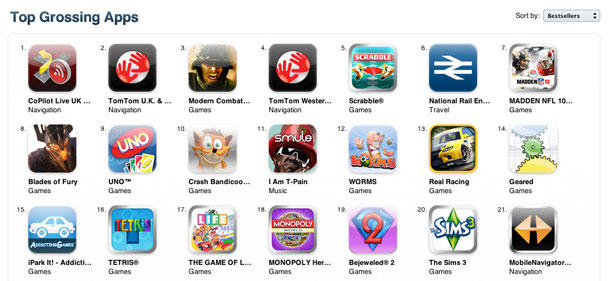
iTunes 9 and OS X for iPhone 3.1 brought a bunch of refinements, but one strikes me as odd: along with charts for paid apps and free apps, we now have one for ‘top grossing’ apps.
It’s pretty clear this an attempt to appease developers, increasingly annoyed at the rush to 99 cents on the App Store. But here’s the thing: will anyone care? I can’t see too many consumers rushing to see which apps have grossed the most and make buying decisions based on that. ‘Top grossing apps’ also sounds pretty ugly—not really what you’d expect from Apple.
That said, there’s definitely a need to push apps with slightly higher price-points more prominently. Higher-priced apps (and I’m talking maybe $5 and above, not the likes of $50+ sat-nav apps) enable longer development periods, often leading to richer end products.
I wonder whether the App Store should instead have taken a leaf out of the 1980s games industry—at least as it was in the UK. Around 1985, publishers started toying with ‘budget’ videogames, selling cheap, relatively throwaway titles at £1.99, with full-price games being four or five times more expensive. Such publishers typically advertised less, and developers of full-price games started to get antsy. (Sound familiar?)
The solution then was simple: the chart was split. So you had a ‘full price’ chart and a ‘budget’ chart. One might argue this would only serve to push people away from high-price apps, but it would also provide a mechanism for highlighting stuff that’s unlikely to be crap. And ‘full price’ or ‘premium’ certainly sounds a whole lot nicer than ‘top grossing’.

Craig Grannell was once Cult of Mac’s designer and an occasional contributor. Find out whatever he’s doing now on Twitter @CraigGrannell or his website, craiggrannell.com.