Analysts: Apple is a Bad Economic Indicator
11:28 pm, July 20th, 2009, Pete Mortensen
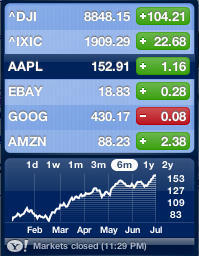
Apple is due to announce Wednesday its earnings for the quarter that ended June 27, and you know what that means: wild speculation by analysts followed by pouting and a drooping stock price when Apple out-performs expectations.
But lately, it’s gotten still more insane: now, these same analysts are trying to infer some read of the overall economic condition based on Apple’s earnings. Which, to me, is a comically fruitless exercise, because Apple operates in a different universe from most companies. It has radically differentiated offerings in all of its businesses, and its focus on innovation is such that it always comes out with a new market-defining product that the rest of the industry can’t match. Apple’s an especially bad indicator of the rest of the consumer tech sector during this recession. Apple doing well doesn’t mean that Dell’s in good shape, or vice versa.
BusinessWeek’s Arik Hesseldahl, a long-time Apple-watcher, has a very sober account of this lunacy, which suffers from the problems associated with a lot of traditional business reporting — in pursuit of balance, he can’t actually address the questionable premise that Apple, a company that was out-performing the market before it collapsed, might signify the end of the recession by continuing to out-perform the market.
I can say this much: Apple will have great earnings on Wednesday. And that means that it remains good to be an Apple stockholder, even as the rest of the world is in chaos. It doesn’t mean we’re getting back to normal anywhere else.
Posted by Pete Mortensen in Apple, News, Opinions | Comment on this article


I agree that Apple seems to charting its own course and creating its own dynamic. Apple’s sales are rising when the rest of the computer market is flat or in decline. This relative advantage is warranted by the fact that Apple’s competition is so lacking. Apple is stealing market share from Microsoft and Linux. It would do so even if the rest of the market was vibrant.
The world is headed toward years of stagnant economies combined with price inflation. This results from Socialist practices imbedded in government regulations which are catching up to us. Those practices created institutions which will fail, taking with it many people’s hopes and dreams. Hence, companies will founder because their management failed to take the right steps now. Betting on the past will turn out to be a losing strategy.
Microsoft’s business plan, which propelled it to the top, is falling apart. There are a multitude of reasons for this. Microsoft needs a constant turnover in PC hardware to make a profit and that is not happening.
There is little reason to buy a new computer. Computer speeds have risen to the point where any current computer will suffice until it breaks down. The megahertz in Processors are not rising. Cores are expanding but most applications cannot take advantage of multiple cores.
The world’s computer market is in a replacement mode until a new paradigm appears. That new paradigm shift is coming, driven by technology. The lower costs from this will favor Apple and Linux, but not Microsoft or the rest of the computer industry. The latter will become the equivalent of buggy whip makers.
Microsoft is behind the eight ball; it bet the farm on the old paradigm. It is desperately trying to hold onto its market share and failing to do so. Vista was awful; Windows Seven is better, but it merely puts a polish on a broken system. Most of Microsoft’s customers did not want or need an Advanced Compositing Graphics Engine such as Apple’s Aqua or Window’s Areo. What they wanted was a Windows XP which worked and protected them from the Internet. That was never in the cards.
The Internet is broken. It is rife with malware, scams and applications which don’t serve the customer’s needs. The Internet is broken because people use Microsoft Windows, which was never designed to withstand the rigors of the Web. Windows is a stand alone system designed for a secure Local Area Network. It cannot be fixed, but only abandoned.
The reason that Apple is rising is because the rest of the market is in decay. Apple is not attacking Microsoft directly, but it is nibbling away at its periphery. Apple’s core markets were resource hogs: Graphics, design and Education. This meant that Apple needed a heavy weight Operating System which could withstand anything that the outside world could throw at it.
Apple wants the upper half of the consumer market; that is where the money is. So, it left the lower half to Windows, but Google intends to steal that away.
Chrome is a light weight, but secure, OS based on Linux which is designed to undercut Microsoft in the two areas where it makes money: the Windows OS and Microsoft office. The Chrome OS replaces Windows and directs the consumer to Google Web Applications which are adequate for the casual and beginning user. Chrome will be placed on the cheap PC’s, so that Microsoft makes no money from these computer sales.
If Google is smart; it will abandon the X Windows system which is used by the other Linux distros. The Chrome OS should look, and act, in no way like Microsoft Windows. It should, instead, look and act like the Mac. This will benefit both Apple and Google as they steal away the consumer market. If a consumer needs a heavy duty application or needs to safeguard his data, then Google will pass off to Apple.
Naturally, this assumes that Apple and Google are in collusion to take down Microsoft. That is why Eric Schmidt is on Apple’s board. There is no conflict of interests because each wants a different segment of the consumer market which is currently under served by Microsoft.
Microsoft and the Wintel manufacturers will be forced back on their niche markets in Enterprise and government sales. Apple will strip away the Small to Medium sized Business market from Enterprise. Even Microsoft’s government and big business markets will be nibbled away at.
As computers get ever cheaper, there will be ample opportunity for Apple to make good profits. Once the world’s economy recovers, new devices will be available which will completely revamp the computer marketplace. The way that we think of computers will change dramatically. How we interact with them will undergo a sea change. Microsoft has too much baggage to keep up with this transmogrification.
louis wheeler, on July 21st, 2009 at 9:45 am
It’s sad that you had to say something this obvious. Perhaps there is a perceived (obviously very short term) personal gain for those making such silly statements.
M., on July 21st, 2009 at 10:15 am
So the numbers are out and AAPL did have a fantastic quarter. This can be taken as some indicator of the economy if you use the information with care.
It can be said that there is a lot disposable income still available to be spent. The argument can be made that lots of people will turn towards value rather than a low price when times are tough. One might argue that trustworthiness comes into play as well. If money is tight some would rather spend their money on a known and trusted entity. Innovation can also be seen as a drawing card in that if you can produce something truly new and useful that will draw customers, at least in the tech world.
I agree, you shouldn’t make the blanket argument that since AAPL is doing well the recession is over. Yes, Apple marches to the beat of a different drummer. Apple is largely a consumer products company, Dell and others have large exposure to the corporate market. Nevertheless, if people are spending money on Apple that has to mean something.
Cramer made this point the other day. He said that Dell and Nokia are down because they make products people don’t want and AAPL is up because they make products people want.
John, on July 21st, 2009 at 7:14 pm
Apple had a blowout quarter and the stock didn’t droop and pout. What’s up with that?
Partners in Grime, on July 23rd, 2009 at 10:05 pm

