Rolling Stone‘s Special Issue of the 500 Greatest Songs of All Time made its debut Tuesday on Zinio, a digital publishing platform that could spell the difference between “survive” and “thrive” for old-school media publications looking to keep the doors open in coming years.
With a stable of top-tier periodicals such as National Geographic, Esquire, American Photo, Car & Driver and many more, Zinio definitely leads the way in showing how paper publications might remain not only relevant but vital and attractive to a new generation of “readers” weaned on the sizzle and flash of gaming and 3D entertainment.
Publication is morphing into something beyond simple words and pictures, evolving into an immersive medium that both pushes ideas and information out to consumers — and draws them in with interactive features and activities that take one beyond the superficial layers of what an article or essay might seem to offer.
Thus, with such crucial stakes at hand, did Zinio, Apple and Rolling Stone produce something of a mixed scorecard with the 500 Greatest issue.
Zinio is available as a free app in the iTunes App Store (link) and supports all three of Apple’s mobile hardware devices, the iPad, iPhone and iPod Touch, in addition to offering cloud-based services accessible through a web browser on any computer connected to the internet.
Most magazines in the catalog can be purchased in-app by the single issue or by subscription — and these transactional nuts and bolts Zinio has down cold.
Not surprisingly, some of the more ephemeral aspects of this digital publishing game, such as delivering the content and handling the fancy interactive bells and whistles on offer, work best — and look best — on the iPad.
To begin with, the larger screen is far more suited to showcasing the visual media of traditional magazines, and the iPad’s core processor seems to deliver a faster, smoother user experience than either Zinio on the web or using the app on the smaller iPhone and iPod Touch. While the iPhone 4’s Retina Display enhances the visual experience on that device, downloading magazines on an older device is an opportunity to cultivate patience, at best.
With respect to the Rolling Stone 500 Greatest issue itself, Apple missed a great opportunity to promote its own assets as well as the future of interactive publishing.
What a great idea, to offer embedded tracks of the music being written about in a magazine devoted to the 500 Greatest Songs of All Time. Right? What better way to showcase the multidimensional nature of publishing that lies just over the horizon?
The missed opportunity here lies in the 30 second samples embedded in the magazine. Couldn’t Apple have used the technology it purchased with the once-promising LaLa to offer whole cuts of each song that could be played all the way through once — for free — as LaLa offered its customers and as other music services such as iLike and Rhapsody offer now?
Is Apple further away from being able to stream iTunes than we think, or was this merely a short-sighted caving to the lure of easy money and the idea that people would just buy the music if the 30 second sample has an iTunes link?
Regardless, what’s been served up is hundreds of annoying 30 second samples that do little but defeat the interactive purpose of the new digital publishing realm and leave readers doing exactly what they did with old paper copies of magazines in the days of yore, flipping pages and looking at the pretty pictures.
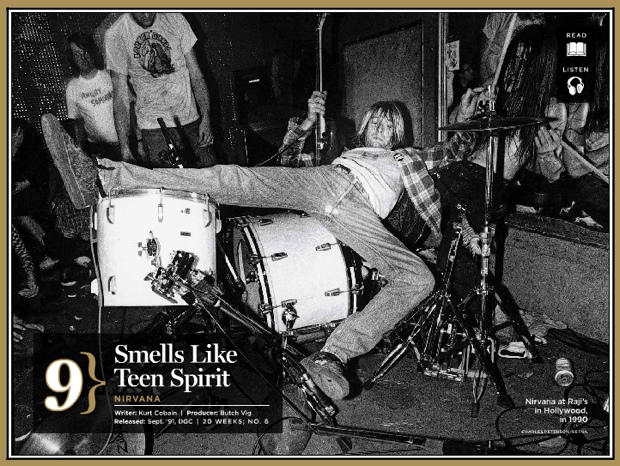
Plus, even if someone does want to purchase a copy of Smells Like Teen Spirit, doing so requires leaving the app and the magazine behind and going into iTunes to do that dance. The whole point of Zinio’s approach to digital publication is to immerse readers in the magazine, to take them deeper and deeper into content, into impulse buying opportunities — yes — but not to drive them out of the magazine and into the byzantine realms of something like iTunes.
Which doesn’t even begin to address the complete absence of even samples — or links — to the many Beatles songs that happen to be among the 500 Greatest Songs of All Time.
Of course, that’s a whole ‘nother story.

Lonnie Lazar is a writer-musician-web designer-attorney. He writes about Apple for Cult of Mac and Mac|Life, and about VoIP and telecommunications for Voxilla. Follow Lonnie on Twitter @LonnieLazar, join the Cult of Mac on Facebook, and find Lonnie’s photos on Flickr.

