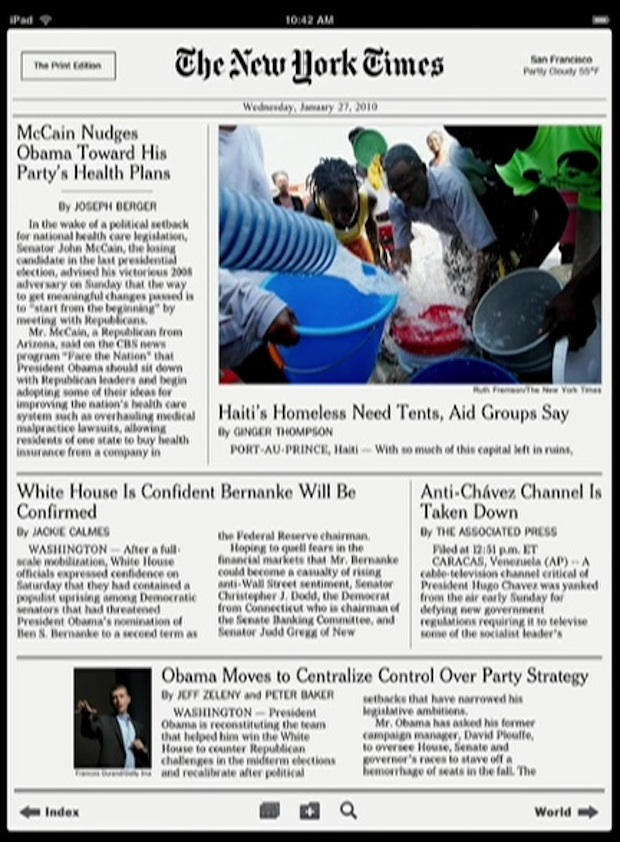
Report: Newspapers, Magazines Balking at iBook Information Demands

Report: Newspapers, Magazines Balking at iBook Information Demands

If Apple CEO Steve Jobs is to realize his vision for the iPad as an information-sharing device, he may have to win-over newspapers to that idea, a new report suggests. Although talks between Apple and newspapers are described as “friendly,” the head of one major daily calls Cupertino’s demands a potential “dealbreaker.”

The key sticking points in the discussions are two-fold: Apple’s desire to share subscriber information and other data viewed as valuable by publishers, as well as how revenue-sharing applies to newspaper and magazine publishers. Publishers have amassed subscriber names, addresses and credit cards often used to develop marketing campaigns, even newspaper content.

A battle could also be waged over Apple taking nearly a third of subscription revenue “forever,” the Financial Times reports. The Cupertino, Calif. company is seen as unwilling to compromise on this issue, seeing it at the crux of how it made $0.99 songs via iTunes profitable.

Although Apple has offered a 70/30 revenue split with publishers taking the largest portion, some media executives balk at the “forever” provision. “30 percent forever changes the economics,” one exec told the FT. “You can imagine we feel less good about it,” the exec explained. While the revenue split is advantageous for book publishers selling $20 titles, the revenue-sharing concept doesn’t make as much economical sense when it comes to newspaper or magazine subscriptions, publishers argue. Such a deal could cede to Apple a third of subscription sales at a time when newspapers and magazines are struggling to stay afloat, according to the report.

Of course, this struggle isn’t new for the industry. The same concerns arose when music publishers were approached to sell via iTunes or newspaper publishers were asked to sell via Amazon’s Kindle.

DON'T MISS
Amazon Offers 70/30 Revenue Split to Magazine, Newspaper Publishers

[Via Silicon Alley Insider, 9to5Mac and Financial Times]

About the author

Ed Sutherland

Ed Sutherland is a veteran technology journalist who first heard of Apple when they grew on trees, Yahoo was run out of a Stanford dorm and Google was an unknown upstart. Since then, Sutherland has covered the whole technology landscape, concentrating on tracking the trends and figuring out the finances of large (and small) technology companies.


(sorry, you need Javascript to see this e-mail address)| Read more posts by .

Posted in News |

  • Gazoobee

    All I can say is if newspapers are “developing content” based on subscriber information, then they are no longer newspapers but rather magazines. instead.

    I wouldn’t be surprised if the distinction gets further blurred as we move forward either. If things are no longer printed on paper, then the main signifier as to whether you are reading a magazine or a newspaper (glossy stock versus newsprint), is also missing. If both gain “interactive content,” then is there really a difference at all?

  • Darren

    It seems there has been some misunderstanding or mistranslation here as you wrote this post, or it was just poorly written. The sticking point isn’t Apple’s *desire* to share subscriber details, it’s their intention to *not* share that information.

    Quoted directly from the FT source article:
    “Apple’s practice of sharing with its partners little consumer data beyond sales volume is a problem”

  • http://www.toxicspark.com Andrew Macdonald

    Yeah I agree with Darren here. Apple do NOT want to share subscriber details, not hand it over to the publishers.

    Also, If newspapers and magazines feel the revenue split isn’t fair, nobody is forcing them to jump on the iBooks bandwagon.

    They are perfectly fine to continue doing business as they are currently, but they need to keep in mind that their business is slowly going down the pan, with the continuing decline in the media industry.

    Apples iTunes store changes the music industry, its just starting to change the film industry for the better, and its just about to change the book industry.

    The media need to either get on board, or go away and slowly die.

  • Maxx Wyler

    Personally, I do not want my information shared. My purchasing habits, credit card numbers etc do not need to be given to publishers. Some publishers are claiming that they use that info to create content based on trends. IMHO, the publishers need to get back to more responsible, unbiased and news worthy publishing instead of fluff pieces and opinionated reporting. I thought that “newspapers” reported the news. As for magazines, I let most of my subscriptions run out because there is little content.

    I also don’t get why the publishers are complaining about Apple taking 30% of the subscription price. In the publisher’s current business model they have to pay to have their content printed, pay to have it shipped or delivered etc. Certainly Apple will have an ongoing expense of distributing their content and should be compensated.

  • Alfred

    If I buy a newspaper from a store, the publisher would *never* know it was little ‘ol me who bought it. So there would be no difference if Apple chose to withhold my personal data from the publishers.

    However, if I **subscribed** to a newspaper or magazine, the publishers may indeed know my name and address, at least if that’s passed on to them by the local distributor — and perhaps even my age, profession, and average income, as they sometimes ask for that optional info on the subscription forms (at least they do in my country).

    Thus, this rumor suggests that Apple is negotiating a subscription-based model, which we all expected – but it’s good to know it’s really happening.

    As for the 30/70 revenue split, (someone can correct me if I’m wrong) but I was told that publishers usually spend no more than 10% of the retail price on printing and distribution. So if your issue of WIRED lands on your doormat once a month, WIRED gets 90% of the money you paid for it, after printing and shipping charges.

    Thus, if Apple demanded a 30% cut, that would make iPad distribution of the magazine *more expensive* than print. IF I’ve got this right, then I can see why the publishers are calling Apple’s demands a “dealbreaker”.

    This extra cost would either have to be passed on to the consumer, making the product less attractive, or the cost would have to be absorbed into the publishers profits. The publishers don’t want either option — especially not right now when their industry is struggling.

    Let’s hope (for the publisher’s sakes) that if Apple sticks to their guns on the 30/70 split, that the extra publicity from being on the iPad would lead to such a growth in subscribers, that the “Apple distribution tax” would neither have to be passed on to the consumer, nor be absorbed into the publisher’s profits.

  • Rubber Johnny

    As usual, poor reporting from the biz guru. Asleep at the wheel, again. Eeesh.

  • aragoran

    http://www.200Linx.com – The Ultimate iPad Home page
    Apple’s new iPad is designed to make navigating the web easier and intuitive.
    200Linx was designed to be the ultimate, most convenient iPad home page.
    It’s brings you everything that’s good on the Internet in one click, on one place.
    iPad is the best way to experience the web.
    200Linx is the best way to experience iPad.