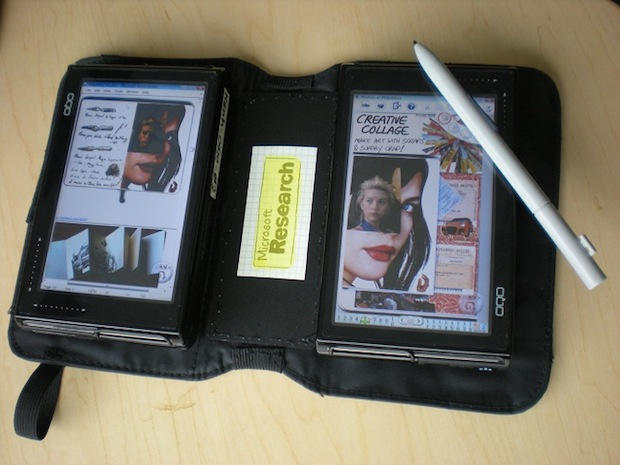
Microsoft’s Courier tablet isn’t just a concept.
The company’s Research Lab built a remarkably similar device in 2008 called Codex. And in the real world, the Microsoft tablet is not quite as slick as the demos make it look.
ZDNet’s Mary-Jo Foley is reporting that Courier is more than a concept: it’s an “incubation project” slated for a possible mid-2010 release. Also, Microsoft is “leaning toward” building the hardware itself, like the Xbox, to speed the device to market, and presumably offer competition to Apple’s rumored tablet.
Check the video and pictures after the jump to see what it actually might look like in real life.
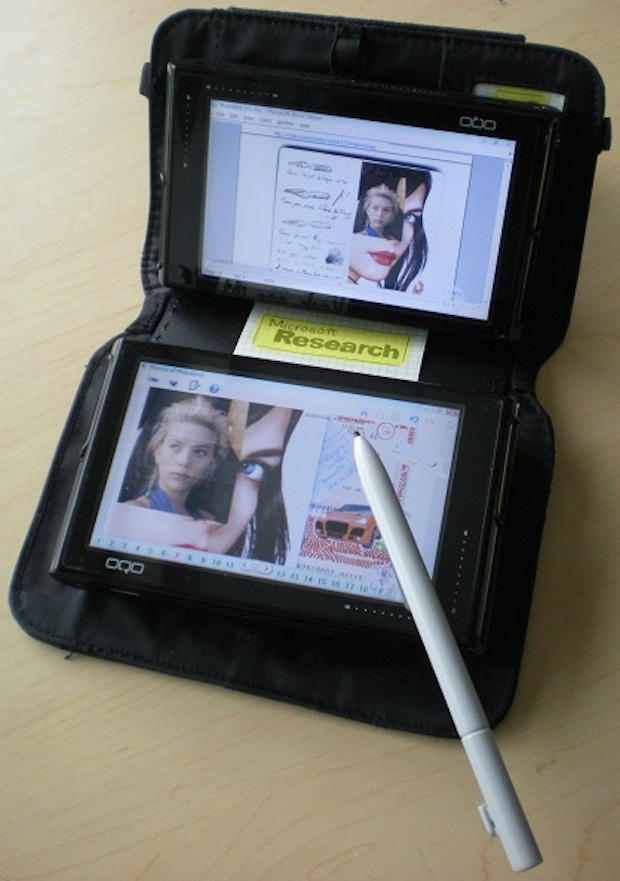
Codex is prototype dual-screen pen computer made from two off-the-shelf OQO pocket computers, which are about the size of a Moleskine notebook but a lot thicker.
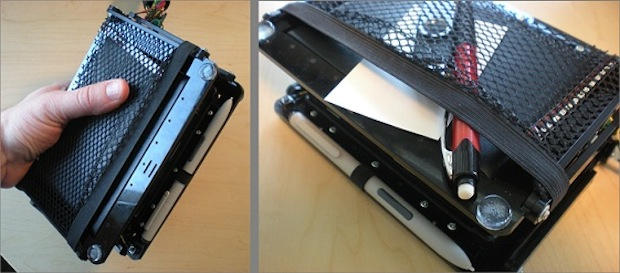
The Microsoft researcher, Ken Hinckley, lashed two of them together in a pouch that folds together, like a book. The pouch has a Moleskine-like elastic strap to hold it closed and a mesh pocket for business cards, scraps of paper and the device’s pen, of course. It weighs just over two pounds.
While Apple’s rumored tablet appears to be a device for media consumption — watching movies, reading ebooks and listening to multimedia-enhanced music (the rumored “Cocktail” project) — Codex is all about production.
“I wasn’t interested in an ebook reader,” writes Hinckley in a blog post describing the Codex protoype. “I wanted a device that was all about writing… a tool for thought. To me that means a tool with writing, sketching, and annotating as the core of the experience.”
Like Codex, the latest Courier concept video also shows a device designed for writing, sketching and annotating research material. The two devices appear to be very similar in both concept and design.
Hinckley writes that Codex’s two screens are not designed to mesh together, presenting material across two screens like the extended desktop on a dual-monitor desktop computer.
Rather, one screen can function as a work area, while the other presents research materials, for example.
“It’s all about the intelligent partitioning of tasks and interface elements across the screen,” Hinckley writes. “The two screens are invaluable because I always have the reference material in the context of what I am working on, instead of feverishly flipping between them on a single screen.”
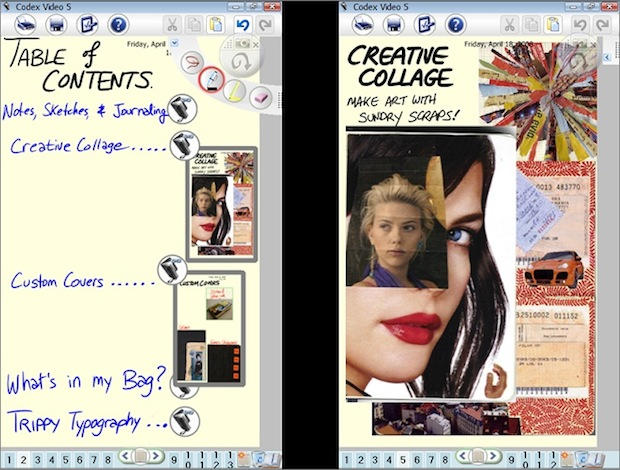
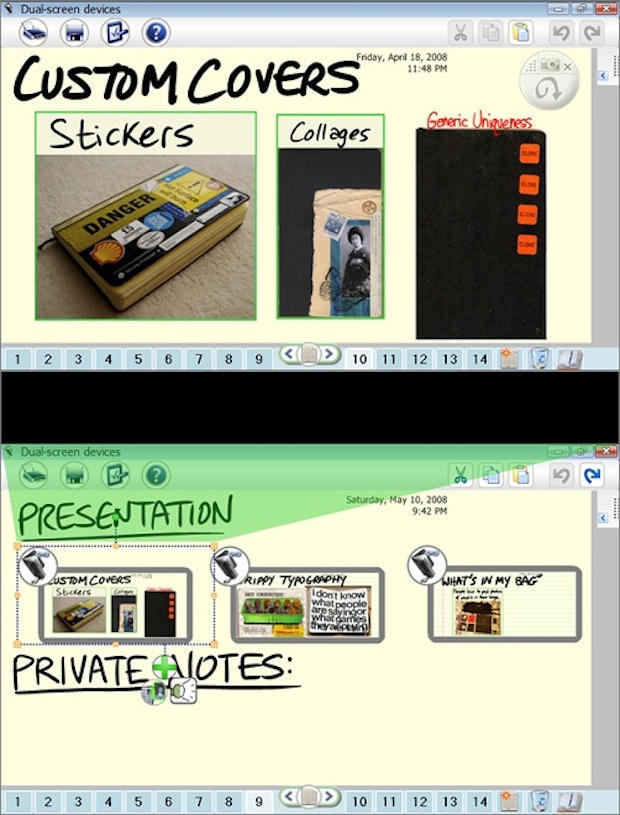
Here’s a screenshot of the two screens in action. The left-hand screen is a navigation screen showing the table of contents for a mini website. Each of the pages in the mini website is hotlinked, and on the right-hand screen he’s opened the “Creative Collage” page to work on. To open another page, he clicks it on the left-hand screen. In other words, left=navigation, right=content.
Here’s another screenshot of the Codex’s workspace. But this time, the left-hand screen is the work area and the right-hand screen the navigation space. Hinckley is working on a storyboard. He clicks on one of the six “sidebar” boxes, and it opens on the left hand-screen. Here it’s displaying a bunch of photos from Flickr. The latest Courier concept video shows a very similar setup with the device’s “Infinite Journal.”
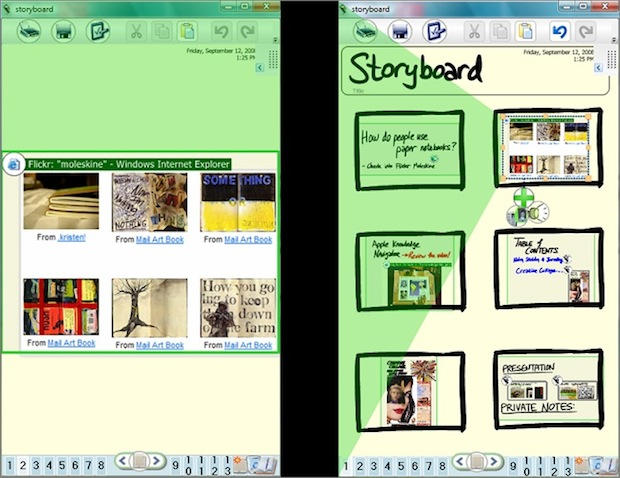
The thing that strikes me about these screenshots is the complexity of the workspace. It’s basically Windows 7-meets-Palm-circa-1999. Look at all the tiny navigation buttons and UI elements that need to be hit with a pen stylus to make things happen. This is hardly a paradigm shift. It’s the old WIMP interface shrunk to a smaller screen, like an old Palm V. It is not a modern multitouch interface where objects are direct manipulated onscreen like the iPhone, iPod Touch, and even Microsoft’s own Surface table.
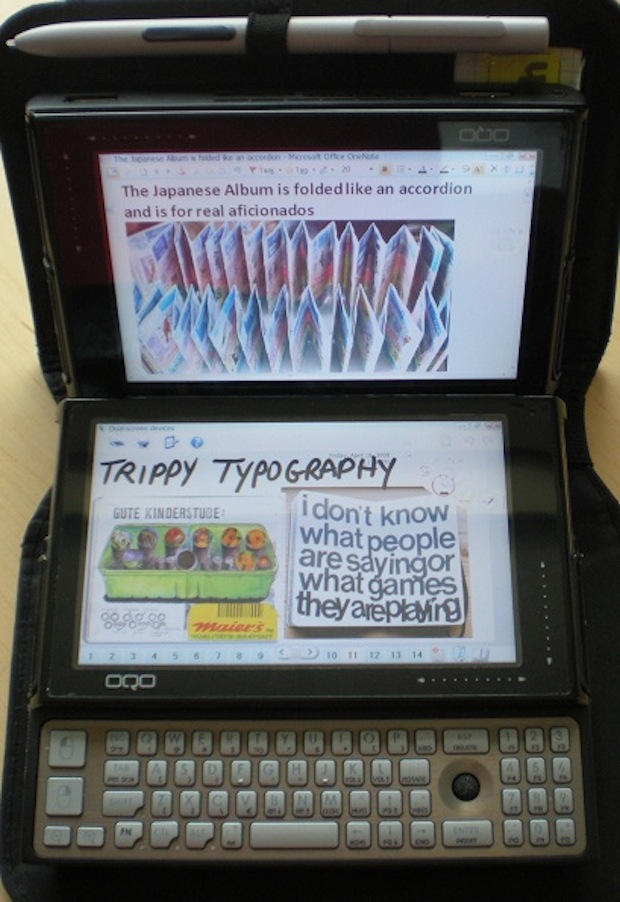
The Codex changes presentation mode when its orientation shifts. Here it is in landscape mode.
And here are Codex’s dual screens in landscape mode.
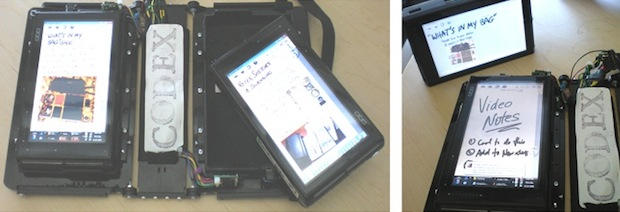
The Codex can be used by two people at the same time by lifting the spine and putting the screens back-to-back, Battleships-style.

The screens are also detachable. They can be popped out of the carrying pouch and sat on a desktop.
Researcher Hinckley is no fan of pop-up keyboards, which he says defeat the object of having a dual-screen device: your fingers cover one of the screens. Hinckley much prefers a clip-on external keyboard.

Leander Kahney is the editor and publisher of Cult of Mac.
Leander is a longtime technology reporter and the author of six acclaimed books about Apple, including two New York Times bestsellers: Jony Ive: The Genius Behind Apple’s Greatest Products and Inside Steve’s Brain, a biography of Steve Jobs.
He’s also written a top-selling biography of Apple CEO Tim Cook and authored Cult of Mac and Cult of iPod, which both won prestigious design awards. Most recently, he was co-author of Cult of Mac, 2nd Edition.
Leander has been reporting about Apple and technology for nearly 30 years.
Before founding Cult of Mac as an independent publication, Leander was news editor at Wired.com, where he was responsible for the day-to-day running of the Wired.com website. He headed up a team of six section editors, a dozen reporters and a large pool of freelancers. Together the team produced a daily digest of stories about the impact of science and technology, and won several awards, including several Webby Awards, 2X Knight-Batten Awards for Innovation in Journalism and the 2010 MIN (Magazine Industry Newsletter) award for best blog, among others.
Before being promoted to news editor, Leander was Wired.com’s senior reporter, primarily covering Apple. During that time, Leander published a ton of scoops, including the first in-depth report about the development of the iPod. Leander attended almost every keynote speech and special product launch presented by Steve Jobs, including the historic launches of the iPhone and iPad. He also reported from almost every Macworld Expo in the late ’90s and early ‘2000s, including, sadly, the last shows in Boston, San Francisco and Tokyo. His reporting for Wired.com formed the basis of the first Cult of Mac book, and subsequently this website.
Before joining Wired, Leander was a senior reporter at the legendary MacWeek, the storied and long-running weekly that documented Apple and its community in the 1980s and ’90s.
Leander has written for Wired magazine (including the Issue 16.04 cover story about Steve Jobs’ leadership at Apple, entitled Evil/Genius), Scientific American, The Guardian, The Observer, The San Francisco Chronicle and many other publications.
Leander has a postgrad diploma in artificial intelligence from the University of Aberdeen, and a BSc (Hons) in experimental psychology from the University of Sussex.
He has a diploma in journalism from the UK’s National Council for the Training of Journalists.
Leander lives in San Francisco, California, and is married with four children. He’s an avid biker and has ridden in many long-distance bike events, including California’s legendary Death Ride.
You can find out more about Leander on LinkedIn and Facebook. You can follow him on X at @lkahney or Instagram.