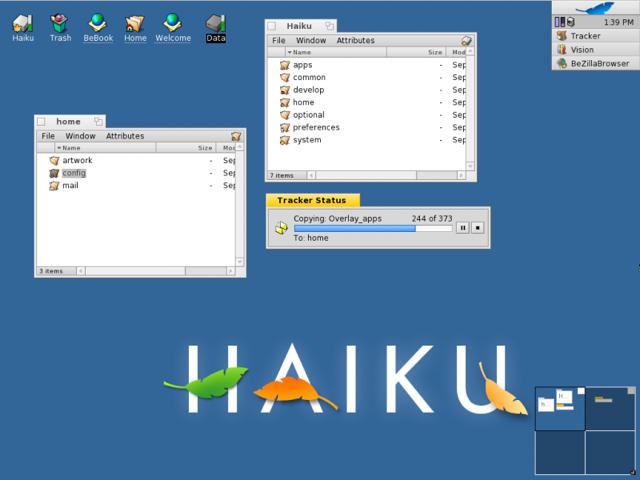
BeOS Back From the Dead as Haiku Project

17_tracker-copying-files

Back in the mid-1990s, there was one thing incredibly obvious to anyone using a Mac: Apple wasn’t ever going to develop a modern successor to the classic Mac Operating System. Despite screenshots of the planned Copland system, the ship date kept getting pushed out, and the pages of MacWeek, MacUser, and MacWorld all started devoting more time to other possible replacements for the core Mac experience. Some mentioned NeXT (the true eventual source of Mac OS X), others ludicrously suggested Windows NT on PowerPC might suffice (seriously), but the consensus was that Jean-Louis Gassee’s BeOS would be the winner.

The upstart operating system had a lot going for it: Native PowerPC support, remarkable multiprocessor optimization (this thing screamed on dual PPC 603s), and, of course, the requisite modern multi-tasking support. Though it ended up losing out to Steve Jobs, a fact almost no one mourns, a lot of us longtime Mac-heads still have a soft spot for the Be-fueled Macs that never were. The software is now mainly found on embedded devices (Palm tried to make it the next Palm OS long before the creation of the Pre) and has no real future.

But you can relive the glory days of the BeOS today, now, on any Intel Mac, provided you have VMWare, Parallels, or VirtualBox (caveat: I’ve only gotten this working on VMWare — the others should work, though). Meet the Haiku Project, an open-source effort to recreate the magic of Be for the modern era. That’s pretty much the pitch — and it mostly delivers. It’s fairly impressive for what it is, though it’s more novelty than anything else for the time-being.

DON'T MISS
Hackers Re-Enable Atom Processor For Mac OS X 10.6.2

Any true Be-lievers out there? Head to Haiku to get your install disks. If you’re on VMWare, just get the VM file here and go to.

About the author

Petemortensen

Pete Mortensen is a design strategist for consulting firm Jump Associates and the co-author of Wired to Care: How Companies Prosper When They Create Widespread Empathy, a book and blog that are significantly more interesting than you might initially think. Pete's particular Apple avocations are both around design--interface and industrial. Follow him on Twitter!

(sorry, you need Javascript to see this e-mail address)| Read more posts by .

Posted in Software, Vintage Tech |

  • MacRat

    From their FAQ: “The only BeOS code that has made it into Haiku are Tracker and the Deskbar”

    So it really has little to do with BeOS.

  • http://gilest.org Giles Turnbull

    MacRat:

    Also from the Haiku web site: “The Be Operating System introduced progressive concepts and technologies that we believe represent the ideal means to simple and efficient personal computing. Haiku is the realization of those concepts and technologies in the form of an operating system that is open source and free.”

    So, while you’re right to point out that little original BeOS code remains, it’s unfair to say that Haiku has “little to do” with it. Haiku is *all about* BeOS: about recreating its concepts and technologies.

  • OlsonBW

    Just because that is the only code doesn’t mean that it doesn’t look and act exactly like BeOS did. All apps that ran on BeOS (intel version) run on Haiku, or at least that is what they are shooting for. It is an Alpha version remember. But from what I understand (and I’ve been following Haiku from shortly after the project started), full binary support is what they are shooting for.

  • OlsonBW

    I have fond memories of BeOS too. I even have the 20 minute Be video that was created so people could see what it was all about.

    I loved being able to play 16 different videos (even if it very small windows) at the same time. All ran without losing any frames and audio instantly switched from one to another which a click of the mouse.

    I even bought BeProductive (I have no connection other than being a user) and still have the disks for three versions. BeProductive is an office suite (small but pretty good).

    The last time I looked there were over 300 useful or semi useful programs.

    The last version of BeOS I had was the Intel version (same with BeProductive).

    It still wasn’t everything I wanted. I wasn’t crazy about the looks of the desktop and apps but I understand why they liked it that way (based on documents you could read which I don’t have anymore).

    At this time I was moving on to Apple computers and when my “PC” power supply died I didn’t fix it and therefore lost the ability to run BeOS. I kept following it though to see what was going to happen and watched it die and then OpenBeOS/Haiku raise to rise like a Phoenix from the ashes.

    It’s great they’ve made it to Alpha. It looks pretty stable. I need to update my version of VMWare (I think) and then I’ll be able to test it. I wonder of BeProductive works. I’ll also find out if it recognizes my digital camera and video camera.

  • http://www.reviewcentral.co.za clasqm

    @OlsonBW: Yes, Gobe Productive will run under Haiku:

    http://www.haikuware.com/20071025128/gobe-productive-running-in-haiku

    and I have Haiku running sweetly (everything except sound) under VirtualBox on a iMac, so feel free to renew your acquaintance with “BeOS”"
