iTunes App Store: Does Anyone Even Care About Top Grossing Apps?

Top Grossing apps. But does anyone care?

Top Grossing apps. But does anyone care?

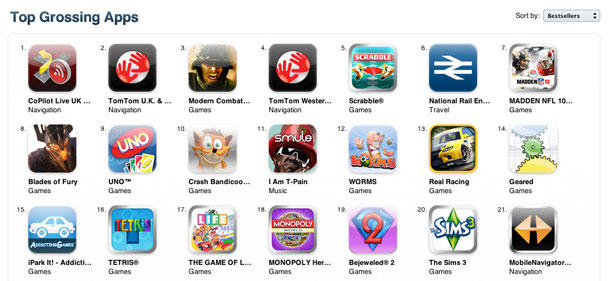
iTunes 9 and OS X for iPhone 3.1 brought a bunch of refinements, but one strikes me as odd: along with charts for paid apps and free apps, we now have one for ‘top grossing’ apps.

It’s pretty clear this an attempt to appease developers, increasingly annoyed at the rush to 99 cents on the App Store. But here’s the thing: will anyone care? I can’t see too many consumers rushing to see which apps have grossed the most and make buying decisions based on that. ‘Top grossing apps’ also sounds pretty ugly—not really what you’d expect from Apple.

That said, there’s definitely a need to push apps with slightly higher price-points more prominently. Higher-priced apps (and I’m talking maybe $5 and above, not the likes of $50+ sat-nav apps) enable longer development periods, often leading to richer end products.

I wonder whether the App Store should instead have taken a leaf out of the 1980s games industry—at least as it was in the UK. Around 1985, publishers started toying with ‘budget’ videogames, selling cheap, relatively throwaway titles at £1.99, with full-price games being four or five times more expensive. Such publishers typically advertised less, and developers of full-price games started to get antsy. (Sound familiar?)

DON'T MISS
In Terms of iOS Gaming, the Freemium Model Makes the Most Cash [Report]

The solution then was simple: the chart was split. So you had a ‘full price’ chart and a ‘budget’ chart. One might argue this would only serve to push people away from high-price apps, but it would also provide a mechanism for highlighting stuff that’s unlikely to be crap. And ‘full price’ or ‘premium’ certainly sounds a whole lot nicer than ‘top grossing’.

About the author

Craig Grannell

Craig Grannell is Cult of Mac's designer and an occasional contributor. He also runs iPhoneTiny.com, a Twitter-driven reviews site for iPhone apps and games. Follow Craig on Twitter @CraigGrannell and visit his website, Snub Communications.

(sorry, you need Javascript to see this e-mail address)| Read more posts by .

Posted in iPhone Apps, News, Opinions |

  • http://appsfire.com Ouriel Ohayon

    Developers will care, because it will give them a better idea on how to price correctly a successful app. Many make mistake on this point.

    We (Appsfire.com) were first to announce top grossing apps (a few weeks before Apple with this name). And the reaction was very positive when we did

  • Charlie

    Of course, the game industry almost died in the mid 1980s because of this problem. There were so many games, it didn’t if you split htem into ‘budget’ and more expensive ones. Just becasue they were expensive means that they were good.

    The real savior of the gaming industry was nintendo. The “Seal of Approval” that used to be on all their games was a sign that ‘This game does not completley suck balls’, which many games did. It allowed people to sort through games well.

    Just clarifying =D.

  • http://www.snubcommunications.com Craig Grannell

    Depends where you live. The videogames industry in the UK positively thrived between 1984 and the late 1980s. Eventually, the budget games killed full-price efforts, but that was only when the 8-bit platforms had reached the ends of their lives.

    And I’m not sure Nintendo’s ‘seal of approval’ meant squat. There was just as much crap on the NES as on, say, the C64 or the Spectrum.

  • iGenius

    Likely so few developers are making money that Apple is trying to placate them with “See! Some folks ARE making money in the App Store! Don’t give up and go away…please…”